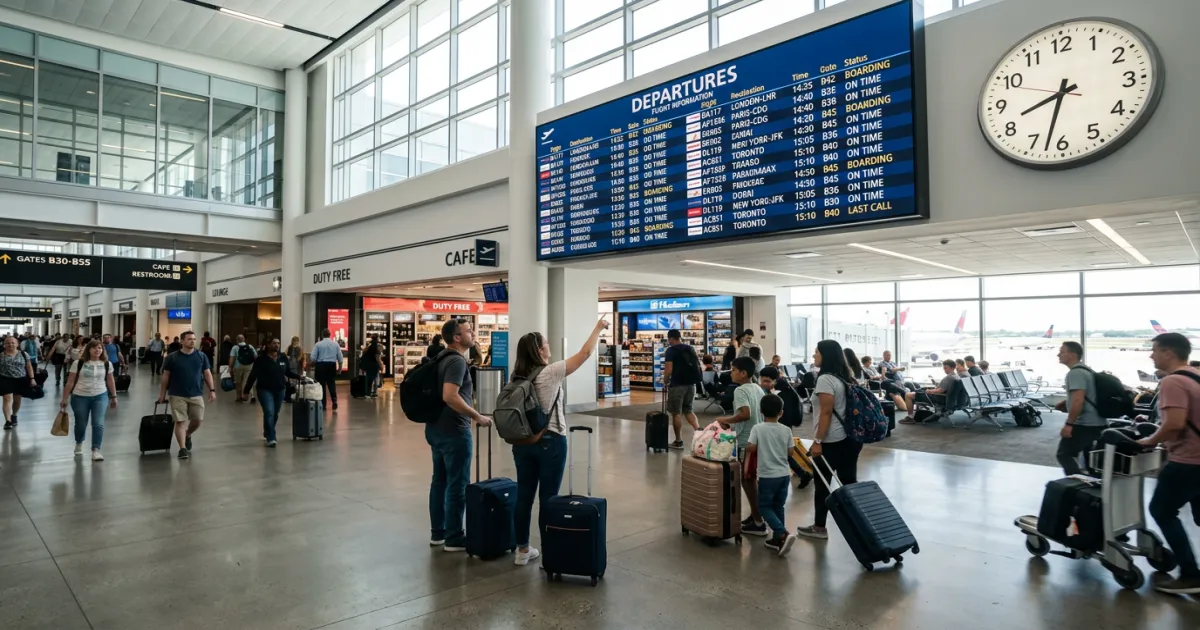
Booking a flight with a layover? The amount of time you need between flights depends on several factors: whether you are flying domestic or international, the airport you are connecting through, whether you need to clear customs, and whether your flights are on the same ticket.
This guide breaks down exactly how much layover time you need for every scenario, from quick domestic hops to complex international connections.
Quick Answer: How Much Layover Time Do You Need?
| Connection Type | Recommended Minimum |
|---|---|
| Domestic, same airline, same terminal | 1 to 1.5 hours |
| Domestic with terminal change | 2 hours |
| International, same airline | 2 to 3 hours |
| International with customs/immigration | 3 to 4 hours |
| Separate tickets (self-connecting) | 4 to 5 hours |
These are practical recommendations, not the airline-set minimums. Keep reading for detailed guidance on each scenario and the factors that affect your specific situation.
Is a 40-Minute Layover Enough?
A 40-minute layover is risky even on domestic flights. While some airlines set minimum connection times (MCTs) as low as 30 to 45 minutes at smaller airports, that assumes everything goes perfectly: your inbound flight arrives exactly on time, you are seated near the front of the plane, and your connecting gate is nearby.
In reality, even minor delays can eat up those 40 minutes quickly. If your first flight lands just 10 minutes late, you may have less than 30 minutes to deplane, walk to your gate, and board before the doors close.
When a 40-minute layover might work:
- Small regional airport with a single terminal
- Same airline, both flights on the same ticket
- No checked baggage
- The airline’s booking system allowed it (meaning it meets their MCT)
When to avoid a 40-minute layover:
- Large hub airports like Atlanta (ATL), Chicago O’Hare (ORD), or Dallas (DFW)
- Any connection requiring a terminal change
- International connections of any kind
- When you have checked bags that need to transfer
Is a 1-Hour Layover Enough?
A 1-hour layover is tight for domestic flights and generally not enough for international connections.
Domestic flights: One hour can work if you are connecting through a smaller or mid-size airport on the same airline, in the same terminal, with no checked bags. At large hub airports, one hour often is not enough time even for domestic connections, especially if you need to change terminals or take an inter-terminal train.
International flights: One hour is almost never enough for international connections. If you need to clear customs and immigration, reclaim and recheck bags, or pass through security again, you should plan for significantly more time. Even at efficient airports, immigration lines alone can take 30 to 45 minutes during peak periods.
If an airline sells you an itinerary with a 1-hour connection on a single ticket, they believe it is doable based on their minimum connection time data. But “doable” and “comfortable” are very different things. Any flight delay, long taxi time, or slow deplaning can turn a 1-hour connection into a missed flight.
Is a 2-Hour Layover Enough?
Two hours is the sweet spot for most domestic connections and a workable minimum for some international ones.
Domestic flights: A 2-hour layover gives you a comfortable buffer for domestic connections at most airports, including large hubs. You will have time to handle terminal changes, grab food, use the restroom, and still arrive at your gate with time to spare. Even if your inbound flight is delayed by 20 to 30 minutes, you should still make your connection.
International flights: Two hours is tight for international connections, especially in the United States. When arriving from an international flight into the US, you must clear customs and immigration at your first point of entry, collect your checked bags, recheck them, and pass through TSA security before your connecting flight. This process alone can take 60 to 90 minutes during busy periods. Two hours leaves very little margin for error.
At airports outside the US, two hours may work for international-to-international connections where you stay airside (in the transit zone) and do not need to clear customs. Many European and Asian airports are designed for efficient transit connections.
Minimum Connection Times: What Airlines Actually Require
Every airline sets a Minimum Connection Time (MCT) for each airport they serve. The MCT is the shortest layover the airline will sell you on a single ticket. If a connection falls below the MCT, the airline’s booking system simply will not offer that itinerary.
How MCTs are determined:
- Airlines work with each airport to calculate the minimum time needed to walk between gates, clear security or customs, and board the next flight
- MCTs vary by airport, terminal, and whether the connection is domestic-to-domestic, domestic-to-international, or international-to-international
- The same airport can have different MCTs for different airlines depending on which terminals they use
Typical MCT ranges:
- Domestic-to-domestic: 30 to 90 minutes depending on airport size
- Domestic-to-international: 60 to 120 minutes
- International-to-domestic (with customs): 90 to 150 minutes
- International-to-international: 60 to 120 minutes (varies widely by country)
Important: MCTs represent the legal minimum, not the practical recommendation. They assume ideal conditions: on-time arrival, fast walking speed, no lines, and no issues with bags. Most travel experts recommend adding at least 30 to 60 minutes beyond the MCT for a comfortable connection.
Factors That Affect How Much Layover Time You Need
No single number works for every traveler at every airport. Here are the key factors that determine how much time you actually need.
Airport Size and Layout
Connecting through a single-terminal regional airport is fundamentally different from navigating a sprawling mega-hub. At Atlanta’s Hartsfield-Jackson (ATL), the world’s busiest airport, walking from one end of the terminal complex to the other can take 20 to 30 minutes even using the automated train. At a small airport like Boise (BOI), your connecting gate might be a 2-minute walk away.
Terminal Changes
If your connecting flight departs from a different terminal, you may need to take a shuttle bus, train, or even exit and re-enter security. At airports like New York JFK, the inter-terminal connection can add 30 to 45 minutes to your transfer time. Always check whether your flights use the same terminal.
Customs and Immigration Requirements
International arrivals into the United States require clearing customs and immigration at your first port of entry. This applies even if you are just connecting to another flight. The process involves exiting the plane, going through passport control, claiming your bags, passing through customs, rechecking your bags, and going through TSA security. Budget 60 to 90 minutes for this process, more during peak hours.
Many other countries, including most in Europe and Asia, allow transit passengers to stay airside without clearing customs, which significantly reduces connection time. For more on how customs work during layovers, see our layover hub.
Same Airline vs. Different Airlines
When both flights are on the same airline (or partner airlines on the same ticket), your bags typically transfer automatically and the airline will rebook you if you miss your connection due to a delay on their end. When flying on separate tickets with different airlines, you must claim your bags, recheck them at the other airline’s counter, and you bear all the risk if something goes wrong.
Checked Baggage
Carry-on only travelers have more flexibility with short layovers. If you have checked bags, those bags need time to transfer between aircraft. On same-ticket bookings, airlines handle this, but the process still takes time. On separate tickets, you must physically collect and recheck your bags yourself.
Mobility Needs
Travelers with reduced mobility, families with young children, or anyone who needs extra time to move through the airport should add buffer time beyond the standard recommendations. Many large airports require significant walking distances between gates, and elevator or escalator access may add time compared to stairs.
Time of Day
Airports are busiest during morning rush (6 to 9 AM) and late afternoon/evening (4 to 7 PM). Security lines, immigration queues, and terminal crowds are all longer during these periods. If your layover falls during peak hours, add extra time.
Airport-Specific Guidance
Not all airports are created equal when it comes to connections. Some are designed specifically for efficient transfers, while others can make even a generous layover feel tight.
Airports Where You Need More Time
New York JFK (JFK): JFK has multiple terminals operated by different airlines with no centralized transit system. Transferring between terminals can require exiting security, taking an AirTrain, and reclearring security. Allow 3 hours minimum for connections between different terminals.
Los Angeles (LAX): LAX is spread across nine terminals with limited airside connections. Walking between distant terminals takes 20 to 30 minutes, and during construction periods even longer. The Tom Bradley International Terminal handles most international flights but connections to domestic terminals require leaving the secure area.
London Heathrow (LHR): Heathrow has four terminals with no airside connections between most of them. Terminal transfers require a bus and additional security screening. International-to-international connections in the same terminal work well, but cross-terminal connections need 2 to 3 hours.
Chicago O’Hare (ORD): O’Hare is a massive complex with four terminals. While Terminals 1, 2, and 3 are connected airside, Terminal 5 (international arrivals) requires clearing customs and taking the ATS train. Allow extra time, especially for international-to-domestic connections.
Dallas/Fort Worth (DFW): DFW has five terminals spread over a large area. While the Skylink train connects all terminals airside, the ride between distant terminals takes 10 to 15 minutes plus walking time to and from the train stations.
Airports Where Connections Are Efficient
Singapore Changi (SIN): Consistently rated one of the world’s best airports for connections. All terminals are connected airside with a Skytrain, and transit passengers rarely need to clear immigration. A 90-minute international connection is comfortable here.
Amsterdam Schiphol (AMS): A single-terminal airport designed around a central plaza. Most connections involve walking 10 to 20 minutes. Schiphol is built for transit, and 60 to 90 minutes works for most connections.
Munich (MUC): Known for efficient connections with clear signage and a compact layout. The Munich Airport Center connects the two terminals, and most connections take 30 to 45 minutes of walking time.
Dubai (DXB): Terminal 3, used by Emirates, is designed for seamless connections. Transit passengers skip immigration, and connections within Terminal 3 are straightforward. Allow 90 minutes for comfort.
Denver (DEN): Despite being large, Denver’s automated train system efficiently connects all concourses to the main terminal. Domestic connections are smooth, typically requiring just 45 to 60 minutes.
What Happens If You Miss Your Connection
Understanding the consequences of a missed connection helps you decide how much buffer time is worth having.
Same Ticket (Airline Rebooks You)
If both flights are on the same ticket and you miss your connection because of a delay on the airline’s end, the airline is obligated to rebook you on the next available flight at no additional cost. This is true even if the connection was tight. The airline may also provide meal vouchers or hotel accommodation if the next flight is not until the following day.
Separate Tickets (Your Problem)
If you booked your flights on separate tickets (self-connecting), you are treated as a no-show on the second flight if you miss it. The airline has no obligation to rebook you, and you will need to purchase a new ticket at the walk-up fare, which can be extremely expensive. This is why self-connecting passengers should allow 4 to 5 hours between flights.
Travel Insurance
A good travel insurance policy can cover the cost of rebooking if you miss a connection, whether on the same ticket or separate tickets. Look for policies that cover “missed connection” as a named benefit. This is especially important for self-connecting itineraries and for international trips where rebooking costs can run into thousands of dollars.
The Sweet Spot: Ideal Layover Times
Based on real-world travel conditions and expert recommendations, here are the ideal layover times that balance efficiency with peace of mind.
Domestic connections: 2 to 3 hours. This gives you enough time to handle delays, terminal changes, and still have a few minutes to relax or grab a meal. At smaller airports, you can get away with 1.5 hours. At large hubs, lean toward 2.5 to 3 hours.
International connections: 3 to 4 hours. This accounts for customs and immigration, baggage recheck, and security screening. At efficient transit airports (Singapore, Amsterdam, Dubai), 2 to 2.5 hours can work. At complex airports (JFK, LAX, Heathrow), plan for 3 to 4 hours.
Intentional long layovers (6 to 8 hours): If you have a long layover, consider it an opportunity rather than an inconvenience. Many airports are located near city centers, and 6 to 8 hours gives you enough time to leave the airport, explore the city, have a meal, and return for your next flight. Check out our layover guides for ideas on what to do during a long layover at airports worldwide.

When a Layover Is Too Long
While longer layovers reduce the risk of missed connections, there is a point where a layover becomes inconvenient, especially if you are stuck in the airport.
Overnight Layovers
If your layover stretches past midnight, you need a plan. Some airports have dedicated rest zones or sleeping pods, but many close parts of the terminal overnight. Check whether your airport has 24-hour access before assuming you can stay inside.
Airport Hotels
Many major airports have hotels located inside the terminal or connected by a walkway. These are ideal for overnight layovers and typically offer day rates for shorter stays. Booking a few hours in an airport hotel can make a 10 to 14-hour layover much more comfortable. Some options include transit hotels at Singapore Changi, YOTEL at several major airports, and various chain hotels at most large US and European hubs.
Airport Lounges
If your layover is 4 to 8 hours, an airport lounge can make the time pass comfortably. Many lounges offer day passes for $30 to $60, and some credit cards include complimentary lounge access. Lounges typically offer comfortable seating, food and drinks, Wi-Fi, showers, and quiet spaces to work or rest.
Leaving the Airport
For layovers of 5 hours or more, leaving the airport to explore the city is often a better use of your time than sitting in the terminal. Before you leave, check that you have the proper visa or transit permission for the country, you know how long it takes to get from the airport to the city center and back, and you have allowed enough time to re-clear security before your next flight. Plan to return to the airport at least 2 hours before your next flight for domestic connections and 3 hours for international.
Booking Layovers Strategically
With the right tools and approach, you can book layovers that work for your schedule and even enhance your trip.
Using Google Flights to Filter Layover Duration
Google Flights lets you filter results by maximum layover duration. After searching for flights, click “Stops” and adjust the layover slider to set your preferred minimum and maximum connection times. This helps you avoid both dangerously short connections and unnecessarily long waits.
Building Intentional Stopovers
Some airlines allow free or low-cost stopovers at their hub cities. Icelandair offers free stopovers in Reykjavik, Turkish Airlines offers free hotel stays for long layovers in Istanbul, and Singapore Airlines and Emirates also offer stopover programs. These programs let you turn a necessary connection into a mini-vacation at no extra cost.
Multi-City Tickets
Instead of booking a round trip with a layover, consider booking a multi-city itinerary. This lets you spend a day or two in your layover city as a planned part of your trip. Multi-city tickets are often the same price or only slightly more than standard round trips, especially when booked through airline alliances.
Planning Tools
Use the Yopki AI Travel Planner to map out your itinerary including layover cities. If you are planning a more complex trip, our trip planning guide walks you through every step from choosing destinations to booking flights.
Frequently Asked Questions
Is 45 minutes enough for a connecting flight?
It depends on the airport and connection type. At small domestic airports on the same airline, 45 minutes can work if the airline allows it (meets their MCT). At large airports or for international connections, 45 minutes is not enough. As a general rule, avoid connections under 1 hour unless you are confident about the airport layout and your flights are on the same ticket.
Do I need to go through security again during a layover?
For domestic-to-domestic connections in the US, you typically stay airside and do not need to re-clear security. For international arrivals into the US, you must clear customs and then go through TSA security again. At some international airports, you may need to pass through security when transferring between terminals even for domestic connections.
Will my bags transfer automatically during a layover?
If both flights are on the same ticket (same airline or partner airlines), your bags are typically checked through to your final destination and transfer automatically. If you booked separate tickets, you must collect your bags, recheck them at the second airline’s counter, and may need to pay a second baggage fee.
What if my first flight is delayed and I have a short layover?
If both flights are on the same ticket, the airline will rebook you on the next available flight at no cost. Notify a flight attendant on your first flight that you have a tight connection so they can arrange assistance. If on separate tickets, you are responsible for making your connection, so travel insurance is strongly recommended.
Can I leave the airport during a long layover?
In most cases, yes, but it depends on the country and your visa status. In the US, domestic travelers can freely leave and re-enter the airport through security. International travelers may need a transit visa to leave the airport in some countries. Always check visa requirements before planning to leave the airport. For country-specific guidance, explore our layover guides by airport.
How do I find out the minimum connection time at a specific airport?
Airlines do not publicly list MCTs for every airport. The easiest way to check is to search for your itinerary on the airline’s website. If the airline will sell you the connection, it meets their MCT. You can also call the airline directly to ask about minimum connection times for a specific airport and terminal combination.
Are layover times different for budget airlines?
Budget airlines (Ryanair, Spirit, Frontier, etc.) typically do not offer connecting itineraries at all. Each flight is sold separately, so you are self-connecting by default. This means you need to allow extra time (4 to 5 hours) to collect bags, check in for your second flight, and go through security again. Your bags will not transfer automatically between budget airline flights.