
You have heard both terms tossed around, but what actually separates a layover from a stopover? The answer affects everything from how you book your flights to whether you can squeeze in a free mini vacation on your next trip.
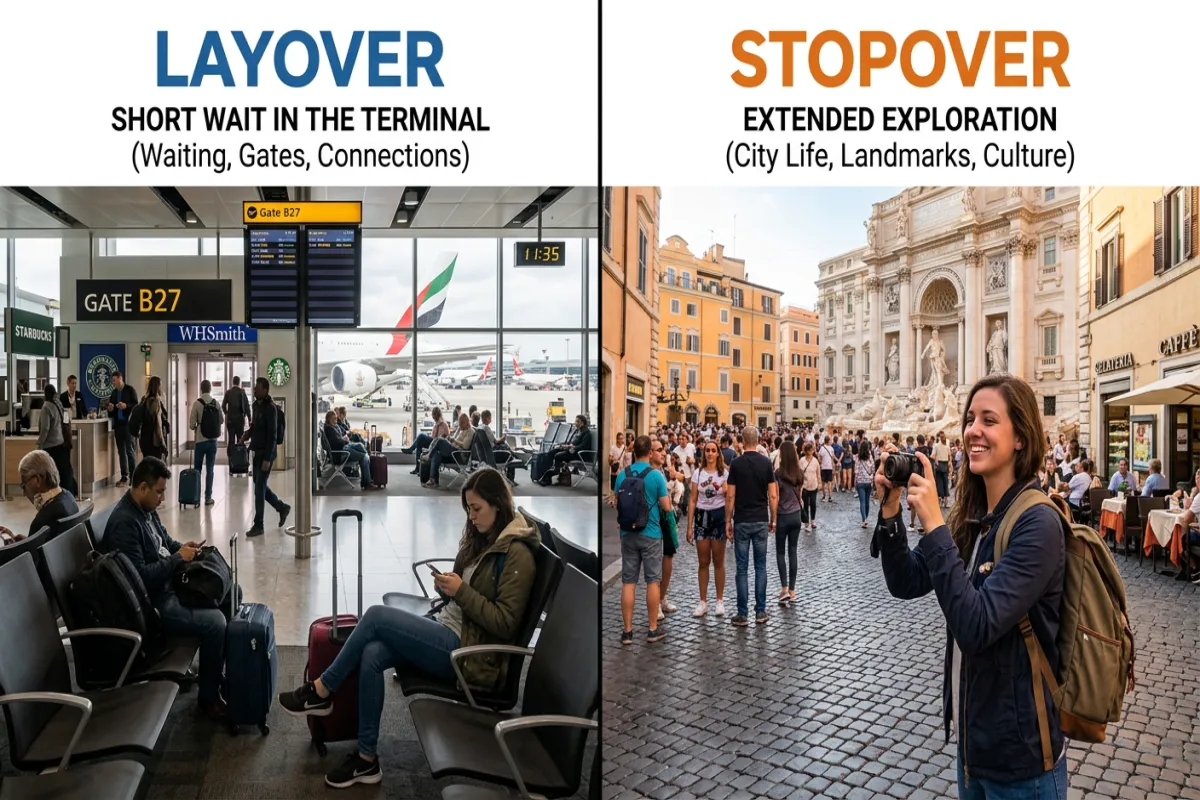
Here is the short version: a layover is a brief connection at an intermediate airport, typically lasting less than 24 hours. A stopover is an intentional, extended stay of 24 hours or more at a connecting city, often at little to no extra cost.
But the details matter. Airline policies, booking strategies, and even the direction you are flying can change the rules. This guide breaks down everything you need to know so you can make smarter decisions on your next booking.
Quick Answer: Layover vs Stopover
A layover is a connection of less than 24 hours (or less than 4 hours on domestic flights) where you wait at the airport between flights. A stopover is a planned stop of 24 hours or more, where you leave the airport and explore the connecting city before continuing your journey.
Think of it this way: a layover is a pause, and a stopover is a side trip.
What Is a Layover?
A layover is the time you spend at a connecting airport between two flights. Most travelers experience layovers regularly, especially on international routes where direct flights are not available or are significantly more expensive.
Key characteristics of a layover:
- Duration: Less than 24 hours for international flights, less than 4 hours for domestic flights
- Location: You typically stay inside the airport terminal
- Baggage: Your checked bags usually transfer automatically to your next flight
- Booking: Layovers are built into your itinerary as part of a single ticket
- Cost: No additional airfare charge beyond the original ticket price
- Planning: Minimal planning required since the airline handles the connection
Most layovers last between 1 and 4 hours. Some international connections can stretch to 8 or even 12 hours, which airlines still classify as layovers since they fall under the 24-hour threshold.
During a layover, you are essentially in transit. You may pass through a security checkpoint, grab a meal, or relax in an airport lounge, but the airport remains your temporary home until your next flight boards.
What Is a Stopover?
A stopover is an intentional, extended break in your journey at a connecting city. Unlike a layover, a stopover is designed to give you time to leave the airport and actually experience the destination.
Key characteristics of a stopover:
- Duration: 24 hours or more (international flights) or 4+ hours (domestic flights)
- Location: You leave the airport and explore the city
- Baggage: You collect your bags and check them in again when you continue
- Booking: Booked as part of a multi-city itinerary or through airline stopover programs
- Cost: Often free or low-cost when booked through airline programs
- Planning: Requires more planning for accommodation, activities, and airport transfers
The real appeal of stopovers is that many airlines actively encourage them. Some carriers offer free hotel stays, city tours, and transit visas as part of their stopover programs, essentially giving you a bonus destination at no extra airfare cost.
Stopovers can last anywhere from 24 hours to several days, and some airline programs allow stays of up to 7 or even 10 days in the connecting city.
Key Differences: Layover vs Stopover
| Factor | Layover | Stopover |
|---|---|---|
| Duration | Under 24 hours (international) or under 4 hours (domestic) | 24+ hours (international) or 4+ hours (domestic) |
| Purpose | Brief connection between flights | Intentional city visit or mini vacation |
| Cost | Included in ticket price | Free to low-cost through airline programs |
| Luggage | Usually transfers automatically | You collect and re-check bags |
| Planning | Minimal | Hotel, activities, and logistics needed |
| Airport exit | Usually stay in terminal | Leave the airport to explore |
| Visa needs | Transit visa or none | May need a tourist visa depending on country |
| Ticket type | Standard connecting flight | Multi-city booking or stopover program |
How to Book a Stopover
Booking a stopover is easier than most travelers realize. Here are three reliable methods:
1. Airline Stopover Programs
The simplest way to add a stopover is through an airline’s dedicated program. Airlines like Icelandair, Turkish Airlines, and TAP Air Portugal have built stopover booking directly into their websites. When you search for flights, you will see the option to add a stop in the hub city at no extra airfare cost.
2. Multi-City Bookings
Most airline booking engines and travel search sites offer a “multi-city” option. Instead of booking a round trip, you book separate legs with a gap in between. For example, you could fly New York to Istanbul, spend three days there, then continue Istanbul to Bangkok. The total fare is often comparable to a standard connecting flight.
3. Points and Miles Bookings
Many frequent flyer programs allow free stopovers on award tickets. This is one of the best ways to maximize the value of your miles since you effectively get two destinations for the price of one redemption.
A Note About Hidden City Ticketing
You may have heard of “hidden city ticketing,” where you book a cheaper flight with a connection in your actual destination and simply skip the final leg. While this can save money, airlines actively discourage it. It violates most carriers’ terms of service, can result in your frequent flyer account being closed, and your checked bags will be sent to the ticketed final destination rather than the connecting city. This approach is not recommended.
Airlines That Offer Free or Low-Cost Stopovers
Several major airlines have turned their hub cities into stopover destinations. Here are the most notable programs available in 2026:
Icelandair: Stopover in Iceland
Icelandair lets transatlantic passengers add a stopover of up to 7 days in Iceland at no additional airfare cost. The program is built directly into their booking engine, making it one of the easiest stopovers to arrange. Hotels and activities are not included, but Iceland’s compact size means you can see a surprising amount even in 2 or 3 days.
Turkish Airlines: Touristanbul
Turkish Airlines runs one of the most generous stopover programs in the industry. Economy passengers with layovers between 6 and 24 hours get free guided city tours of Istanbul. Business class passengers with international connections get up to 2 or 3 free nights at 4- and 5-star hotels, including properties like the Conrad and Hilton Istanbul.
Qatar Airways: Doha Stopover
Qatar Airways offers subsidized stopover packages in Doha starting at around $14 per person per night for 4-star hotels and $24 for 5-star properties. Stays of up to 4 nights are available. While not entirely free, these rates make Doha one of the most affordable stopover options for premium experiences.
Singapore Airlines: Singapore Stopover
Singapore Airlines offers stopover packages for passengers transiting through Changi Airport. Premium cabin passengers may receive 1 to 2 complimentary hotel nights, while economy passengers get SGD 20 vouchers. Award ticket holders can enjoy free stopovers for up to 30 days. The airline also partners with local attractions for discounted entry.
Ethiopian Airlines: Addis Ababa Stopover
Ethiopian Airlines provides free hotel accommodation for passengers with layovers between 8 and 24 hours in Addis Ababa. The program includes transit visas, meal vouchers, and transportation between the airport and hotel. It is a great way to sample Ethiopian culture and cuisine between connections.
TAP Air Portugal: Portugal Stopover
TAP Air Portugal allows passengers to add a stay of up to 10 days in Lisbon or Porto at no additional airfare cost. The program includes partner discounts on accommodation, experiences, and domestic travel within Portugal. The stopover option is integrated into TAP’s booking engine.
Emirates: Dubai Stopover
Emirates offers Dubai stopover packages that let passengers extend their stay for several days. Eligible itineraries may include a free hotel night with transfers and meals. The airline also partners with Dubai tourism for curated experiences including desert safaris, sightseeing tours, and shopping excursions.

When Does a Layover Become a Stopover?
The 24-hour mark is the standard dividing line for international flights. Once your connection exceeds 24 hours, airlines and booking systems classify it as a stopover rather than a layover.
For domestic flights within the United States, the threshold is typically 4 hours. A connection longer than 4 hours on a domestic itinerary is generally treated as a stopover.
However, airline policies vary. Some carriers are more flexible about what counts as a layover versus a stopover, especially when it comes to award ticket routing rules. Always check the specific airline’s policy before assuming a long connection qualifies as one or the other.
The classification matters because it affects pricing. A stopover on a paid ticket may add cost to your fare, while a long layover on the same route might not. On award tickets, some programs allow one free stopover while charging extra miles for additional ones.
Pros and Cons: Long Layovers vs Planned Stopovers
Long Layovers
Pros:
- No additional planning needed
- Bags transfer automatically
- No extra accommodation costs
- Lower risk of missing your connecting flight
- Some airports have excellent lounges, restaurants, and amenities
Cons:
- Hours spent sitting in an airport
- Limited ability to explore the connecting city
- Can be tiring and uncomfortable
- Airport food and drink are typically overpriced
Planned Stopovers
Pros:
- Visit an extra destination at little to no additional airfare
- Break up long journeys and reduce jet lag
- Take advantage of free hotel nights and tours from airline programs
- Explore a city you might never visit otherwise
Cons:
- Requires additional planning and logistics
- You may need a visa for the stopover country
- Hotel and meal costs add up (unless covered by an airline program)
- Need to collect and re-check luggage
- Risk of delays affecting the next leg of your journey
How to Make the Most of Each
Making the Most of a Layover
Even a standard layover does not have to be wasted time. Here is how to use it well:
- Airport lounges: Many lounges offer day passes for $30 to $60, or you can access them with certain credit cards. Hot food, showers, and comfortable seating make a long layover much more bearable.
- Quick city visits: If your layover is 6 hours or longer and the airport has good transit connections, you may have time for a quick visit to the city. Just make sure you account for immigration, transit time, and security re-entry.
- Airport amenities: Many major airports offer spas, sleep pods, movie theaters, swimming pools, and even indoor gardens. Research your connecting airport in advance.
- Stay connected: Download entertainment, charge your devices, and use free airport Wi-Fi to stay productive or plan the next leg of your trip.
Making the Most of a Stopover
A planned stopover deserves real preparation. Here is how to maximize it:
- Book accommodation early: Even if your airline offers a free hotel night, you may want to extend your stay. Book in advance for better rates.
- Plan activities: Research the top sights and experiences in advance. With only 1 to 3 days, you want to hit the highlights without wasting time figuring out what to do.
- Check visa requirements: Some countries require a tourist visa for stopovers, even if transit passengers are exempt. Verify this before booking.
- Pack a day bag: Keep essentials in your carry-on so you can leave your checked luggage at the hotel and explore light.
- Use local transit: Airport transfers can eat into your stopover time. Research the fastest way to get from the airport to the city center.
Planning Tools
The right tools make both layovers and stopovers easier to plan:
- Yopki AI Travel Planner: Get personalized itinerary suggestions for your stopover city, including must-see attractions and local restaurants.
- Trip planning guide: Our complete guide to organizing multi-destination trips, including how to fit stopovers into your overall itinerary.
- How long of a layover do you need?: Figure out the right connection time for different airports and flight types.
- Layover guides by airport: Detailed guides for making the most of your time at major connecting airports worldwide.
Frequently Asked Questions
Can I leave the airport during a layover?
Yes, in many cases you can leave the airport during a layover, but it depends on the country’s visa and immigration policies, your layover length, and whether you need to clear customs. Allow enough time for immigration, city travel, and getting back through security.
Do I need to pay extra for a stopover?
Not always. Many airlines offer free or heavily subsidized stopover programs. When booking a multi-city ticket, the additional cost compared to a standard connecting flight is often minimal or zero.
Will my bags be checked through during a stopover?
No. During a stopover, you collect your checked luggage and re-check it when you continue your journey. This is different from a layover, where bags typically transfer automatically.
How long can a stopover last?
It depends on the airline and program. Some allow stopovers of up to 7 days (Icelandair) or even 10 days (TAP Air Portugal). Award ticket stopovers through certain frequent flyer programs can last up to 30 days or more.
Is a stopover the same as a connecting flight?
No. A connecting flight involves a short layover at an intermediate airport. A stopover is an extended, intentional stay of 24 hours or more at a connecting city. Both involve stopping at an airport between your origin and final destination, but the duration and purpose are different.
Can I add a stopover to an existing booking?
This depends on the airline. Some carriers allow you to modify an existing booking to include a stopover, though change fees may apply. It is usually easier and cheaper to include the stopover when you first book your trip.
Do stopovers count as separate trips for travel insurance?
Most travel insurance policies cover stopovers as part of the same trip, as long as the stopover is on the same ticket. If you book the legs separately, you may need separate coverage. Check your policy details before traveling.