
Pet Travel Tips: Before You Go
Good pet travel tips start weeks before your trip, not at the airport. Whether you are flying across the country or driving to a nearby state park, preparation makes the difference between a smooth trip and a stressful one for both you and your pet.
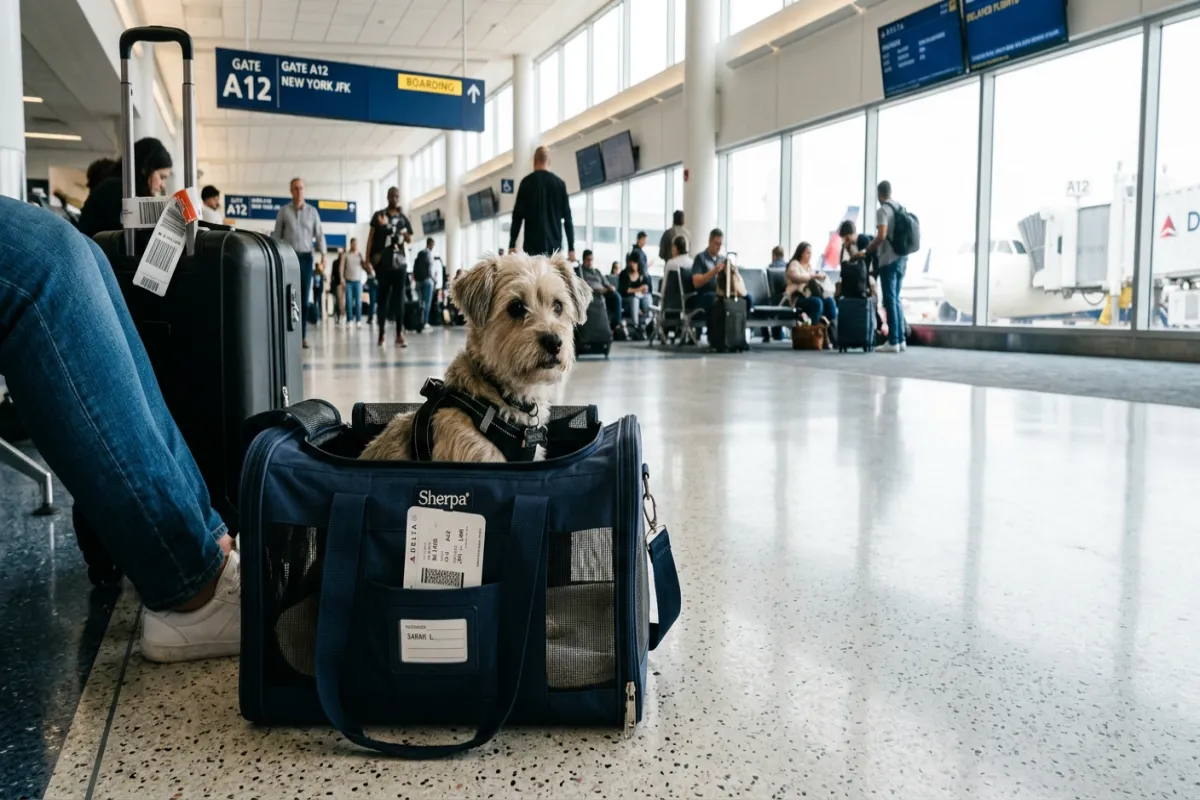
Start with a vet visit 2-4 weeks before your trip. Your veterinarian will confirm your pet is healthy enough for travel, update vaccinations, issue a health certificate if needed, and discuss anxiety management options. Many airlines and hotels require documentation that can only come from this visit.
Next, make sure your pet’s microchip information is current. Update your phone number and address with the microchip registry. If your pet is not microchipped, this is the time to do it. A collar with an ID tag that includes your cell phone number is also essential, but tags can fall off. Microchips do not.
Training Before the Trip
If your pet has never been in a carrier or spent time in a car, do not make the first experience your actual travel day.
- Carrier training (3-4 weeks before): Leave the carrier open at home with treats inside. Let your pet explore it on their own terms. Gradually increase the time spent inside with the door closed.
- Car training (2-3 weeks before): Start with short drives (5 minutes), then build up to 30-60 minutes. Associate the car with positive experiences like trips to the park.
- Crate training: If your pet will be in a crate during travel, practice at home until they are comfortable spending 2-3 hours inside.
Flying with Pets: Everything You Need to Know
Flying with pets requires more planning than most people expect. Each airline has different rules, fees, and restrictions. Here is what you need to know before booking a flight with your dog or cat.
Documentation Required
- Health certificate: Issued by your vet within 10 days of travel (some airlines allow 30 days). Must state the pet is healthy and fit to fly.
- Rabies vaccination proof: Current rabies vaccination certificate with dates.
- Airline pet reservation: Most airlines limit the number of pets per flight. Reserve your pet’s spot when you book your ticket, not the day before.
- For international flights: USDA-endorsed health certificate, import permits, and country-specific documentation (see international section below).
Size and Weight Restrictions
For in-cabin travel, your pet and carrier combined must weigh under 20 pounds on most airlines. The carrier must fit under the seat in front of you, typically within dimensions of 17 x 11 x 8 inches (varies by airline). Pets that exceed these limits must travel in cargo or cannot fly on that airline.
Airline Pet Policies Compared
| Airline | In-Cabin Fee | Cargo Available | Max Carrier Size (in-cabin) | Weight Limit | Breeds Restricted |
|---|---|---|---|---|---|
| American Airlines | $150 | Yes (via AA Cargo) | 19 x 13 x 9 in | 20 lbs (pet + carrier) | Brachycephalic in cargo |
| Delta Air Lines | $150 | Yes (Delta Cargo) | 18 x 11 x 11 in | No strict limit (must fit) | Brachycephalic in cargo |
| United Airlines | $150 | Yes (PetSafe) | 18 x 11 x 11 in | No strict limit (must fit) | Brachycephalic in cargo |
| Southwest Airlines | $125 | No | 18.5 x 8.5 x 13.5 in | No strict limit (must fit) | None (in-cabin only) |
| JetBlue | $125 | No | 17 x 12.5 x 8.5 in | 20 lbs (pet + carrier) | None (in-cabin only) |
| Alaska Airlines | $100 | Yes | 17 x 11 x 7.5 in | No strict limit (must fit) | Brachycephalic in cargo |
Note: Policies change frequently. Always verify directly with your airline before booking. Fees shown are per flight segment, not round trip.
Cabin vs. Cargo: Which Is Right for Your Pet
When to Fly In-Cabin
- Your pet and carrier weigh under 20 pounds combined
- Your pet fits comfortably in an under-seat carrier
- Your pet is calm in enclosed spaces
- You want to keep your pet close and monitor them during the flight
When Cargo Is the Only Option
- Your pet is too large for in-cabin travel (most dogs over 20 pounds)
- You are traveling with multiple pets and the airline limits in-cabin to one per passenger
- Your destination requires cargo shipping (some international routes)
Making Cargo Safer
- Book nonstop flights. Transfers increase risk and stress.
- Avoid extreme weather days. Do not fly cargo when temperatures exceed 85F or drop below 45F at departure or arrival airports.
- Choose early morning or late evening flights during summer to avoid the hottest part of the day.
- Use an airline-approved hard-sided crate with “LIVE ANIMAL” labels, food and water dishes attached to the door, and absorbent bedding.
- Attach a photo of your pet to the crate with your contact information and emergency vet info.
- Do not sedate your pet for cargo travel unless specifically advised by your vet. Sedation affects breathing and temperature regulation at altitude.
Pet Carrier Requirements for Air Travel
Your carrier is the most important piece of pet travel gear. The wrong carrier means your pet gets turned away at the gate.
In-Cabin Carrier Requirements
- Soft-sided carriers are preferred (fit more easily under seats)
- Must fit under the seat in front of you (check your specific airline’s dimensions)
- Must have adequate ventilation on at least two sides
- Must close securely so the pet cannot escape
- Must have a waterproof bottom or include an absorbent liner
- Pet must be able to stand, turn around, and lie down inside the carrier
Cargo Crate Requirements
- Hard-sided, IATA-compliant crate
- Metal bolts securing top and bottom halves (not plastic clips)
- Ventilation on all four sides
- “LIVE ANIMAL” labels with arrows showing which side is up
- Food and water dishes attached to inside of door (accessible from outside)
- Large enough for pet to stand, turn around, and lie down comfortably
Road Trips with Pets: Pet Travel Tips for Driving
Road trips offer more flexibility than flying, especially for larger dogs. But car travel has its own safety considerations.
Car Safety Basics
- Restrain your pet. An unrestrained 60-pound dog becomes a 2,700-pound projectile in a 35mph crash. Use a crash-tested harness, a secured crate, or a pet barrier between the cargo area and passenger area.
- Never let pets ride in the front seat. Airbags can seriously injure or kill pets.
- Never leave pets in a parked car. Even with windows cracked, car interiors reach 120F within minutes on a warm day. This is illegal in many states.
- Cats should always be in a carrier in the car. A loose cat can get under the brake pedal or cause accidents.
Planning Pet-Friendly Stops
- Stop every 2-3 hours for bathroom breaks, water, and stretching
- Use the BringFido or GoPetFriendly apps to find pet-friendly rest stops, parks, and restaurants along your route
- Always use a leash at rest stops, even if your dog has reliable recall. New environments are full of distractions and escape opportunities.
- Bring a collapsible water bowl and a gallon of water from home. Unfamiliar water sources can cause stomach upset.
Keeping Pets Comfortable in the Car
- A familiar blanket or bed from home provides comfort and scent
- Window shades block direct sun on your pet’s side
- Keep the car cool. Pets overheat faster than humans.
- Feed a light meal 3-4 hours before driving to prevent car sickness
- For dogs prone to car sickness, ask your vet about anti-nausea medication
Plan your pet-friendly road trip with Yopki’s trip planner to map stops, accommodations, and activities that welcome your four-legged travel companion.
Finding Pet-Friendly Hotels and Accommodations
Pet-friendly hotel policies vary wildly. “Pet-friendly” can mean anything from “we tolerate small dogs for an extra $50/night” to “we have a dog park, pet room service, and complimentary treats.”
What to Check Before Booking
- Pet fee: Ranges from $0 to $150 per night. Some charge per pet, per stay, or per night.
- Weight limits: Many hotels restrict to dogs under 25 or 50 pounds.
- Breed restrictions: Some hotels ban specific breeds regardless of size or temperament.
- Number of pets: Most limit to 1-2 pets per room.
- Where pets are allowed: Some restrict pets to first-floor rooms or specific buildings.
- Damage deposit: Some hotels hold a refundable deposit of $50-$250.
Most Pet-Friendly Hotel Chains
- Kimpton Hotels: No pet fees, no weight limits, no breed restrictions. The gold standard.
- La Quinta: No pet fees at most locations. Two pets allowed.
- Red Roof Inn: One pet under 80 lbs free at most locations.
- Motel 6: One pet per room, free at most locations.
- Best Western: Pet-friendly at most locations, policies vary. $20-$50/night typical.
Vacation rentals (Airbnb, Vrbo) often offer more space and fewer restrictions than hotels. Filter for “pet-friendly” when searching, and always confirm the pet policy with the host before booking.
International Pet Travel: Documentation and Quarantine Rules
International pet travel is significantly more complex than domestic. Some countries make it easy. Others require months of preparation and quarantine periods.
Standard Requirements for Most Countries
- Microchip: ISO-standard (15-digit) microchip. Must be implanted before or at the same time as rabies vaccination.
- Rabies vaccination: Current, with the date administered recorded on the health certificate.
- USDA-endorsed international health certificate: Your vet completes the form, then it must be endorsed by a USDA-accredited veterinarian and often by the USDA APHIS office. Allow 2-3 weeks for this process.
- Import permit: Some countries require you to apply for an import permit weeks or months in advance.
Countries with Strict Requirements
- Australia: 10-day mandatory quarantine. Pets must arrive via approved routes only. Application process starts 6+ months before travel.
- New Zealand: Similar to Australia. Minimum 10-day quarantine, extensive pre-travel testing.
- Japan: 180-day quarantine can be reduced to 12 hours with proper advance preparation (rabies blood titer test 180+ days before arrival).
- United Kingdom: No quarantine if entering under the Pet Travel Scheme with proper documentation, microchip, and rabies vaccination.
- Hawaii: Though a U.S. state, Hawaii has its own quarantine program. A 120-day pre-arrival process can reduce the 120-day quarantine to direct release at the airport.
EU Pet Travel (Pet Passport)
The EU uses a pet passport system. Pets entering the EU from the U.S. need a USDA-endorsed health certificate, current rabies vaccination, and a microchip. Once inside the EU, your pet’s documentation works across all member states.
Start international pet travel planning at least 4-6 months before your trip. Some requirements have strict timelines that cannot be rushed.
Managing Pet Travel Anxiety
Travel anxiety is common in both dogs and cats. Signs include panting, drooling, whining, trembling, refusal to eat, and attempting to escape the carrier. Here is how to help.
Before the Trip
- Carrier desensitization: Make the carrier a positive place weeks before travel. Feed meals inside it. Place treats and favorite toys inside. Leave it open in a common area.
- Practice trips: Short car rides to positive destinations (park, pet store). Gradually increase duration.
- Calming supplements: Products containing L-theanine, melatonin, or CBD (check legality at your destination) can reduce anxiety. Start 2-3 days before travel so you know how your pet responds.
- Pheromone products: Adaptil (dogs) and Feliway (cats) sprays or collars release calming pheromones. Spray the carrier 30 minutes before placing your pet inside.
During Travel
- Place a worn t-shirt or blanket with your scent in the carrier
- Cover the carrier with a light blanket to create a den-like environment (especially helpful for cats)
- Speak calmly to your pet. Your calm demeanor directly affects theirs.
- Offer small treats to create positive associations with the travel experience
- For car travel, keep the environment cool and play soft music (studies show classical music reduces canine stress)
When to Talk to Your Vet
If your pet has severe travel anxiety that does not respond to training and supplements, your vet may prescribe anti-anxiety medication specifically for travel days. Never give your pet human medications or sedate them without veterinary guidance.
Pet Travel Packing List
Essentials
- Health certificate and vaccination records
- Collar with ID tag (current phone number)
- Leash and harness
- Airline-approved carrier or crash-tested car harness
- Food (enough for the entire trip plus 2 extra days)
- Collapsible water and food bowls
- Water from home (1 gallon for road trips)
- Medications (with copies of prescriptions)
- Waste bags
Comfort Items
- Favorite blanket or bed
- Favorite toy
- Worn t-shirt with your scent (for carrier)
- Calming spray or pheromone product
- Treats
Safety and Cleanup
- Pet first aid kit
- Paper towels and stain remover
- Extra absorbent pads for carrier
- Lint roller
- Portable pet gate (for hotel rooms)
Organize your pet-friendly trip with Yopki’s trip planner and keep all your travel documents, vet records, and accommodation confirmations in one place.
Frequently Asked Questions About Pet Travel Tips
How much does it cost to fly with a pet?
In-cabin pet fees on major U.S. airlines range from $95 to $150 per flight segment. Southwest does not allow pets in cargo, but charges $125 for in-cabin. Cargo shipping through airline programs costs $200-$1,000+ depending on the size of the pet, distance, and carrier dimensions. International flights typically charge higher fees, ranging from $200-$500 for in-cabin and $500-$2,000+ for cargo.
Can cats fly in the cabin on a plane?
Yes. Most major airlines allow cats in the cabin in an approved carrier that fits under the seat. Cats must stay in their carrier for the entire flight. The same size and weight limits that apply to dogs apply to cats, typically a combined pet-plus-carrier weight of 20 pounds and carrier dimensions around 17 x 11 x 8 inches. Cats generally handle flights well because they are naturally inclined to stay in enclosed spaces.
What documents do I need to fly with a pet?
For domestic flights within the U.S., most airlines require a health certificate issued by your veterinarian within 10 days of travel and proof of current rabies vaccination. Some airlines accept the health certificate up to 30 days before travel. For international travel, you need an international health certificate (USDA-endorsed), proof of required vaccinations, microchip documentation, and potentially an import permit from the destination country. Requirements vary widely by country, so check at least 3-4 months before travel.
How do I calm my dog on a plane?
Start with a familiar blanket or shirt with your scent in the carrier. Exercise your dog thoroughly before the flight. Use a calming supplement (consult your vet for recommendations), a ThunderShirt or anxiety wrap, or calming pheromone sprays. Avoid sedatives unless specifically prescribed by your veterinarian for travel, as sedation can cause respiratory and cardiovascular problems at altitude. Practice carrier time at home for weeks before the flight so the carrier feels safe, not stressful.
Is it safe to put a dog in cargo on a plane?
Cargo travel is generally safe for healthy dogs when handled by reputable airlines with pressurized, temperature-controlled cargo holds. However, risks increase for brachycephalic (flat-faced) breeds like Bulldogs, Pugs, and Boston Terriers, which have breathing difficulties. Many airlines ban these breeds from cargo entirely. Extreme temperatures (very hot or very cold days) also increase risk, and airlines impose temperature embargoes when conditions are unsafe. If possible, in-cabin travel is always the lower-risk option.