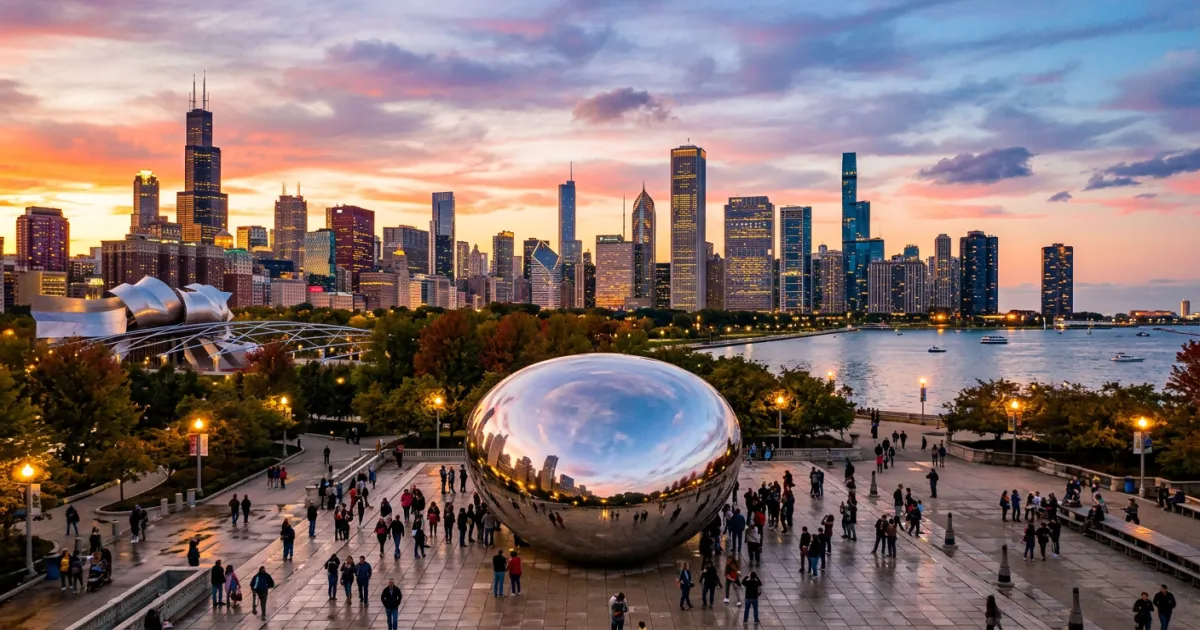
Quick Facts About Chicago
Chicago sits on the southwestern shore of Lake Michigan in Illinois, making it the third-largest city in the United States. The city runs on Central Standard Time (CST/UTC-6), and the currency is the US dollar (USD). With 26 miles of lakefront, more than 70 museums, 580 parks, and one of the most celebrated food scenes in America, Chicago is a city that rewards every type of traveler.
Whether you are drawn by deep dish pizza, world-class architecture, or free attractions like Lincoln Park Zoo and Millennium Park, this guide will help you plan your trip to Chicago with confidence.
Best Time to Visit Chicago
Chicago’s weather shapes the travel experience more than almost any other major US city. Here is how the seasons break down:
- May through October is the prime window for visiting. Temperatures range from the mid-50s to the upper 80s (Fahrenheit), outdoor attractions are fully open, and the lakefront is alive with activity.
- June through September brings the best weather, with long sunny days and average highs between 75 and 85 degrees. Summer is also festival season, with Lollapalooza, Taste of Chicago, the Chicago Air and Water Show, and dozens of neighborhood street festivals filling the calendar. The trade-off is bigger crowds and higher hotel prices.
- May and September through October are the shoulder months and arguably the smartest time to visit. You get pleasant weather (55 to 75 degrees), fewer tourists, and lower hotel rates. Fall foliage along the lakefront is a bonus in October.
- November through March is Chicago’s brutal winter. Temperatures regularly dip below freezing, and the wind off Lake Michigan cuts right through you. However, if you can handle the cold, you will find significantly cheaper hotels, no lines at museums, and holiday events like the Christkindlmarket and the Zoo Lights at Lincoln Park.
How Long to Spend in Chicago
Plan for 3 to 5 days to experience Chicago properly. Three days covers the major highlights: Millennium Park, the Art Institute, an architecture river cruise, and a deep dish pizza crawl. Five days lets you dig deeper into neighborhoods like Pilsen, Hyde Park (home of the new Obama Presidential Center opening in 2026), and Wicker Park. A long weekend of 4 days is the sweet spot for most first-time visitors.
Chicago Trip Budget: What to Expect
Chicago is a mid-range US city for travel costs. It is cheaper than New York or San Francisco but pricier than cities in the South or Midwest. Here is a breakdown of daily budgets per person:
- Budget traveler: $80 to $120 per day (hostel or budget hotel, L train, street food and casual dining, free attractions)
- Mid-range traveler: $200 to $300 per day (3-star hotel, mix of dining, paid attractions, occasional rideshare)
- Luxury traveler: $400+ per day (upscale hotel, Michelin dining, private tours, premium experiences)
A typical 3-day, 2-night weekend trip for a mid-range traveler runs $600 to $900 per person, excluding flights.
Save with CityPASS
If you plan to visit multiple attractions, the Chicago CityPASS saves up to 50% on admission to five top attractions including Shedd Aquarium and Skydeck Chicago, plus your choice of three more from the Field Museum, Art Institute, Museum of Science and Industry, and others. There is also the Chicago C3 option at $109 for adults ($79 for kids ages 3 to 11), which lets you pick any three attractions from the full list. Both passes are valid for 9 consecutive days from first use.
Use our travel budget template to map out your Chicago spending before you go.
Where to Stay in Chicago
Chicago’s neighborhoods each have a distinct personality. Here are the best areas for visitors:
- The Loop (Downtown): The city’s central business district and the hub for transit, theaters, and Millennium Park. Ideal if you want to be within walking distance of major attractions. Hotels range from budget to luxury.
- Magnificent Mile and River North: Michigan Avenue’s famous shopping stretch and the surrounding River North area offer upscale hotels, restaurants, and nightlife. This is the classic tourist base and the most convenient for first-timers.
- West Loop: Chicago’s foodie epicenter. Restaurant Row on Randolph Street is home to some of the city’s best dining, including several Michelin-starred spots. Great for travelers who prioritize food experiences.
- Wicker Park and Bucktown: Trendy, artsy neighborhoods with independent boutiques, craft cocktail bars, and a vibrant nightlife scene. A good pick for younger travelers and those who want a less touristy feel.
- Lincoln Park and Lakeview: Residential neighborhoods near the free Lincoln Park Zoo, the lakefront, and Wrigley Field. Family-friendly with a good mix of restaurants and green space. Lakeview’s Boystown area is the heart of Chicago’s LGBTQ+ community.
Getting Around Chicago
Chicago has one of the best public transit systems in the country, and you do not need a car.
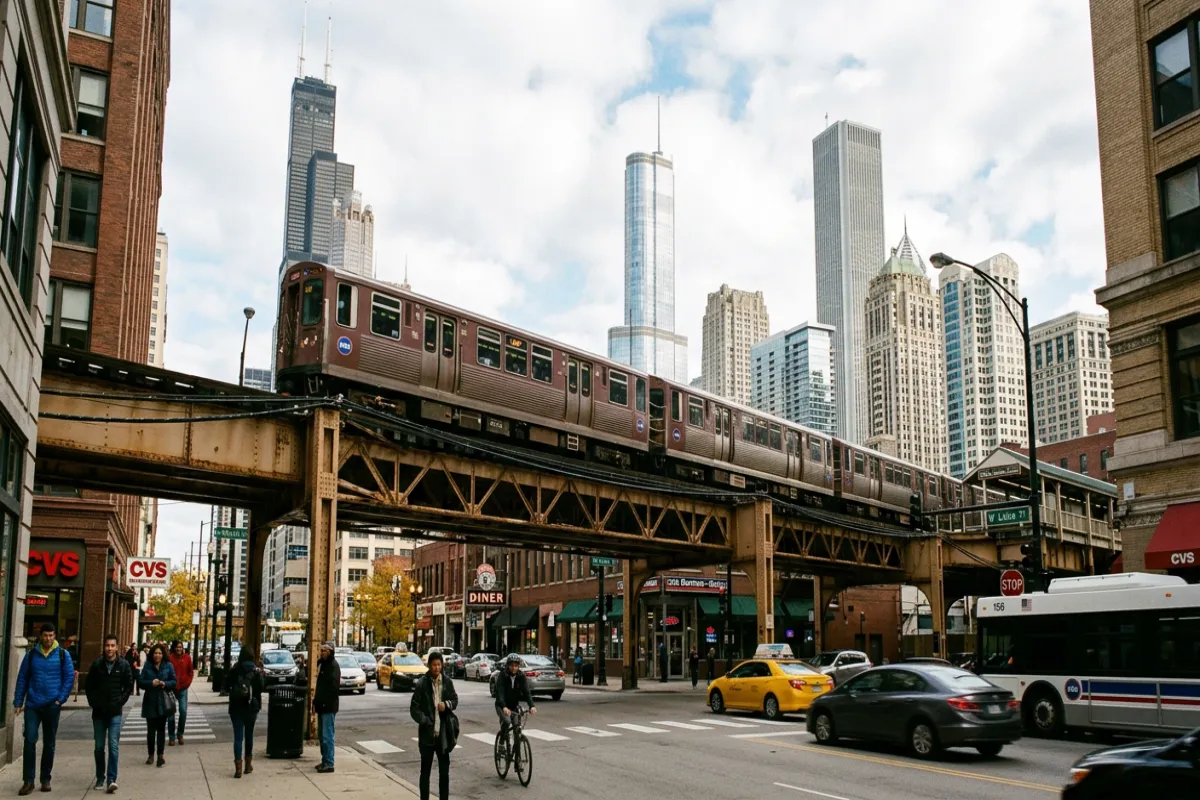
- The L Train (CTA): Chicago’s elevated and subway rail system is the backbone of city transit. Eight color-coded lines connect downtown to neighborhoods, airports (O’Hare and Midway), and major attractions. A single ride costs $2.50 using a Ventra card, which you can buy at any L station. Day passes are available: $5 for a 1-day pass, $20 for a 7-day pass, and $75 for a 30-day pass.
- Walking: Downtown Chicago, especially the Loop and Magnificent Mile, is very walkable. The Lakefront Trail stretches 18 miles along the water and connects several neighborhoods and parks.
- Water Taxi: During summer months (typically May through October), Shoreline Sightseeing operates water taxi service along the Chicago River, connecting stops at Michigan Avenue, Chinatown, and Ogilvie/Union Station. It is both practical transit and a scenic ride.
- Divvy Bikes: Chicago’s bike-share system has thousands of bikes and e-bikes at stations across the city. Single rides start at $1 to unlock plus per-minute charges, or you can get a day pass.
- Uber and Lyft: Widely available and often the easiest option for late nights or trips to neighborhoods not well served by the L.
- Parking: If you do drive, expect to pay $30 to $60 per day for downtown parking garages. Street parking in neighborhoods is easier but still metered in busy areas. Seriously, skip the car.
Must-See Chicago Attractions
Chicago packs an enormous amount into a compact, walkable core. Here are the attractions that belong on every first-time visitor’s list:
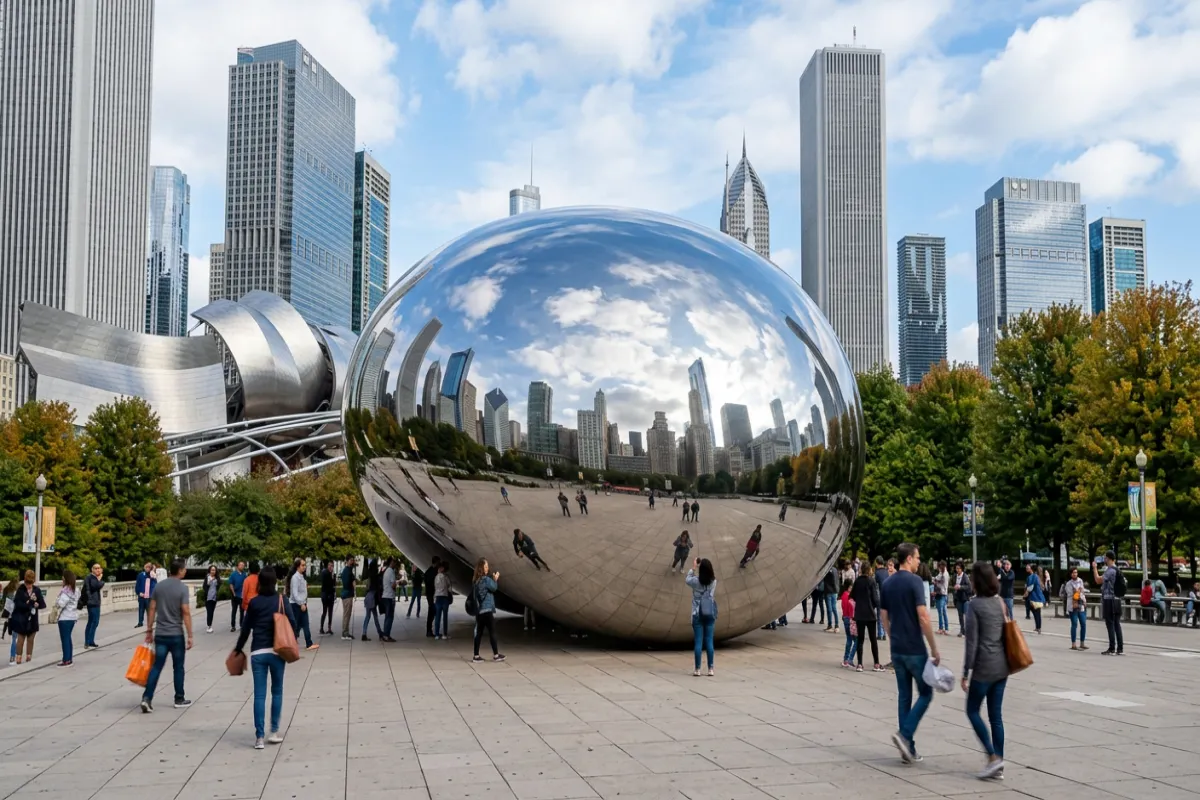
Millennium Park and Cloud Gate (The Bean)
The centerpiece of downtown Chicago and arguably the city’s most iconic spot. Cloud Gate, the massive reflective sculpture by Anish Kapoor that everyone calls “The Bean,” draws millions of visitors a year. The park also features the Jay Pritzker Pavilion for outdoor concerts, the Crown Fountain, and Lurie Garden. Free admission, open daily.
The Art Institute of Chicago
One of the oldest and largest art museums in the United States, housing over 300,000 works spanning 5,000 years. Highlights include Georges Seurat’s “A Sunday on La Grande Jatte,” Grant Wood’s “American Gothic,” and Edward Hopper’s “Nighthawks.” Adult admission is $32, though Illinois residents get $5 off and Chicago residents pay just $20. Children under 14 enter free. Free Thursday evenings are available for Illinois residents throughout the summer.
Willis Tower Skydeck and The Ledge
Standing 1,353 feet tall, Willis Tower was the world’s tallest building for 25 years. The Skydeck on the 103rd floor offers views of up to four states on a clear day. The Ledge, a set of glass-floored balconies that extend 4.3 feet out from the building, is a thrill even for those who are not afraid of heights. General admission starts at $32 for adults, $24 for children 3 to 11.
Navy Pier
Chicago’s most-visited attraction stretches 3,300 feet into Lake Michigan. Beyond the Centennial Wheel (a 200-foot Ferris wheel), you will find the Chicago Children’s Museum, an IMAX theater, restaurants, boat tour departures, and seasonal events including a summer fireworks show every Wednesday and Saturday night. The pier itself is free to walk.
Architecture River Cruise
This is the one activity that virtually every Chicago visitor should do. A 90-minute boat tour along the Chicago River, narrated by trained docents, covers more than 50 buildings and the history of how Chicago rebuilt itself after the Great Fire of 1871. The Chicago Architecture Foundation (CAF) cruise is considered the gold standard, but several operators run similar tours. Book in advance during summer; this sells out regularly. Tickets typically run $45 to $55 per person.
The Magnificent Mile
The stretch of North Michigan Avenue between the Chicago River and Oak Street is one of the great shopping boulevards in the world. Even if shopping is not your thing, the architecture alone is worth the walk, from the Wrigley Building and Tribune Tower to the historic Water Tower, one of the few structures to survive the Great Fire.
Lincoln Park Zoo
One of the last remaining free-admission zoos in the country, Lincoln Park Zoo has been free since 1878. Home to more than 1,100 animals across 200 species, it sits in the heart of Lincoln Park, a 1,200-acre green space along the lakefront. The zoo operates year-round.
Museum of Science and Industry
Located in the Hyde Park neighborhood, the MSI is the largest science museum in the Western Hemisphere. Highlights include a captured World War II German U-boat (U-505), a full-size coal mine replica, and a 40-foot tornado simulation. Plan at least 3 to 4 hours here.
Field Museum
Home to SUE, the largest and most complete Tyrannosaurus rex fossil ever discovered, the Field Museum houses over 40 million artifacts across anthropology, botany, geology, and zoology. The Inside Ancient Egypt exhibit is a standout. Located in the Museum Campus alongside Shedd Aquarium and Adler Planetarium.
Wrigley Field
Even if you are not a baseball fan, catching a Cubs game at Wrigley Field is a quintessential Chicago experience. Built in 1914, it is the second-oldest ballpark in Major League Baseball. The surrounding Wrigleyville neighborhood is packed with sports bars and restaurants. If the Cubs are not playing, stadium tours are available.
Second City
The legendary comedy club that launched the careers of Tina Fey, Steve Carell, Bill Murray, John Belushi, and countless others. Shows run nightly in the Old Town neighborhood. Tickets range from $30 to $75, and the late-night improv sets are often free or discounted.
What to Eat in Chicago
Chicago’s food identity runs deep. The city did not just adopt dishes; it invented them. Here is what to eat and where to find it:

Deep Dish Pizza
Lou Malnati’s and Giordano’s are the two names you will hear most, and both deliver the real thing: a buttery, cornmeal crust filled with mozzarella and topped with a chunky tomato sauce. Lou Malnati’s “The Lou” with its butter crust and exclusive sausage blend is many locals’ pick. Giordano’s specializes in a stuffed version with an extra layer of dough. Plan for a 30 to 45 minute wait for your pizza to bake. Pequod’s in Lincoln Park is the locals’ sleeper pick, famous for its caramelized cheese crust.
Chicago-Style Hot Dog
A Vienna beef hot dog on a poppy seed bun, topped with yellow mustard, neon green relish, chopped onion, tomato slices, a dill pickle spear, sport peppers, and celery salt. The cardinal rule: never put ketchup on a Chicago hot dog. Seriously, do not do it. Portillo’s, Superdawg, and Jim’s Original on Maxwell Street are the go-to spots.
Italian Beef
Thinly sliced, seasoned roast beef piled on a long Italian roll and dipped in the cooking jus (order it “dipped” or “wet” for maximum flavor). Topped with sweet peppers or hot giardiniera. Al’s #1 Italian Beef on Taylor Street has been serving them since 1938. Johnnie’s Beef in Elmwood Park is worth the trip.
Michelin Dining
Chicago has one of the largest Michelin-starred dining scenes in the United States. Alinea (three stars) is one of the most celebrated restaurants in the world, offering a multi-course avant-garde tasting menu. The West Loop’s Restaurant Row on Randolph Street is the epicenter, with spots like Girl & The Goat, Avec, and numerous others. For a broader range, Chinatown is excellent for affordable dim sum and Cantonese cuisine, and Greektown on Halsted Street is one of the oldest Greek neighborhoods in the country.
Tipping
Tipping 18% to 20% at sit-down restaurants is standard in Chicago, consistent with the rest of the United States. Bartenders typically receive $1 to $2 per drink. For counter service, 15% to 18% is common.
Practical Tips for Visiting Chicago
- The wind is real: Chicago is called the Windy City, and while the nickname originally referred to boastful politicians, the wind off Lake Michigan is no joke. Even in summer, bring a light jacket for lakefront evenings. In winter, layer up with a proper windproof coat, hat, and gloves.
- Nobody calls it Willis Tower: The building was officially renamed from Sears Tower to Willis Tower in 2009, but most Chicagoans still call it the Sears Tower. You will sound more like a local if you do too.
- The Chicago flag is iconic: You will see the city’s distinctive four-star flag on everything from tattoos to bar signs. Each star represents a major event in city history (Fort Dearborn, the Great Fire, the 1893 World’s Fair, and the 1933 Century of Progress Exposition).
- Safety: Tourist areas including the Loop, Magnificent Mile, River North, Lincoln Park, and the Museum Campus are generally safe. As with any large city, stay aware of your surroundings, especially after dark. Avoid leaving valuables visible in parked cars.
- Parking is expensive: Downtown parking garages charge $30 to $60 per day. If you are flying in, take the L from O’Hare (Blue Line, about 45 minutes to downtown, $5) or Midway (Orange Line, about 30 minutes). Both are direct connections with no transfers needed.
- New in 2026: The Obama Presidential Center is opening in Hyde Park, making that neighborhood even more worth a visit. Combine it with the Museum of Science and Industry for a full south-side day.
Sample 4-Day Chicago Itinerary
Day 1: Downtown and the Lakefront
Start at Millennium Park for photos at The Bean, then walk to the Art Institute of Chicago (plan 2 to 3 hours). Grab lunch in the Loop, then walk the Lakefront Trail south to the Museum Campus. Spend the afternoon at the Field Museum or Shedd Aquarium. End with deep dish pizza at Lou Malnati’s on State Street.
Day 2: Architecture and the River
Morning Architecture River Cruise (book the first departure to beat crowds). After the cruise, walk the Magnificent Mile for shopping and sightseeing. Lunch in River North. Afternoon at the Willis Tower Skydeck. Evening in the West Loop for dinner on Restaurant Row.
Day 3: Neighborhoods and Culture
Morning at Lincoln Park Zoo (free) and a walk through Lincoln Park. Lunch in Wicker Park or Bucktown. Afternoon at the Museum of Science and Industry in Hyde Park (take the Metra Electric or a rideshare). Evening at Second City for a comedy show.
Day 4: Baseball, Food, and Farewells
If in season, catch a Cubs game at Wrigley Field (or take a stadium tour). Explore Wrigleyville for lunch. Afternoon visit to Navy Pier for the Centennial Wheel and lakefront views. Farewell dinner: Italian beef at Al’s #1 on Taylor Street, followed by a Chicago-style hot dog at Portillo’s because why not end on a double.
Need help building a custom itinerary? Try the Yopki AI travel planner to create a personalized Chicago trip plan, or start with our vacation itinerary template.
Planning Tools and Resources
Getting organized before your trip saves time and money once you arrive. Here are some resources to help:
- How to plan a trip (step-by-step planning framework)
- AI travel planner (build a custom Chicago itinerary in minutes)
- Travel budget template (track your Chicago spending)
- Vacation itinerary template (organize your daily schedule)
- Layover in Chicago (ORD) (if you are connecting through O’Hare)
- Chicago museums guide (detailed museum listings and tips)
Frequently Asked Questions
Is Chicago expensive to visit?
Chicago is moderately priced compared to other major US cities. A mid-range traveler should budget $200 to $300 per day including accommodation, food, transit, and attractions. It is noticeably cheaper than New York, San Francisco, or Los Angeles.
How many days do you need in Chicago?
Three to five days is ideal. Three days covers the highlights, while five days lets you explore neighborhoods and take day trips. A 4-day trip is the sweet spot for most visitors.
Is the L train safe?
The CTA trains are generally safe, especially during daytime hours and on routes that serve tourist areas (Blue, Red, Brown, and Orange lines). Use standard big-city awareness: keep your phone secure, stay alert, and avoid empty cars late at night.
Do I need a car in Chicago?
No. Chicago’s combination of the L train, buses, rideshares, and walkable neighborhoods makes a car unnecessary and often a hassle. Parking is expensive and traffic is heavy. Save your money and use public transit.
What is the best deep dish pizza in Chicago?
This question starts arguments. Lou Malnati’s and Giordano’s are the most famous. Pequod’s in Lincoln Park is the cult favorite for its caramelized cheese crust. Try at least two and decide for yourself.
When is the cheapest time to visit Chicago?
January through March offers the lowest hotel rates and flight prices. You will deal with serious cold, but museums and indoor attractions are crowd-free, and the city runs winter-specific events and festivals.