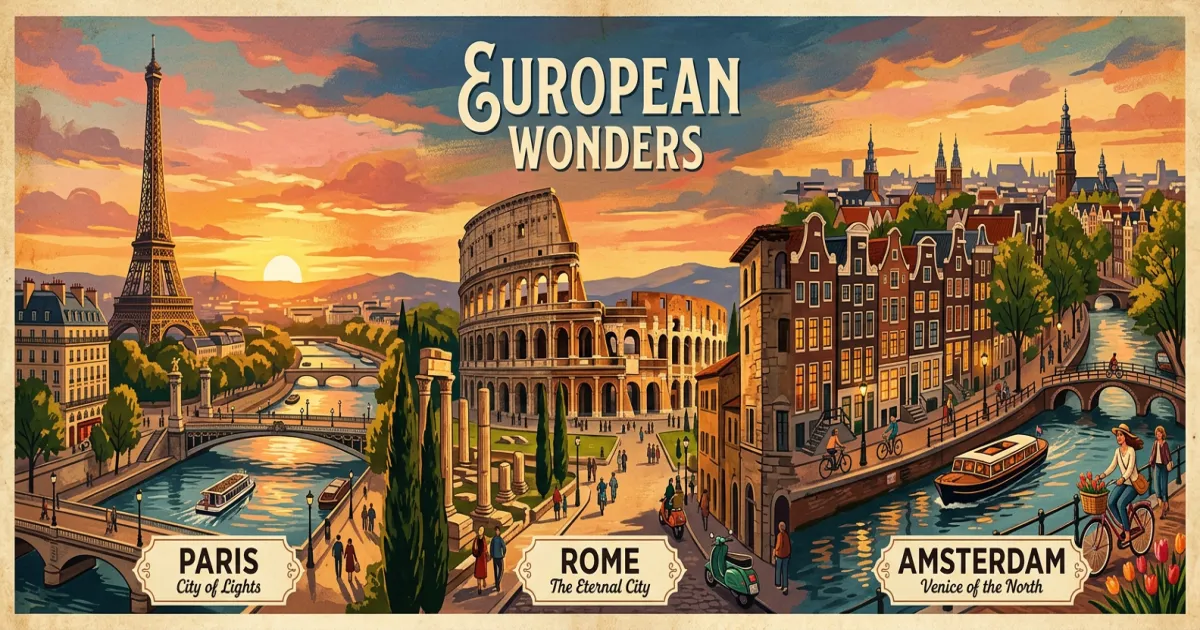
Europe is the world’s most popular travel destination for good reason. From the art-filled streets of Rome to the canals of Amsterdam, this continent packs an incredible variety of cultures, cuisines, and landscapes into a surprisingly compact area. But planning a multi-country European trip can feel overwhelming, especially if it’s your first time.
This guide breaks down everything you need to know to plan a trip to Europe in 2026, from choosing countries and booking transport to budgeting by region and navigating the new ETIAS travel authorization.
Quick Facts: Europe Travel in 2026
| Detail | What You Need to Know |
|---|---|
| ETIAS | New travel authorization launching Q4 2026. Cost: 7 euros, valid 3 years. Applies to visa-exempt travelers (US, Canada, UK, Australia, others). Transitional period with grace period after launch. |
| Schengen Rule | 90 days within any 180-day period across 27 Schengen countries. Your passport must be valid for at least 3 months beyond your return date. |
| Currency | Euro in 20 countries. UK uses pounds, Switzerland uses francs, Scandinavia uses kroner/kronor. Multi-currency cards like Wise or Revolut are essential. |
| Best Time to Visit | Shoulder seasons: April to May and September to October. Lower prices, fewer crowds, pleasant weather. |
| Daily Budget Range | Eastern Europe: 50 to 80 euros. Western Europe: 120 to 185 euros. Scandinavia: 180 to 230 euros. Switzerland: 200 to 320 euros. All per person, as of 2026. |
| Languages | English is widely spoken in tourism areas. Translation apps help in rural regions. |
Choosing Your Countries
The biggest mistake first-time visitors make is trying to cram too many countries into one trip. Europe looks small on a map, but moving between cities takes real time, and you lose entire travel days to trains, flights, and airport transfers.
The golden rule: plan for 2 to 3 countries in a 2-week trip. This gives you enough time to actually experience each place rather than just checking boxes.
Popular Country Combinations
- Classic Western Europe: France + Italy (or France + Spain). Connected by fast trains, culturally rich, great food in both.
- Iberian Peninsula: Spain + Portugal. Easy overland travel, excellent value, warm weather, and stunning coastlines.
- British Isles: England + Ireland (or Scotland). Same language, easy logistics, different landscapes.
- Central Europe: Austria + Czech Republic + Hungary. Great value, stunning architecture, connected by short train rides.
- Mediterranean: Italy + Greece. Iconic history, incredible food, island-hopping options.
If you’re particularly drawn to Italy, check out our detailed guide to planning a trip to Italy for city-by-city breakdowns.
Best Time to Visit Europe
When you go matters as much as where you go. The difference between peak and shoulder season can mean half the cost and a fraction of the crowds.
Shoulder Season (April to May and September to October)
This is the sweet spot. Weather is pleasant across most of the continent, major attractions have shorter lines, and flights and hotels are noticeably cheaper than summer. September in particular is ideal: warm enough for Mediterranean beaches, cool enough for comfortable city walking, and the summer tourist crush has died down.
Summer (June to August)
Peak season across all of Europe. Expect the highest prices, the biggest crowds, and the need to book popular attractions weeks or months in advance. That said, this is the only time some northern destinations (Iceland, Norway, Scottish Highlands) have reliably good weather. Book accommodations and key attractions 6 to 9 months ahead for summer travel.
Winter (November to March)
The off-season brings the lowest prices, but shorter daylight hours and cold weather across much of the continent. The big exception is December, when Christmas markets in Germany, Austria, and the Czech Republic draw millions. Ski resorts in the Alps are in full swing from December through March.
How Long to Stay
Your trip length shapes everything else about your planning.
- 1 week: Stick to one country or even one region. A week in Tuscany, the south of France, or exploring London and the English countryside is far more rewarding than trying to squeeze in three capitals.
- 2 weeks: The minimum for a comfortable multi-country trip. You can cover 2 to 3 countries at a relaxed pace with enough time to go beyond the must-see checklist.
- 3 to 4 weeks: The ideal length if you can swing it. You get flexibility to add spontaneous side trips, rest days, and deeper exploration of smaller towns.
Whatever your timeline, build in at least one “free day” per city with no plans. Some of the best travel experiences happen when you wander without an agenda.
Budget and Costs
Europe’s cost of travel varies dramatically by region. The difference between a day in Zurich and a day in Budapest can be 4x or more. Understanding these regional differences is key to building a realistic travel budget.
Daily Budget Ranges by Region (as of 2026)
| Region | Budget Traveler | Mid-Range Traveler | Examples |
|---|---|---|---|
| Eastern Europe | 35 to 60 euros/day | 70 to 130 euros/day | Poland, Hungary, Czech Republic, Romania, Bulgaria |
| Southern Europe | 50 to 80 euros/day | 100 to 170 euros/day | Spain, Portugal, Greece, Croatia |
| Western Europe | 70 to 110 euros/day | 130 to 185 euros/day | France, Germany, Netherlands, Belgium |
| UK and Ireland | 80 to 120 euros/day | 150 to 200 euros/day | England, Scotland, Ireland |
| Scandinavia | 100 to 150 euros/day | 180 to 230 euros/day | Norway, Sweden, Denmark, Finland |
| Switzerland | 130 to 180 euros/day | 200 to 320 euros/day | Switzerland, Liechtenstein |
These ranges include accommodation, food, local transport, and a couple of paid activities per day. Flights between countries are extra.
Budget tip: Balance your itinerary between expensive and affordable regions. Spending a week in Portugal before heading to Paris lets you average out your daily costs. Many travelers find that a mix of Eastern and Western Europe gives the best value-to-experience ratio.
Getting There
Flights from North America to Europe are most affordable when booked 2 to 4 months in advance. Here are the strategies that save real money:
- Open-jaw flights: Fly into one city and out of another (for example, into London and out of Rome). This eliminates backtracking and saves an entire travel day. Most flight search engines support multi-city bookings.
- Hub airports: London Heathrow, Paris CDG, Amsterdam Schiphol, and Frankfurt are major hubs with the most competitive pricing. If you have a long layover at one of these airports, our London layover guide and Paris layover guide can help you make the most of your time.
- Flexible dates: Shifting your departure by even a day or two can save hundreds. Tuesday and Wednesday departures are typically cheapest.
- Budget carriers: Norwegian, PLAY, and French Bee offer lower fares on transatlantic routes, though baggage fees can close the gap if you’re not careful.
Getting Around Europe
Europe has the best public transportation network of any continent. Your main options for moving between cities and countries:
Trains
The most popular and scenic way to travel Europe. High-speed trains connect major cities efficiently: Paris to London takes about 2 hours 15 minutes on the Eurostar, Rome to Florence is 1 hour 30 minutes on the Frecciarossa, and Barcelona to Madrid is about 2 hours 30 minutes on the AVE.
Eurail Pass vs. point-to-point tickets: A Eurail Global Pass (starting around 335 euros for 7 travel days in second class, as of 2026) offers flexibility and convenience, especially in countries like Germany, Switzerland, and the Netherlands where point-to-point fares are expensive. However, if you plan your route in advance and book early, individual tickets are often cheaper, particularly in France, Spain, and Italy. Note that some high-speed trains require seat reservations (5 to 35 euros each) even with a pass.
Budget Airlines
Ryanair, EasyJet, Wizz Air, and Vueling connect hundreds of European cities with fares as low as 15 to 40 euros if booked early. The catch: strict baggage limits, fees for everything from seat selection to carry-on bags, and airports that are often far from city centers. Always factor in the cost of getting to and from the airport.
Buses
FlixBus is the dominant long-distance bus operator across Europe, with fares starting around 5 to 15 euros for shorter routes. Slower than trains but significantly cheaper, and the network reaches smaller towns that trains skip.
Driving
Renting a car makes sense for rural areas like Tuscany, the Scottish Highlands, or Norway’s fjords. For city-hopping, it’s more hassle than it’s worth due to parking costs, congestion charges, and restricted traffic zones. An International Driving Permit is recommended in many countries.

Where to Stay
Accommodation is typically your biggest daily expense. Options across the continent include:
- Hostels: Not just for backpackers anymore. Many European hostels offer private rooms alongside dorms. Expect 20 to 50 euros per night for a dorm bed, 60 to 100 euros for a private room. Generator, St. Christopher’s, and a&o are reliable chains.
- Hotels: Mid-range hotels in Western Europe run 100 to 200 euros per night. In Eastern Europe, you can find quality hotels for 50 to 100 euros. Booking directly with the hotel sometimes gets you better rates or perks than third-party sites.
- Vacation Rentals: Airbnb and similar platforms remain popular, though regulations have tightened significantly across Europe in 2025 and 2026. Cities like Paris, Amsterdam, Barcelona, and Florence have strict caps on short-term rental nights, leading to fewer listings and higher prices in some areas. Booking.com’s apartment listings often have more availability in regulated cities.
- Guesthouses and B&Bs: Excellent in rural areas and smaller towns. Often family-run with local breakfast included. Popular in the UK, Ireland, and Italy (called “agriturismo” in the Italian countryside).
Use our vacation itinerary template to organize your accommodation bookings alongside your daily plans.
Top European Destinations for First-Timers
If this is your first time in Europe, these cities deliver the experiences most travelers are looking for:
- Paris, France: The Eiffel Tower, Louvre, and cafe culture. Book the Louvre and Musee d’Orsay tickets online in advance. Allow 3 to 4 days minimum.
- Rome, Italy: The Colosseum, Vatican, and the best food scene on the continent. Timed entry for the Vatican Museums is essential. Plan for 3 to 4 days.
- Barcelona, Spain: Gaudi’s architecture, Mediterranean beaches, and world-class nightlife. La Sagrada Familia requires advance booking (often 2 to 3 weeks out in summer). Allow 3 days.
- Amsterdam, Netherlands: Canals, the Van Gogh Museum, and a walkable city center. The Anne Frank House sells out months ahead. Plan 2 to 3 days.
- London, England: History, theater, and free world-class museums (British Museum, National Gallery, Tate Modern). Allow 3 to 4 days for the highlights.
- Prague, Czech Republic: Stunning medieval architecture at Eastern European prices. One of the best value-for-money capitals in Europe. Plan 2 to 3 days.
- Santorini, Greece: Iconic white-washed villages and sunsets. Best visited in shoulder season (May or September to October) to avoid extreme crowds and heat.

Money and Practical Tips
A few practical details that trip up first-time European travelers:
Currency and Cards
- Multi-currency cards are essential. Wise and Revolut cards let you spend in local currencies at the real exchange rate with minimal fees. Order one at least 2 weeks before your trip.
- Notify your bank of your travel dates so your cards don’t get blocked for suspicious activity.
- Always pay in local currency when given the option at card terminals. “Dynamic currency conversion” (paying in your home currency) always has a worse exchange rate.
- Carry some cash. Smaller shops, markets, and some restaurants in Southern and Eastern Europe are cash-preferred. ATMs with the Visa/Mastercard logos offer the best exchange rates.
Tipping
Tipping customs vary widely. In France and Italy, service is included in the bill (rounding up is appreciated). In the UK, 10 to 12% is standard at sit-down restaurants. In Germany and Spain, rounding up by a euro or two is common. In Scandinavia, tipping is not expected.
Power Adapters
Most of continental Europe uses Type C/F plugs (two round pins). The UK and Ireland use Type G (three rectangular pins). Bring a universal adapter or one of each type. A small power strip lets you charge multiple devices from one adapter.
ETIAS Travel Authorization
Starting in Q4 2026, visa-exempt travelers (including US, Canadian, UK, and Australian citizens) will need an ETIAS authorization to enter Schengen Area countries. The application is online, costs 7 euros, and is valid for 3 years. Travelers under 18 or over 70 are exempt from the fee. There will be a transitional grace period after launch, but it’s best to apply before you travel once the system goes live.
Connectivity
Buy a European eSIM or SIM card for data. Providers like Airalo, Holafly, and Orange Holiday offer plans covering multiple EU countries. EU roaming regulations mean one SIM works across all EU member states at no extra charge.
Sample 14-Day Europe Itinerary
This itinerary covers four countries using trains and one short flight, moving roughly south through Western Europe:
Days 1 to 3: London, England
Arrive and adjust to the time zone. Visit the British Museum (free), walk along the South Bank, see Westminster and Buckingham Palace. Take a day trip to Stonehenge or Windsor Castle. Enjoy West End theater in the evening.
Days 4 to 6: Paris, France
Take the Eurostar from London St Pancras to Paris Gare du Nord (about 2 hours 15 minutes). Explore the Eiffel Tower, walk through the Marais district, visit the Louvre and Musee d’Orsay. Take a day trip to Versailles.
Days 7 to 8: Swiss Alps
Take the TGV from Paris to Lausanne or Interlaken (about 4 hours). Spend two days surrounded by mountain scenery. Take a boat ride on Lake Geneva or ride the Jungfrau railway. This is your scenic break between cities.
Days 9 to 10: Milan and Lake Como, Italy
Train from Switzerland to Milan (about 3 to 4 hours through the Simplon Tunnel). Visit the Duomo, see The Last Supper (book weeks ahead), and take a day trip to Lake Como by regional train (1 hour).
Days 11 to 12: Florence, Italy
High-speed train from Milan to Florence (about 1 hour 40 minutes). See the Uffizi Gallery, climb the Duomo, cross the Ponte Vecchio, and eat your way through the San Lorenzo Market.
Days 13 to 14: Rome, Italy
High-speed train from Florence to Rome (about 1 hour 30 minutes). Visit the Colosseum and Roman Forum, explore the Vatican Museums and St. Peter’s Basilica, and toss a coin in the Trevi Fountain. Fly home from Rome Fiumicino.
Estimated cost for this itinerary: 2,800 to 4,500 euros per person (excluding transatlantic flights), depending on accommodation choices. Eastern European alternatives (Budapest, Prague, Krakow) could bring this down to 1,800 to 3,000 euros per person.
Use Yopki’s AI trip planner to customize this itinerary for your dates, budget, and interests.

Planning Tools
Planning a multi-country trip involves a lot of moving pieces. These tools can help:
- Yopki AI Trip Planner: Build a personalized European itinerary based on your travel dates, budget, and interests. The planner accounts for travel times between cities and suggests realistic daily schedules.
- Vacation Itinerary Template: Organize your flights, hotels, and daily plans in one place. Especially useful for multi-city trips where you need to track multiple bookings.
- Travel Budget Template: Track spending across different currencies and categories. Set daily limits by country to keep your trip affordable.
- Seat61.com: The best resource for European train travel. Detailed route guides, booking tips, and schedule information.
- Rome2Rio: Shows all transport options (train, bus, flight, ferry) between any two points in Europe with estimated costs and times.
FAQ
What is the Schengen Area and how does the 90-day rule work?
The Schengen Area is a zone of 27 European countries that have abolished border controls between them. As a visitor from a visa-exempt country, you can stay for up to 90 days within any rolling 180-day period across all Schengen countries combined. Days in the UK, Ireland, and non-Schengen Balkan countries do not count toward your 90 days.
What is ETIAS and do I need it in 2026?
ETIAS (European Travel Information and Authorisation System) is a new pre-travel screening for visa-exempt travelers visiting Schengen Area countries. It launches in Q4 2026 with a transitional period. The application is online, costs 7 euros, and is valid for 3 years. Once fully enforced, you will need an approved ETIAS before boarding your flight to Europe.
Is a Eurail Pass worth it?
It depends on your itinerary. A Eurail Pass (starting at about 335 euros for 7 travel days, as of 2026) is great for flexibility and works best in countries with expensive point-to-point fares like Germany, Switzerland, and the Netherlands. If you plan your route in advance, booking individual train tickets early is often cheaper, especially in France, Spain, and Italy. Factor in mandatory seat reservation fees (5 to 35 euros per journey) that apply even with a pass on many high-speed routes.
How far in advance should I book?
For summer travel (June to August), book flights 2 to 4 months ahead and popular attractions 1 to 3 months ahead. Some high-demand experiences like the Anne Frank House or Vatican Museums can sell out weeks in advance. Shoulder season travel requires less advance planning, but booking 4 to 6 weeks ahead still gets you better prices.
Can I use one power adapter for all of Europe?
No. Continental Europe (most countries) uses Type C/F plugs with two round pins. The UK and Ireland use Type G plugs with three rectangular pins. A universal travel adapter covers both. Switzerland technically uses a different plug (Type J), but Type C adapters fit Swiss outlets in most cases.
Planning a trip to another part of the world? See our guide to planning a trip to Japan or start with our general trip planning guide.