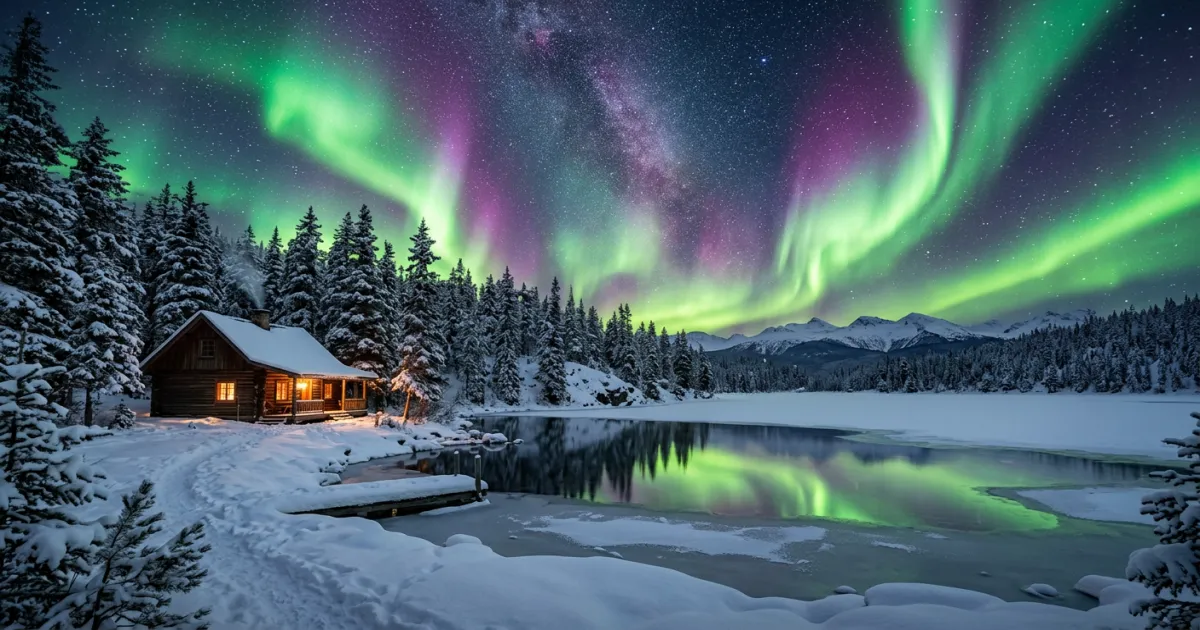
The northern lights are one of nature’s most spectacular shows, and 2026 is an exceptional year to see them. Solar Cycle 25 peaked in late 2024 and continues to produce strong aurora activity through 2026, meaning brighter and more frequent displays than we will see again until the mid-2030s. This guide covers everything you need to plan a successful northern lights trip, from choosing the right destination and timing to photography tips and packing lists.
If you are new to trip planning, start with our complete guide to planning a trip for the fundamentals, then come back here for aurora-specific advice.
Quick Facts: Northern Lights at a Glance
- Best viewing season: September through March (darkness required)
- Prime months: October, November, February, and March
- Best locations: Above 65 degrees north latitude, near the auroral oval
- Solar Cycle 25: Peaked in late 2024 with strong activity continuing through 2026
- Best time of night: 10 PM to 2 AM local time
- Minimum trip length: 3 to 5 nights for reasonable odds of a sighting
- Moon phase: New moon and crescent phases offer the darkest skies
Best Time to See the Northern Lights
The aurora borealis is visible year-round, but you can only see it when the sky is dark. In Arctic regions, the midnight sun from May through August means 24-hour daylight, which rules out summer viewing entirely. The prime aurora season runs from early September through late March, when nights are long enough to provide dark viewing windows.
Within that window, certain months offer advantages:
- September and October: The autumn equinox (around September 22) brings increased geomagnetic activity. Temperatures are milder, and you may catch fall colors alongside the aurora.
- November through January: The longest and darkest nights provide the most viewing hours, but weather can be harsh and cloud cover is common in some locations.
- February and March: Days start getting longer, but nights remain dark enough. The spring equinox (around March 20) brings another bump in geomagnetic activity. Many experienced aurora hunters consider this the sweet spot of reasonable weather and long enough nights.
Why 2026 Is Special
The sun follows an approximately 11-year activity cycle. Solar Cycle 25 peaked in October 2024 and has exceeded all predictions for strength. Solar physicist Dr. Pal Brekke of the Norwegian Space Agency has noted that we are in a period of the “most frequent and intense Northern Lights displays” in years. While activity is now in a gradual decline, 2026 still produces significantly stronger auroras than we will see again until the next solar maximum around 2035 to 2036. If seeing the northern lights is on your list, this is the year to act.
Best Destinations for Northern Lights
The aurora appears in an oval-shaped zone centered roughly around the magnetic north pole. The best viewing happens between 65 and 72 degrees north latitude, though during strong solar storms the lights can be visible much further south. Here are the top destinations, each with distinct advantages.
Iceland
Iceland is the most popular northern lights destination for American travelers thanks to direct flights from many US cities (5 to 6 hours from the East Coast). The entire country sits just below the Arctic Circle, putting it squarely in the auroral zone. You can combine aurora hunting with dramatic landscapes like glaciers, waterfalls, and volcanic terrain. The downside is frequent cloud cover and wind, so flexibility in your schedule is important. If you are considering Iceland, check out our Iceland trip planning guide for logistics.
Pros: Easy to reach from the US, stunning landscapes, good tourism infrastructure, self-drive friendly.
Cons: Unpredictable weather, cloud cover common, can be expensive.
Norway (Tromso and Lofoten)
Tromso, located at 69 degrees north, is often called the “Gateway to the Arctic” and is one of Europe’s best aurora destinations. The city is large enough to have good hotels and restaurants, but dark enough on its outskirts for excellent viewing. The nearby Lofoten Islands offer some of the most photogenic aurora backdrops in the world, with jagged mountain peaks reflecting in fjords.
Pros: Reliable aurora zone, professional guided tours, dramatic scenery, relatively mild for its latitude thanks to the Gulf Stream.
Cons: Expensive (Norway’s cost of living is high), can have cloudy periods.
Finland (Lapland)
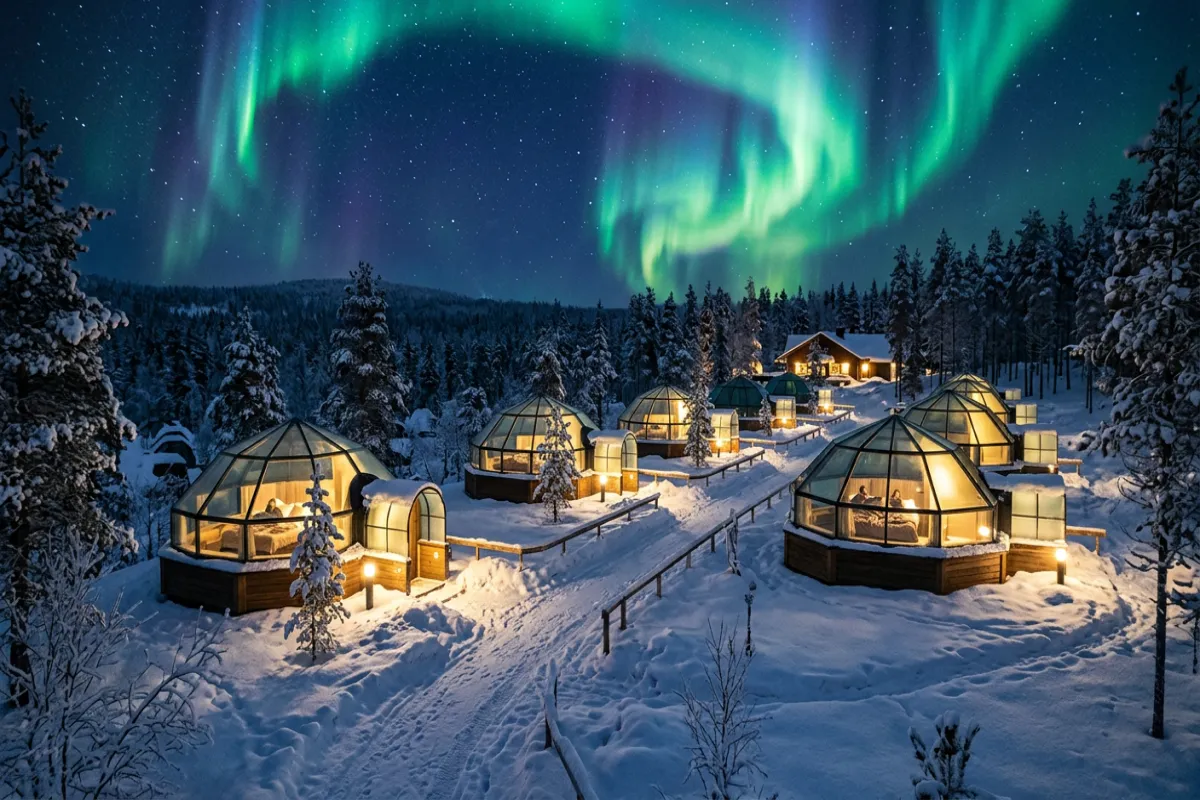
Finnish Lapland sees the northern lights on roughly 200 nights per year. The region is famous for unique accommodations like glass igloos and aurora cabins where you can watch the lights from your bed. Rovaniemi, Inari, and Saariselka are popular base towns. Finland also offers excellent winter activities like husky sledding, reindeer safaris, and ice fishing.
Pros: High frequency of aurora nights, unique glass igloo accommodations, excellent winter activities, family-friendly.
Cons: Can be very cold (minus 20C to minus 30C), requires connecting flights from Helsinki.
Sweden (Abisko)
Abisko in northern Sweden has a reputation as one of the clearest-sky locations in Scandinavia. A phenomenon called the “blue hole of Abisko” creates a pocket of clear air over the area even when surrounding regions are cloudy. The Aurora Sky Station, accessed by chairlift, sits at 900 meters elevation for unobstructed views.
Pros: Statistically the clearest skies in Scandinavia, Aurora Sky Station, less crowded than Tromso or Iceland.
Cons: Remote (3.5-hour drive or train from Kiruna airport), limited accommodation options.
Alaska (Fairbanks)
Fairbanks sits at 64.8 degrees north and is consistently ranked among the best aurora viewing locations on Earth. Its interior location means drier, clearer skies compared to coastal Alaska. The city is well set up for aurora tourism with lodges that offer wake-up calls when the lights appear. For more details on getting there and what else to do, see our Alaska trip planning guide.
Pros: No passport required for US citizens, clear interior skies, aurora wake-up services at lodges, good road access to dark sky areas.
Cons: Extremely cold (minus 30C to minus 40C in winter), limited flight options and expensive airfare, fewer cultural attractions than Scandinavia.
Canada (Yellowknife and Yukon)
Yellowknife in the Northwest Territories sits directly under the auroral oval, making it one of the most statistically reliable spots on the planet. Aurora Village, a dedicated viewing site outside town, offers heated teepees and guided experiences. Whitehorse in the Yukon is another strong option with easier access and a range of winter activities.
Pros: Directly under auroral oval, dry and cold means clear skies, dedicated aurora tourism infrastructure, no passport for US citizens (Canada entry requirements apply).
Cons: Very cold, remote with limited direct flights, fewer accommodation options than European destinations.
How Long Should Your Trip Be?
The northern lights are a natural phenomenon, not a scheduled event. Cloud cover, low solar activity, or bad timing can mean a night without a sighting. The general rule is: the more nights you have, the better your odds.
- 3 nights: Roughly 50 to 60% chance of seeing the aurora at least once (in a prime location during prime season)
- 5 nights: Around 80 to 90% chance
- 7 nights: Nearly guaranteed if you are in the right location and season
Most aurora trip planners recommend a minimum of 4 to 5 nights. Fill your days with other activities (more on this below) so you are not just waiting around for darkness.
Budget Considerations
Northern lights trips vary enormously in cost depending on your destination, travel style, and timing. Here is a rough breakdown of daily costs per person (excluding flights):
- Iceland: $150 to $300/day (self-drive with guesthouse and groceries on the low end, hotels and restaurants on the high end)
- Norway: $200 to $400/day (Norway is expensive; budget travelers should self-cater)
- Finland: $150 to $350/day (glass igloos can run $500+ per night)
- Sweden: $120 to $250/day (Abisko is relatively affordable by Scandinavian standards)
- Alaska: $100 to $250/day (accommodation is the main cost)
- Canada: $120 to $280/day (Yellowknife lodges and tours add up)
Guided aurora tours typically cost $100 to $250 per person per excursion. A dedicated 5-day northern lights trip (flights included from the US) generally runs $2,000 to $5,000 per person. Use our travel budget template to plan your spending.
How to Maximize Your Chances
Seeing the northern lights requires a combination of solar activity, clear skies, darkness, and being in the right place. Here is how to stack the odds in your favor:
- Get away from city lights. Light pollution is the enemy of aurora viewing. Drive at least 20 to 30 minutes outside of any town. Many hotels in prime locations are already in dark-sky areas.
- Check the KP index. The KP index measures geomagnetic activity on a scale of 0 to 9. A KP of 3 or higher means good aurora conditions at high latitudes. KP 5+ means the lights may be visible at lower latitudes too.
- Use aurora forecast apps. Apps like My Aurora Forecast, Aurora Alerts, and the University of Alaska Fairbanks aurora forecast provide real-time predictions and alerts.
- Clear skies are essential. You cannot see the aurora through clouds. Check local weather forecasts obsessively and be willing to drive to clearer areas.
- Stay up late (or wake up early). Peak activity is typically between 10 PM and 2 AM. Many lodges offer aurora wake-up services.
- Face north. The aurora typically appears on the northern horizon first, then expands overhead during strong displays.
- Plan around the new moon. A full moon brightens the sky and washes out fainter aurora displays. Check moon phase calendars when booking your trip.
- Be patient. The aurora can appear suddenly, last for minutes or hours, and disappear just as quickly. Give yourself time outdoors and resist the urge to head inside after 20 quiet minutes.
Photography Tips
Capturing the northern lights on camera requires some specific techniques, but modern technology has made it more accessible than ever.
Camera Settings (DSLR or Mirrorless)
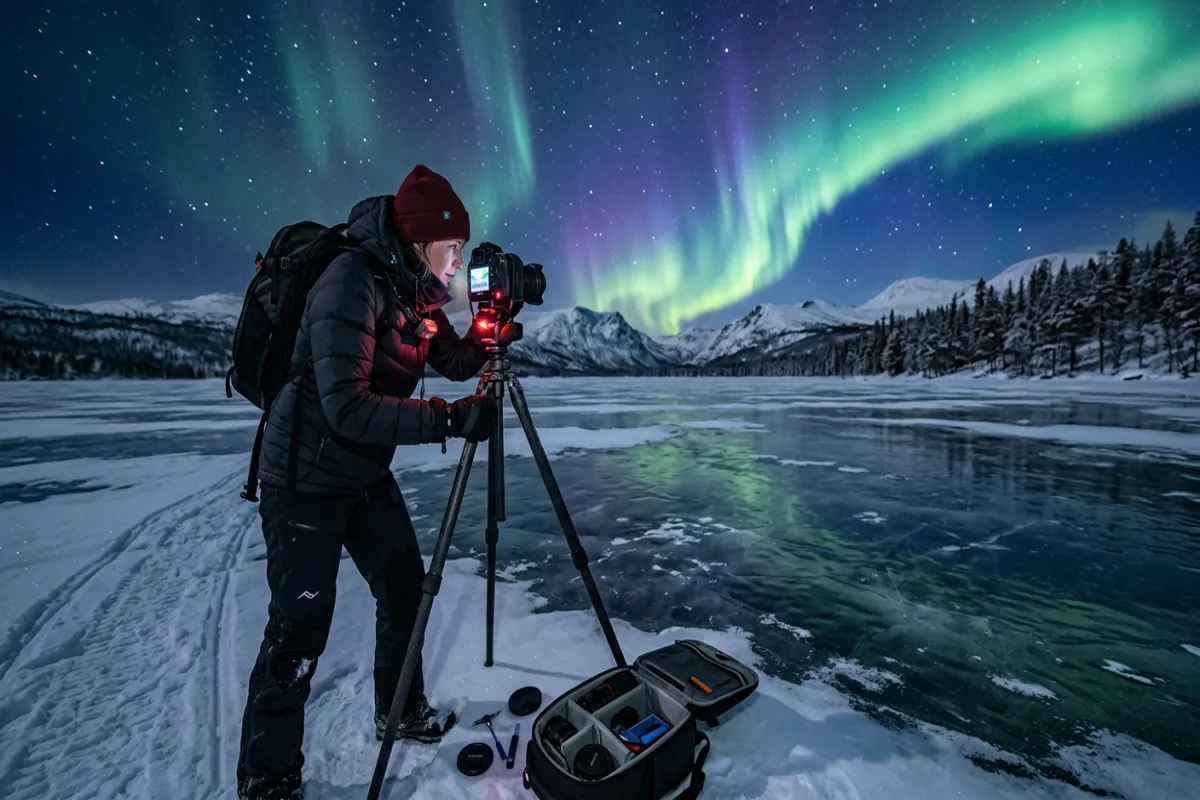
- Tripod: Absolutely essential. You cannot hand-hold long exposures.
- Mode: Full manual mode
- Aperture: As wide as your lens allows (f/2.8 is ideal, f/4 works)
- Shutter speed: 5 to 15 seconds (shorter for fast-moving aurora, longer for faint displays)
- ISO: 1600 to 3200 (higher if needed, but watch for noise)
- Lens: Wide-angle (14mm to 24mm) to capture the full sweep of the aurora
- Focus: Manual focus set to infinity (use live view to focus on a bright star)
- Timer or remote: Use a 2-second timer or remote shutter release to avoid camera shake
Smartphone Photography
Modern smartphone cameras have improved dramatically for night photography. Both iPhone (Night Mode) and Android phones (Night Sight on Pixel, Nightography on Samsung) can capture decent aurora photos. Use a phone tripod mount, set the longest available exposure time (usually 10 seconds in night mode), and keep the phone as still as possible. The results will not match a dedicated camera, but they are far better than what was possible just a few years ago.
General Tips
- Bring extra batteries. Cold weather drains batteries quickly. Keep spares in an inner pocket close to your body.
- Shoot RAW if your camera supports it. This gives you much more flexibility in post-processing.
- Include foreground interest (a cabin, trees, mountains, a lake) to make your photos more compelling.
- Take your eyes off the camera. Some of the best aurora moments happen when you just watch.
What to Wear
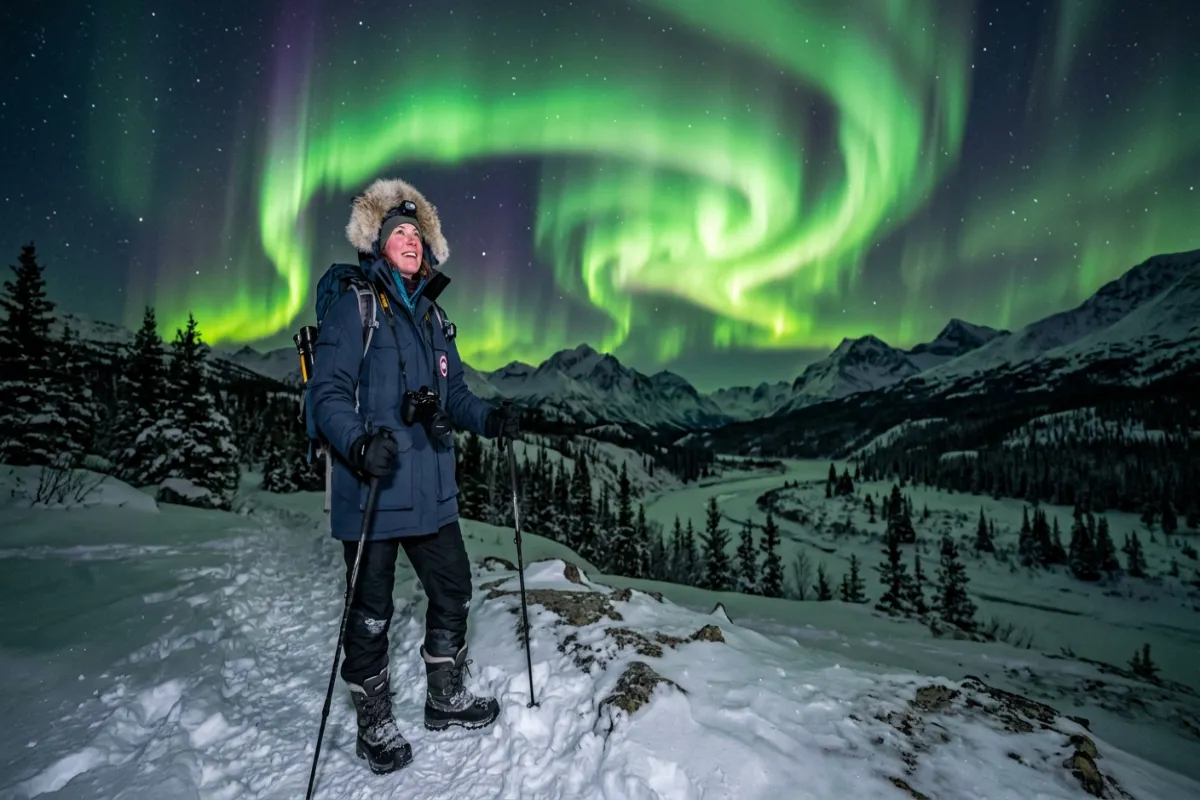
You will be standing outside in Arctic temperatures for extended periods, often in the middle of the night. Proper clothing is not optional. Temperatures can drop to minus 20C (minus 4F) or colder depending on your destination.
Layering System
- Base layer: Merino wool or synthetic thermal underwear (top and bottom). Avoid cotton, which traps moisture and chills you.
- Mid layer: Fleece jacket or insulated down mid-layer
- Outer layer: Windproof and waterproof insulated jacket and pants
Extremities (Where You Lose Heat Fastest)
- Head: Insulated hat that covers your ears, plus a balaclava or neck gaiter for extreme cold
- Hands: Layered glove system: thin liner gloves (so you can operate your camera) under insulated mittens
- Feet: Thick wool socks, insulated winter boots rated to minus 30C or colder
- Warmers: Disposable hand and toe warmers are inexpensive and highly effective
Pro Tips
- Avoid cotton in all layers. Merino wool and synthetics wick moisture and retain warmth when damp.
- Many guided tours provide thermal suits, boots, and hand warmers. Check with your operator before buying gear you will only use once.
- Bring a thermos of hot chocolate or coffee for those long waits in the cold.
Guided Tours vs. Self-Drive
Both approaches have merit. Your choice depends on your comfort level with winter driving, your budget, and how much structure you want.
Guided Aurora Tours
- Guides know the best local spots and monitor weather to chase clear skies
- Transportation included (no winter driving stress)
- Many offer unique experiences: aurora viewing from dog sleds, snowmobiles, or heated glass cabins
- Photography guidance often included
- Typical cost: $100 to $250 per person per excursion
Self-Drive
- Maximum flexibility to go where conditions are best
- No fixed schedule means you can stay out as long as you want
- Often more affordable than guided tours
- Works especially well in Iceland (Ring Road) and Alaska (road system around Fairbanks)
- Requires comfort with winter driving conditions (ice, snow, limited daylight)
A hybrid approach works well: do one or two guided tours for expert local knowledge, then self-drive on other nights for flexibility.
Sample 5-Day Iceland Northern Lights Itinerary
Iceland is the most accessible aurora destination from the US, so here is a sample 5-day itinerary that combines daytime sightseeing with nightly aurora hunting. Use our vacation itinerary template to customize this plan.
Day 1: Arrive in Reykjavik
Pick up your rental car at Keflavik Airport. Drive to Reykjavik (45 minutes). Settle into your hotel, explore the city center, and visit Hallgrimskirkja church and the Harpa concert hall. Have dinner at a local restaurant. After 10 PM, drive 20 minutes outside the city (toward Thingvellir) for your first aurora attempt.
Day 2: Golden Circle
Drive the Golden Circle route: Thingvellir National Park (a UNESCO World Heritage Site where tectonic plates meet), Geysir geothermal area (watch Strokkur erupt every 5 to 10 minutes), and Gullfoss waterfall. Stay overnight near Geysir or Selfoss. Aurora hunt from a dark spot along the route after dinner.
Day 3: South Coast
Drive the South Coast to see Seljalandsfoss and Skogafoss waterfalls, the black sand beach at Vik, and the Reynisfjara basalt columns. Continue to the Jokulsarlon glacier lagoon area if time permits. Overnight near Vik. The South Coast has minimal light pollution, making it excellent for aurora viewing.
Day 4: Flexible Aurora Chase Day
Keep this day flexible. Check aurora and weather forecasts in the morning and drive to wherever clear skies are predicted for the evening. Consider the Snaefellsnes Peninsula (2.5 hours from Reykjavik) for dramatic aurora backdrops over Kirkjufell mountain. Alternatively, revisit your favorite spot from the trip so far.
Day 5: Blue Lagoon and Departure
If your flight is in the afternoon, visit the Blue Lagoon (located between Reykjavik and the airport) for a soak in the geothermal waters. Return your rental car and fly home.
Planning Tools
These tools will help you plan your northern lights trip:
- Aurora forecast: University of Alaska Fairbanks Geophysical Institute provides free 30-minute aurora forecasts (gi.alaska.edu)
- Apps: My Aurora Forecast (iOS/Android), Aurora Alerts (iOS/Android)
- Moon phase calendar: timeanddate.com/moon/phases
- Weather: yr.no (Norwegian weather service, excellent for Scandinavia and Iceland), weather.gov for Alaska
- KP index: NOAA Space Weather Prediction Center (swpc.noaa.gov)
- Trip planning: Yopki AI Travel Planner can help build your complete itinerary
Frequently Asked Questions
Can you see the northern lights with the naked eye?
Yes. During strong displays, the aurora is vivid and clearly visible. During weaker displays, it may appear as a faint green or white glow. Cameras capture colors more vividly than the human eye because of long exposure times, but strong auroras absolutely deliver the greens, purples, and reds you see in photographs.
Can you see the northern lights from Reykjavik or Tromso city center?
It is possible during very strong displays, but city lights significantly diminish the experience. Always try to get at least 15 to 20 minutes outside of town for the best viewing.
What is the KP index?
The KP index (also written Kp) measures geomagnetic disturbance on a scale of 0 to 9. For viewing at typical aurora destinations (65+ degrees north), a KP of 2 to 3 is usually sufficient. Higher KP values (5+) mean the aurora is visible further south and displays are more intense.
Will the northern lights disappear after 2026?
No. The aurora is a permanent phenomenon caused by solar wind interacting with Earth’s magnetic field. However, as Solar Cycle 25 declines toward solar minimum (expected around 2030 to 2031), auroras will become less frequent and generally less intense. They will not disappear entirely, but you will need to be at higher latitudes and have more patience. The next solar maximum is expected around 2035 to 2036.
Are the southern lights (aurora australis) an option?
The aurora australis works the same way but is harder to access because most of the southern auroral zone sits over ocean. New Zealand’s South Island, Tasmania in Australia, and Patagonia in Argentina occasionally see the southern lights during strong solar events, but sightings are far less reliable than their northern counterpart.
Is it safe to drive in Iceland or Scandinavia in winter?
Winter driving in these regions requires caution but is manageable. Roads in Iceland and Scandinavia are generally well-maintained, and rental cars come with studded winter tires. Check road conditions daily (road.is for Iceland, vegvesen.no for Norway) and avoid driving in blizzard conditions. If you are not comfortable with winter driving, guided tours are a great alternative.
Do I need to book aurora tours in advance?
Yes, especially during peak season (October through March). Popular tours in Tromso, Iceland, and Yellowknife sell out weeks or months in advance. Book before you travel, but look for operators with flexible cancellation policies in case weather forces a reschedule.