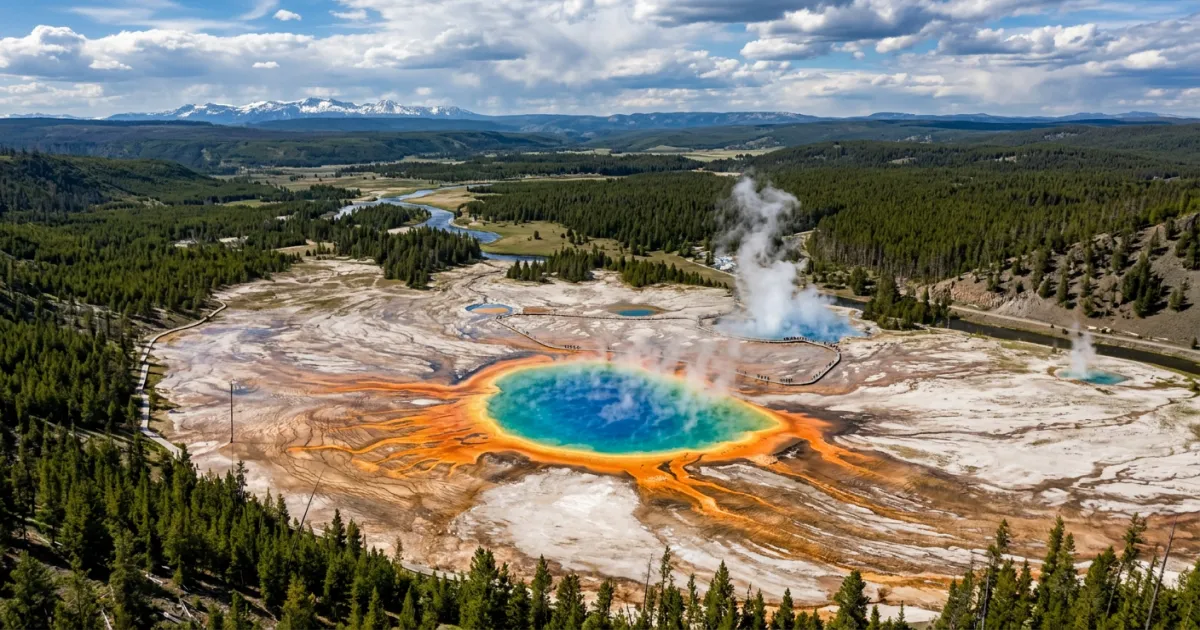
Yellowstone National Park spans nearly 3,500 square miles across Wyoming, Montana, and Idaho. It was the world’s first national park, established in 1872, and it remains one of the most visited parks in the United States with roughly 4.5 million visitors each year. From erupting geysers to roaming bison herds, planning a trip here takes some preparation. This guide covers everything you need to know for 2026, including fees, timing, lodging, and a day-by-day itinerary.
Quick Facts
| Detail | Info |
|---|---|
| Location | Wyoming, Montana, and Idaho |
| Park Size | 2.2 million acres (3,472 square miles) |
| Entrance Fee (2026) | $35 per vehicle (7-day pass) |
| Best Time to Visit | Mid-June through mid-September |
| Ideal Trip Length | 5 to 7 days |
| Nearest Major Airports | Bozeman (BZN), Jackson Hole (JAC) |
| Elevation Range | 5,300 to 11,358 feet |
For help organizing your trip details, try our general trip planning guide or use the Yopki AI Travel Planner to build a custom itinerary.
Best Time to Visit Yellowstone
Your experience at Yellowstone changes dramatically depending on the season. The park is open year-round, but road access and weather vary significantly.
Peak Season: Mid-June to Mid-September
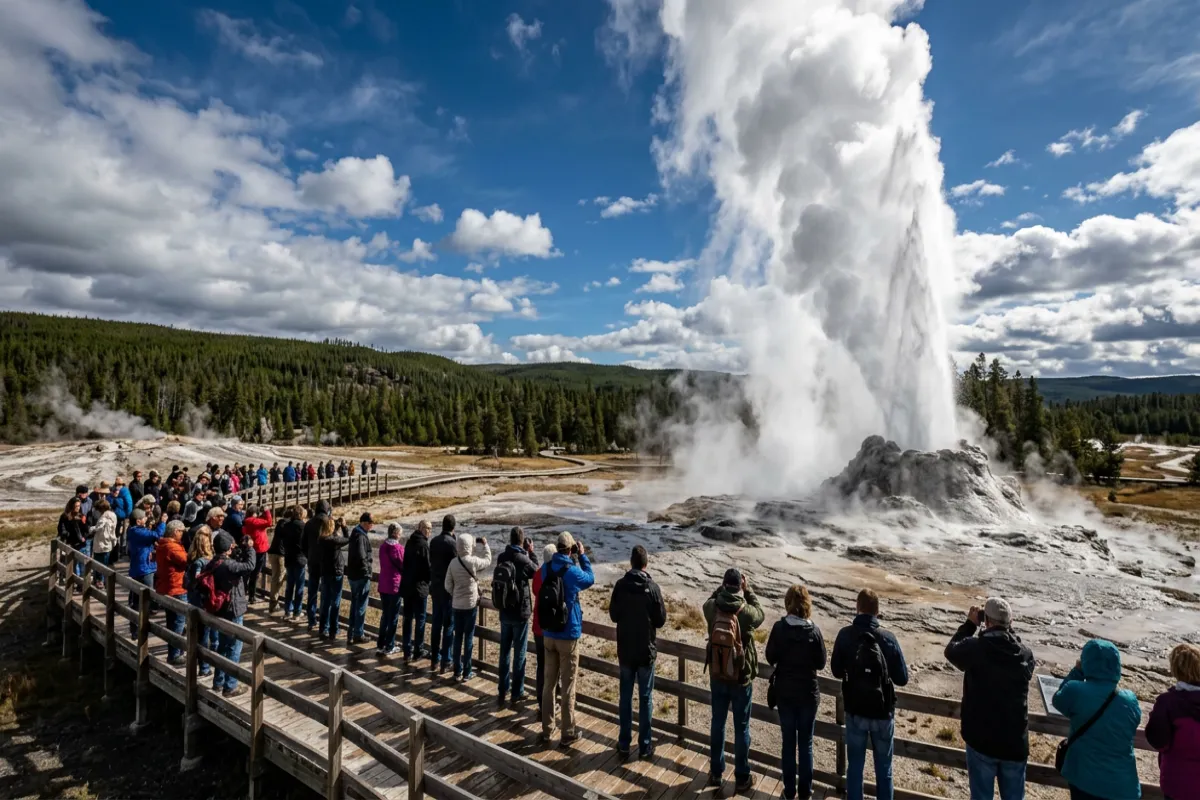
All park roads are open, all lodges and campgrounds operate, and daytime temperatures range from 60 to 80 degrees Fahrenheit. This is when you get the full Yellowstone experience. The trade-off is crowds. Expect packed parking lots at popular trailheads, long waits at Old Faithful, and fully booked lodging. Arrive at major attractions before 9 AM to beat the rush.
Shoulder Season: May and Late September to October
Shoulder months offer mild weather, thinner crowds, and lower lodging prices. However, some roads close due to snow. The road between Mammoth Hot Springs and Tower-Roosevelt typically stays open, but higher-elevation sections like Dunraven Pass close in October. In May, many roads reopen gradually throughout the month. September brings elk bugling season, when bull elk compete for mates with dramatic calls echoing through the valleys.
Winter: November to April
Most park roads close to regular vehicles from early November through mid-April. The road between Gardiner and Mammoth Hot Springs and on to Cooke City stays open year-round. Winter visitors access the interior by snowcoach or guided snowmobile tours. You will see the geysers and hot springs in a completely different light, surrounded by snow and ice, with virtually no crowds. Temperatures regularly drop below zero.
How Long to Spend in Yellowstone
Minimum: 3 days. Three days gives you enough time to see Old Faithful, Grand Prismatic Spring, the Grand Canyon of the Yellowstone, and Lamar Valley. You will feel rushed, but you can hit the highlights.
Ideal: 5 to 7 days. A full week lets you drive both the Upper and Lower Grand Loop Roads, spend time watching wildlife at dawn and dusk, hike a few trails, and visit less-crowded spots like Norris Geyser Basin and Yellowstone Lake. You also build in buffer time for weather delays or spontaneous detours.
Extended: Add 2 days for Grand Teton. Grand Teton National Park sits just 10 miles south of Yellowstone’s South Entrance. Adding two days lets you explore Jenny Lake, hike Cascade Canyon, and drive the stunning Teton Park Road with the jagged peaks as a backdrop.
Yellowstone Trip Budget
Entrance Fees
- Private vehicle (7-day pass): $35
- Motorcycle (7-day pass): $30
- Individual on foot or bicycle: $20
- Annual Yellowstone Pass: $70
- America the Beautiful Annual Pass: $80 (covers all national parks)
- Non-US residents (new in 2026): Additional $100 per person fee for visitors aged 16 and older, unless admitted with an Annual or America the Beautiful Pass
Lodging Costs
- In-park lodges: $194 to $500+ per night. Old Faithful Inn starts around $194 for a basic room without a private bathroom. Premium rooms and suites run over $1,000 during peak season.
- In-park campgrounds: $20 to $45 per night depending on the campground. Roosevelt Lodge campground starts at $20. Canyon and Grant Village campgrounds run around $39.
- Fishing Bridge RV Park: $89 to $99 per night.
- Gateway town hotels: $100 to $300 per night. West Yellowstone and Gardiner offer the most options. Expect higher prices in July and August.
Daily Budget Ranges
- Budget ($75 to $120 per person/day): Camp in the park, cook your own food, and drive your own vehicle.
- Mid-range ($150 to $250 per person/day): Stay in gateway town hotels or budget in-park cabins, eat at park restaurants for some meals.
- Premium ($300+ per person/day): Stay at Old Faithful Inn or Lake Yellowstone Hotel, eat at sit-down restaurants, and book guided tours.
Track your spending with our travel budget template.
Getting to Yellowstone
By Air
The two most practical airports are:
- Bozeman Yellowstone International (BZN): 90 miles from the North Entrance near Gardiner. About a 2-hour drive. This is the largest airport in the region with the most flight options and typically the cheapest fares. It operates year-round.
- Jackson Hole Airport (JAC): 72 miles from Yellowstone’s South Entrance. About a 90-minute drive. Ideal if you plan to visit both Yellowstone and Grand Teton.
- Yellowstone Airport (WYS): Just 3 miles from the West Entrance in West Yellowstone, Montana. Seasonal service only (June through September) with very limited flights.
By Car
Yellowstone has five vehicle entrances. The most popular are the West Entrance (via West Yellowstone, MT) and the North Entrance (via Gardiner, MT). Driving distances from major cities:
- Salt Lake City: approximately 320 miles (5 hours)
- Denver: approximately 560 miles (8 to 9 hours)
- Seattle: approximately 800 miles (11 to 12 hours)
Important: There is no public transportation within Yellowstone. You need your own vehicle or a rental car to get around the park. Gas stations exist inside the park at Canyon, Fishing Bridge, Grant Village, Mammoth, Old Faithful, and Tower Junction, but prices are higher than outside the park. Fill up before you enter.
Planning a broader road trip? Use our road trip itinerary template to map out your route.
Where to Stay
Inside the Park: Lodges
Yellowstone has nine lodges and cabin villages operated by Yellowstone National Park Lodges (managed by Xanterra). Reservations open 13 months in advance, and popular properties sell out quickly.
- Old Faithful Inn: The most iconic lodge in the park. A National Historic Landmark built in 1903-1904, with a massive log-and-stone lobby. Rooms range from basic (shared bathroom) to premium suites. Open May through October.
- Canyon Lodge and Cabins: The most centrally located lodge in the park. Modern rooms with easy access to the Grand Canyon of the Yellowstone and Hayden Valley. A practical base for exploring multiple areas.
- Lake Yellowstone Hotel: A colonial-style hotel on the shores of Yellowstone Lake. The oldest operating hotel in the park, dating to 1891.
- Mammoth Hot Springs Hotel: Located near the North Entrance at the park’s lowest elevation. Open in both summer and winter seasons.
Inside the Park: Camping
Yellowstone has 12 campgrounds with over 2,000 sites. Five accept reservations through recreation.gov (Bridge Bay, Canyon, Grant Village, Madison, and Fishing Bridge RV Park). The remaining campgrounds operate on a first-come, first-served basis. Reservations open on a rolling basis, exactly 6 months before your arrival date.
Senior Pass and Access Pass holders receive a 50% discount at Bridge Bay, Canyon, Grant, and Madison campgrounds.
Gateway Towns
- West Yellowstone, MT: The most popular gateway town. Located at the West Entrance with the widest selection of hotels, restaurants, and shops. Just a 15-minute drive into the park.
- Gardiner, MT: Sits at the North Entrance, the only entrance open year-round to regular vehicles. A small, laid-back town with solid lodging options.
- Cody, WY: Located 52 miles from the East Entrance. Home to the Buffalo Bill Center of the West. The drive into the park through the Wapiti Valley is one of the most scenic approaches.
- Jackson, WY: A larger town 57 miles south of the park’s South Entrance, with easy access to Grand Teton National Park. More dining, nightlife, and shopping options than other gateway towns.
Must-See Attractions
Old Faithful
The world’s most famous geyser erupts roughly every 90 minutes, shooting water 130 to 180 feet into the air. Check the predicted eruption time at the Old Faithful Visitor Education Center when you arrive. The Upper Geyser Basin surrounding Old Faithful contains the largest concentration of geysers on Earth. Walk the boardwalk trail to see Grand Geyser, Riverside Geyser, Morning Glory Pool, and dozens of other thermal features.
Grand Prismatic Spring
The largest hot spring in the United States, measuring 370 feet in diameter. Its vivid bands of blue, green, yellow, orange, and red are caused by heat-loving microorganisms called thermophiles. For the classic aerial-style view, hike the Grand Prismatic Overlook Trail (1.6 miles round trip) from the Fairy Falls trailhead.
Grand Canyon of the Yellowstone
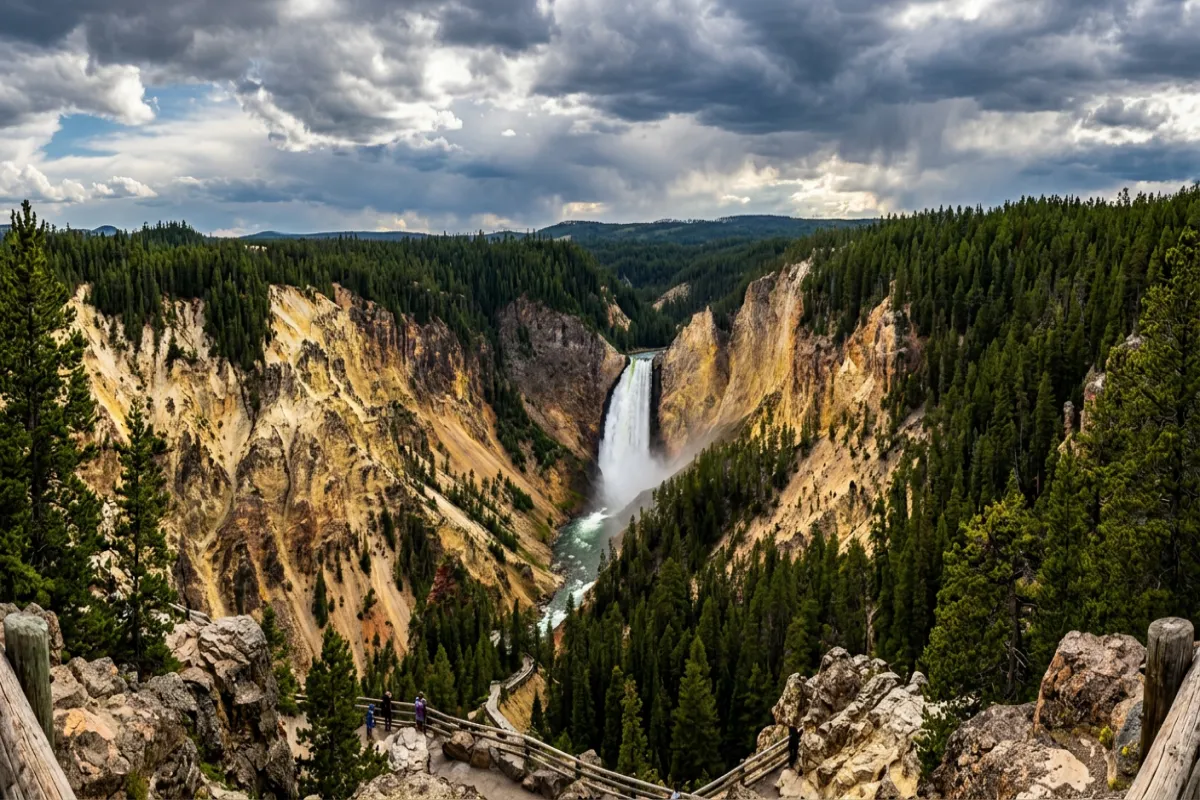
This 20-mile-long canyon features the spectacular Lower Falls, which drops 308 feet (nearly twice the height of Niagara Falls). Walk the South Rim Trail to Uncle Tom’s Trail for a close-up view of the falls, or visit Artist Point for the classic panoramic view. The North Rim Trail offers Lookout Point and Brink of the Lower Falls, where you descend a steep trail to the edge of the waterfall.
Mammoth Hot Springs
Terraced formations of travertine limestone created by hot water rising through limestone deposits. The terraces constantly change as mineral-laden water flows over them. The Upper and Lower Terraces have boardwalk trails. Nearby, you can often spot elk grazing on the lawns around Mammoth Hot Springs Hotel.
Lamar Valley
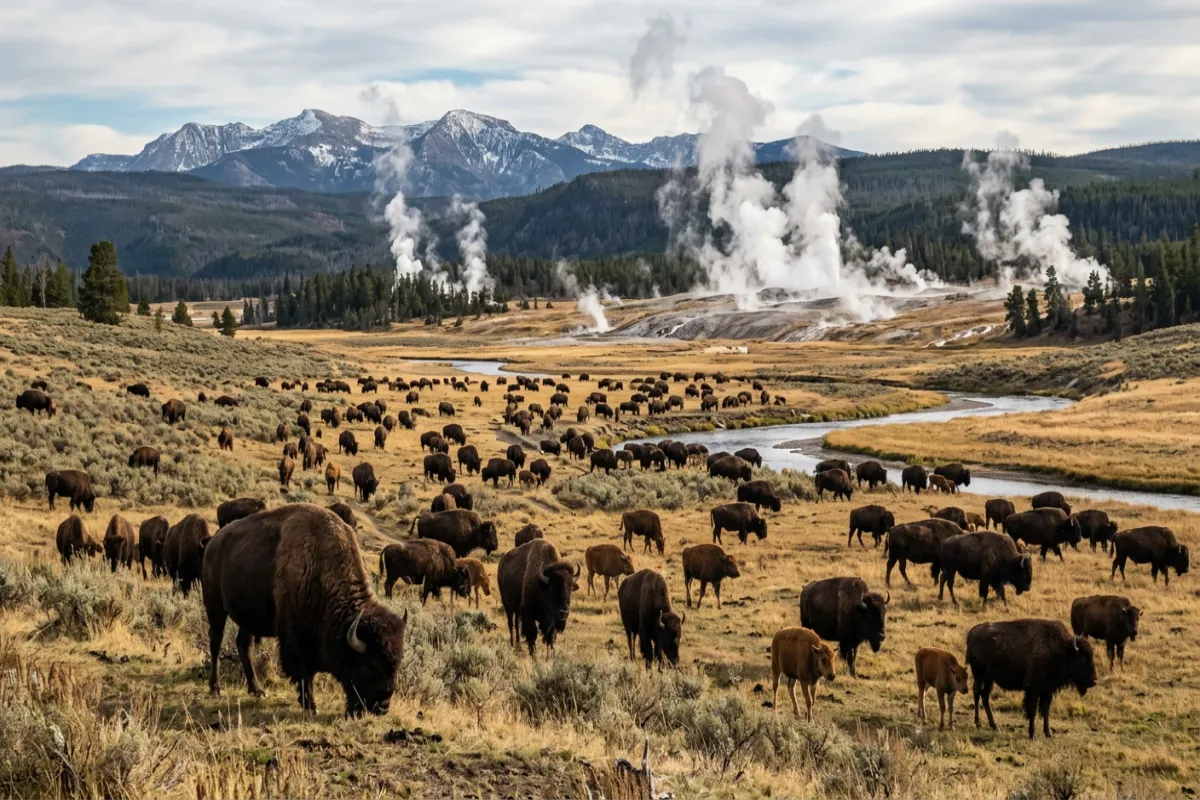
Known as the “Serengeti of North America,” Lamar Valley is the best place in the park for wildlife viewing. Bison herds, wolves, bears, elk, pronghorn, and coyotes are all regularly spotted here. Arrive at dawn or dusk for the best chances. Bring binoculars or a spotting scope.
Norris Geyser Basin
The hottest and most dynamic thermal area in the park. Home to Steamboat Geyser, the world’s tallest active geyser (eruptions reach 300 feet, though they are unpredictable). The Porcelain Basin boardwalk loop offers views of dozens of steaming vents, springs, and geysers in an open, barren landscape.
Yellowstone Lake
The largest high-elevation lake in North America, sitting at 7,733 feet. It covers 136 square miles. You can boat, fish (with a park permit), or kayak here. The shoreline near West Thumb Geyser Basin has thermal features that bubble right at the lake’s edge.
Wildlife Watching and Safety
Yellowstone is home to the largest concentration of mammals in the lower 48 states: bison, elk, grizzly bears, black bears, wolves, moose, bighorn sheep, and pronghorn, among others.
Where to See Wildlife
- Lamar Valley: Wolves, bison, bears, pronghorn. Best at dawn and dusk.
- Hayden Valley: Bison herds, grizzly bears, coyotes, pelicans along the Yellowstone River.
- Mammoth Hot Springs area: Elk are frequently seen right in the village.
- Tower-Roosevelt area: Black bears are often spotted along the road.
Safety Distances
These are federal regulations, not suggestions:
- Stay at least 25 yards (75 feet) from bison, elk, and all other large animals.
- Stay at least 100 yards (300 feet) from bears and wolves.
Never approach, feed, or follow wildlife. Bison injure more visitors in Yellowstone than any other animal. They can run up to 35 mph and are unpredictable. If an animal changes its behavior because of your presence, you are too close.
Bear Safety
Carry bear spray in a holster on your hip (not in your backpack) whenever you hike. Bear spray is available for purchase and rent at park stores and gateway towns. Make noise on the trail to avoid surprising bears. Store all food in bear-proof containers or your vehicle’s trunk. Never leave food or coolers unattended.
Practical Tips for Your Visit
- Altitude: Much of Yellowstone sits above 7,000 feet. If you are coming from sea level, you may feel the effects: shortness of breath, headaches, or fatigue. Drink plenty of water and take it easy on your first day.
- Cell service: Limited to nonexistent in most of the park. Download offline maps before you arrive. The NPS Yellowstone app works offline and includes geyser predictions.
- Boardwalks at thermal features: Stay on the boardwalks and designated trails at all thermal areas. The ground around geysers and hot springs is thin and can collapse. Water temperatures exceed 200 degrees Fahrenheit. People have died from falling into thermal features.
- Binoculars: Bring them. Wildlife viewing is significantly better with optics, and the safety distances mean you will be watching from a distance.
- Gas: Fill up before entering the park. In-park gas stations exist but charge premium prices and can have long lines during peak season.
- Groceries: Park general stores carry basic supplies at high markups. Stock up in gateway towns before entering.
- Traffic: Wildlife jams (“bison jams”) are common, especially in Hayden and Lamar Valleys. Budget extra driving time. The Grand Loop Road is roughly 142 miles and takes about 5 hours to drive without stops.
- Weather layers: Even in July, mornings can be in the 30s and afternoons in the 80s. Bring layers, rain gear, and a warm jacket regardless of season.
Grand Teton Extension
Grand Teton National Park is located immediately south of Yellowstone, connected by the John D. Rockefeller Jr. Memorial Parkway. Your Yellowstone entrance pass covers Grand Teton as well (both are included in the $35 vehicle fee).
Add 2 days to your trip. Here is what to prioritize:
- Jenny Lake: Take the boat shuttle across the lake and hike to Hidden Falls and Inspiration Point. The round trip with the boat ride takes about 2 to 3 hours.
- Teton Park Road: This scenic drive runs along the base of the Teton Range with several turnouts offering jaw-dropping mountain views. The Cathedral Group Turnout is a must-stop.
- Mormon Row Historic District: Iconic barns framed by the Tetons. One of the most photographed spots in the national park system.
- Signal Mountain Summit Road: A short drive to panoramic views of the Tetons, Jackson Lake, and the valley below.
For more ideas on combining parks into a larger European-style multi-stop trip, see our guide to planning a trip to Europe for a framework you can adapt to any multi-destination journey.
Sample 5-Day Yellowstone Itinerary
Day 1: Arrive and Mammoth Hot Springs
Fly into Bozeman and drive to Gardiner (2 hours). Enter through the North Entrance. Explore Mammoth Hot Springs in the afternoon: walk both the Upper and Lower Terraces. Watch for elk around the village. If time allows, drive to the Boiling River area (when open) for a soak where hot spring water meets the Gardner River. Stay in Gardiner or Mammoth campground.
Day 2: Lamar Valley and Tower-Roosevelt
Wake before dawn and drive to Lamar Valley for sunrise wildlife watching. Bring binoculars and a thermos of coffee. Look for bison, wolves, and bears. After the morning session, visit Tower Fall (132-foot waterfall). Drive south through Dunraven Pass to Canyon Village. Check into Canyon Lodge or Canyon campground.
Day 3: Grand Canyon of the Yellowstone and Norris
Start early at the Grand Canyon of the Yellowstone. Walk the South Rim to Artist Point and Uncle Tom’s Trail. Cross to the North Rim for Lookout Point and Brink of the Lower Falls. In the afternoon, drive west to Norris Geyser Basin. Walk both the Porcelain Basin and Back Basin loops. Return to Canyon Village for the night.
Day 4: Old Faithful and Geyser Basins
Drive south through Hayden Valley (watch for bison and grizzlies) to Old Faithful. Time your arrival for a predicted eruption. After Old Faithful, walk the Upper Geyser Basin boardwalk to see Grand Geyser, Morning Glory Pool, and Riverside Geyser. Drive north to Midway Geyser Basin for Grand Prismatic Spring. Hike the Grand Prismatic Overlook Trail for the aerial view. Stay at Old Faithful Inn or drive to West Yellowstone for the night.
Day 5: Yellowstone Lake and Departure
Drive to West Thumb Geyser Basin on the shore of Yellowstone Lake. Walk the boardwalk to see thermal features at the lake’s edge. Continue along the lake to Fishing Bridge and Lake Village. If you have time, stop at Mud Volcano for bubbling mud pots and sulfuric vents. Exit through the East Entrance toward Cody, or loop back north to Bozeman for your flight.
Planning Tools
Make your Yellowstone trip planning easier with these resources:
- Yopki AI Travel Planner: Build a custom day-by-day itinerary for Yellowstone and beyond.
- Road Trip Itinerary Template: Map out driving routes, stops, and timing.
- Travel Budget Template: Track lodging, food, gas, and activity costs.
- How to Plan a Trip (General Guide): Step-by-step planning framework for any destination.
Frequently Asked Questions
Do I need a reservation to enter Yellowstone in 2026?
No. Vehicle reservations are not required to enter Yellowstone. You can purchase your entrance pass at the gate or online in advance through recreation.gov.
Is Yellowstone safe for families with kids?
Yes, with precautions. Stay on boardwalks at thermal areas, maintain wildlife distances, and supervise children closely near any thermal feature or cliff edge. The Junior Ranger program (available at visitor centers) is an excellent way to keep kids engaged.
Can I see wolves in Yellowstone?
Yes. Lamar Valley is the best spot. Arrive before sunrise and bring a spotting scope or binoculars. Wolves are most active at dawn and dusk. Local wolf-watching guides can significantly increase your chances.
When do lodging reservations open?
In-park lodge reservations open 13 months in advance through Yellowstone National Park Lodges (yellowstonenationalparklodges.com). Campground reservations at the five reservable campgrounds open 6 months before your arrival date on recreation.gov.
What if I only have one day?
Focus on the Lower Grand Loop: Old Faithful, Grand Prismatic Spring, and the Grand Canyon of the Yellowstone. Start at Old Faithful at dawn, then drive to Grand Prismatic, and finish at Canyon Village for the falls. It will be a long day, but you will see the three most iconic features.
Is there a connection to Denver?
Denver is about 560 miles from Yellowstone (8 to 9 hours by car). If you are flying through Denver and have a long layover, check out our Denver airport layover guide for tips on making the most of your time.
Last updated: April 2026. Fees and dates are subject to change. Always verify current information on the official NPS Yellowstone website before your visit.