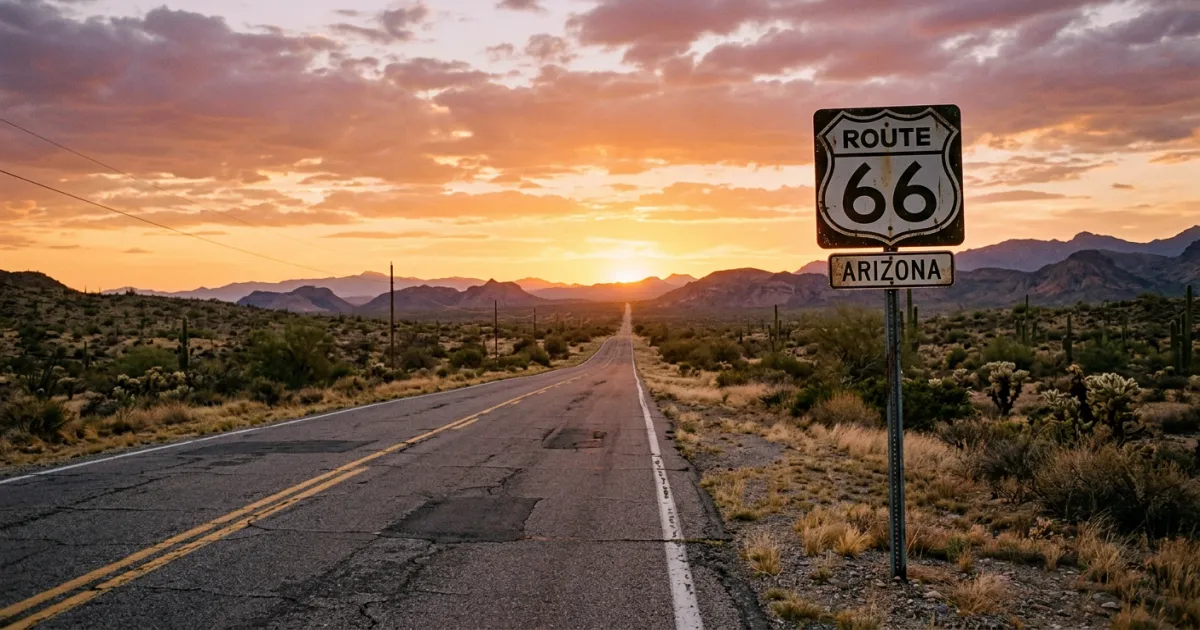
Route 66 is more than a highway. It is a 2,400-mile ribbon of asphalt, neon, and nostalgia stretching from Chicago to Santa Monica. Commissioned in 1926 and officially decommissioned in 1985, the Mother Road remains one of the most iconic drives on Earth. Most of the original alignment is still drivable today, and 2026 marks the route’s 100th anniversary, making this the perfect year to hit the road.
Whether you have one week or three, this guide covers everything you need to plan your Route 66 road trip: direction of travel, budget, state-by-state highlights, where to stay, what to eat, and a sample 14-day itinerary you can adapt to your schedule.
Quick Overview
Route 66 runs approximately 2,400 miles from the corner of Michigan Avenue and Adams Street in downtown Chicago to the Santa Monica Pier in California. The route passes through eight states: Illinois, Missouri, Kansas, Oklahoma, Texas, New Mexico, Arizona, and California. While the highway was removed from the U.S. Highway System in 1985 after the Interstate system replaced it, the vast majority of the original road still exists. Some sections run alongside or overlap with Interstate 40, while others require deliberate detours onto the original alignment.
Route 66 by the Numbers
- Total distance: approximately 2,400 miles (the exact mileage varied over the decades as the route was realigned)
- States crossed: 8 (Illinois, Missouri, Kansas, Oklahoma, Texas, New Mexico, Arizona, California)
- Ideal trip length: 2 to 3 weeks
- Minimum trip length: 7 days if you are willing to rush
- Time zones crossed: 3 (Central, Mountain, Pacific)
- Year commissioned: 1926
- Year decommissioned: 1985
- Centennial year: 2026
Planning Your Direction: East to West or West to East?
The traditional direction is westbound, starting in Chicago and ending in Santa Monica. This follows the path of the original migration routes and the direction John Steinbeck described in The Grapes of Wrath. Starting in Chicago means you begin in the green farmland of Illinois and gradually transition through plains, desert, and mountains before reaching the Pacific Ocean. The sense of arrival at the Santa Monica Pier is hard to beat.
Driving eastbound from Los Angeles to Chicago is also popular. You get the desert and mountain scenery early while you are fresh, and the route numbering on road signs reads more naturally. Some travelers prefer ending in a major city like Chicago where there is plenty to do after the trip.
There is no wrong direction. Most first-timers go westbound for the classic experience, but pick whichever start point is more convenient for your flights or home location.
How Long Do You Need?
The answer depends on your pace and how many stops you want to make.
- 7 days (rushed): You will average 350+ miles per day with limited stops. You will hit the major landmarks but miss many smaller attractions. Best for travelers who have driven long distances before and are comfortable with full days behind the wheel.
- 14 days (comfortable): This is the sweet spot for most travelers. You will average about 170 miles per day, leaving time for two or three stops, a meal at a classic diner, and the occasional detour. You can see most of the highlights without feeling rushed.
- 21 days (thorough): With three weeks, you can explore side trips like the Grand Canyon, Santa Fe, or Carlsbad Caverns. You will have time to linger in towns that interest you and take the scenic backroads.
- 28 days (complete): Some travelers take a full month. This pace lets you spend extra days in cities like Albuquerque, Tulsa, or Flagstaff and really soak in the culture of each state.
If you are unsure, plan for 14 days. You can always extend if your schedule allows. Need help organizing your trip? Our road trip planning guide walks you through the process step by step.
Best Time to Drive Route 66
The best months for a Route 66 road trip are April through June and September through October.
Spring (April to June): Temperatures are mild across most of the route. Wildflowers bloom in Texas and New Mexico. Tourist crowds are smaller than summer, and most attractions are open. Late spring is ideal because the desert is not yet brutally hot.
Fall (September to October): Temperatures cool down after the summer heat. Fall colors appear in Missouri and parts of Illinois. The light is beautiful for photography, and crowds thin out after Labor Day.
Summer (July to August): This is peak tourist season and the most popular time to drive Route 66. However, temperatures in the Texas panhandle, New Mexico, and Arizona desert can exceed 110 degrees Fahrenheit. If you drive in summer, plan to do your desert driving in the early morning or evening.
Winter (November to March): Some attractions close for the season. Snow and ice are possible in northern sections through Illinois and Missouri. The desert is cooler but pleasant during the day. Winter is the least popular time, so you will have the road mostly to yourself.
Route 66 Budget Breakdown
Route 66 can be done on a range of budgets. Here is what to expect for a 14-day trip for one person driving their own car:
- Gas: $400 to $600 depending on your vehicle’s fuel efficiency and current gas prices. The route is approximately 2,400 miles, but detours and exploring add mileage.
- Accommodation: $60 to $120 per night for motels. Budget travelers can find rooms starting around $50 in smaller towns. Camping is available at numerous spots along the route for $15 to $35 per night.
- Food: $30 to $50 per day eating at diners and local restaurants. You can reduce this by packing snacks and making some meals yourself.
- Attractions: $10 to $25 per attraction. Many roadside stops are free, but museums, caverns, and parks charge admission. Budget $150 to $300 total for entrance fees.
- Total estimate: $2,000 to $4,000 for a 14-day trip. Couples sharing a car and room can bring the per-person cost down significantly.
Track your spending with our travel budget template to stay on target.
State-by-State Highlights
Illinois: Where It All Begins
Route 66 starts at the corner of Michigan Avenue and Adams Street in downtown Chicago. The Illinois stretch runs about 300 miles through small towns and farmland. Key stops include the Gemini Giant muffler man in Wilmington, the Route 66 Hall of Fame and Museum in Pontiac, and the Cozy Dog Drive In in Springfield (birthplace of the corn dog on a stick). Do not miss the Abraham Lincoln Presidential Library in Springfield if you have time. Planning a longer stay? Check our Chicago trip planning guide.
Missouri: Caves and the Gateway Arch
Missouri offers about 300 miles of Route 66, starting in St. Louis where you can visit the Gateway Arch. From there, the route winds through the Ozarks. Highlights include Meramec Caverns (a massive cave system that was once used as a hideout by Jesse James, or so the legend goes), the neon-lit strip in Springfield, and the charming town of Carthage. Missouri has some of the best-preserved stretches of original Route 66 pavement.
Kansas: The Shortest Stretch
Route 66 barely clips the southeast corner of Kansas, covering just 13.2 miles. It is the shortest state stretch on the entire route. Still, the tiny towns of Galena, Riverton, and Baxter Springs have character. Stop at Cars on the Route in Galena, an old gas station that inspired the town of Radiator Springs in the Pixar movie Cars.
Oklahoma: Roadside Americana
Oklahoma has the longest drivable stretch of original Route 66, covering about 400 miles. The Blue Whale of Catoosa is one of the most photographed roadside attractions on the entire route. Tulsa has a revitalized Route 66 corridor with classic neon signs. Other highlights include the Round Barn in Arcadia, Pops 66 Soda Ranch (a modern gas station with a giant soda bottle out front), and the Oklahoma Route 66 Museum in Clinton.
Texas: The Panhandle
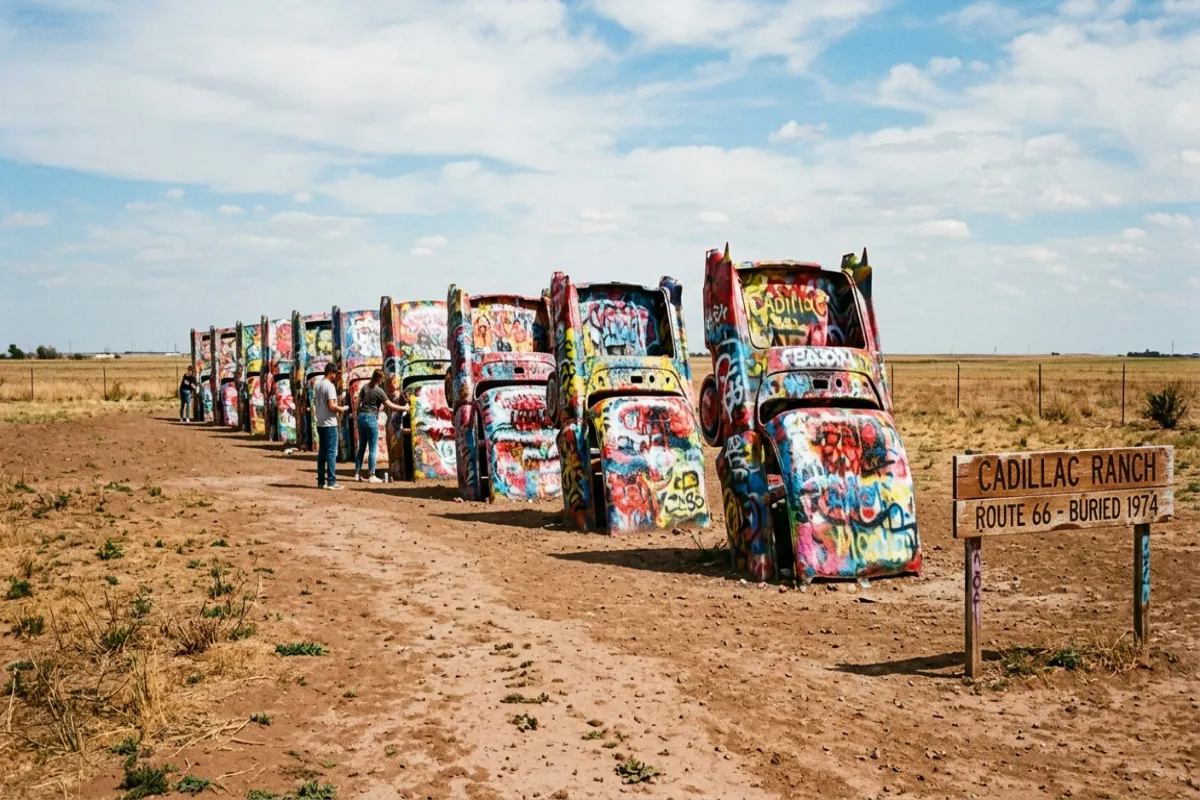
The Texas stretch runs about 180 miles through the flat panhandle. Cadillac Ranch outside Amarillo is unmissable: ten Cadillacs buried nose-first in a field, covered in spray paint. Visitors are encouraged to add their own layer. In Amarillo, the Big Texan Steak Ranch has offered a free 72-ounce steak dinner to anyone who can eat it in one hour since 1960. The Midpoint Cafe in Adrian marks the halfway point of Route 66.
New Mexico: Land of Enchantment
New Mexico offers roughly 500 miles of Route 66 and some of the most dramatic scenery on the trip. Albuquerque’s Old Town dates back to 1706 and is a wonderful place to explore on foot. Santa Fe is a short detour north and absolutely worth the side trip for its adobe architecture, art galleries, and food scene. Tucumcari has more neon signs per capita than almost anywhere on the route. The Blue Hole in Santa Rosa is a crystal-clear natural swimming hole that stays 62 degrees year-round.
Arizona: Desert Grandeur
Arizona’s stretch of Route 66 runs about 400 miles and includes some of the most stunning landscapes on the entire drive. The Petrified Forest National Park lets you walk among 225-million-year-old fossilized trees. Meteor Crater is a privately owned impact site nearly a mile across and 550 feet deep. The town of Oatman is famous for its wild burros (donkeys) that roam the streets, descendants of animals used by miners. Seligman is considered the birthplace of the Route 66 preservation movement, thanks to barber Angel Delgadillo who campaigned to save the highway. And the Grand Canyon is just a 60-mile detour north from Williams. Check our Grand Canyon trip planning guide for that side trip.
California: The Final Stretch
California’s portion covers roughly 300 miles, starting with a crossing of the Mojave Desert. The desert stretch between Needles and Barstow can feel remote, but the scenery is stark and beautiful. Victorville and San Bernardino mark the transition into the Los Angeles metro area. The route ends at the Santa Monica Pier, where a “Route 66 End of the Trail” sign marks the finish line. Stand at the end of the pier, look out at the Pacific, and know you just drove one of the most famous roads in the world. Thinking about a detour to Las Vegas? It is only about 4 hours from the Route 66 corridor. See our Las Vegas trip planning guide.
Navigation Tips: Staying on Route 66
Here is the most important thing to know about driving Route 66: your GPS will not always follow the historic route. Navigation apps default to the fastest path, which is usually the Interstate. You will need to take matters into your own hands.
- Buy the EZ66 Guide: Written by Jerry McClanahan, this turn-by-turn guide is considered the bible of Route 66 navigation. It provides detailed directions for following the original alignment through every state. Most Route 66 travelers consider it essential.
- Look for the signs: Brown “Historic Route 66” signs mark much of the route, but they are not always consistent. Some states are better about signage than others.
- Expect Interstate overlap: In some areas, the original Route 66 has been paved over by Interstate 40 or other highways. You will drive on the Interstate for short stretches before exiting back onto the historic road.
- Download offline maps: Cell service is spotty or nonexistent in parts of New Mexico, Arizona, and the Mojave Desert. Download offline maps before you leave.
- Plan for detours: Some sections of original Route 66 are in poor condition or on private property. The EZ66 Guide notes these areas and suggests alternatives.
Where to Stay: Classic Motels and Beyond
Staying in classic Route 66 motels is part of the experience. These independently owned motor courts are a window into mid-century America, and your dollars help keep them alive. Here are some of the most iconic options:
- Wigwam Motel (Holbrook, Arizona): Sleep in a concrete teepee. Built in 1950, this quirky motel is one of the most photographed lodgings on Route 66.
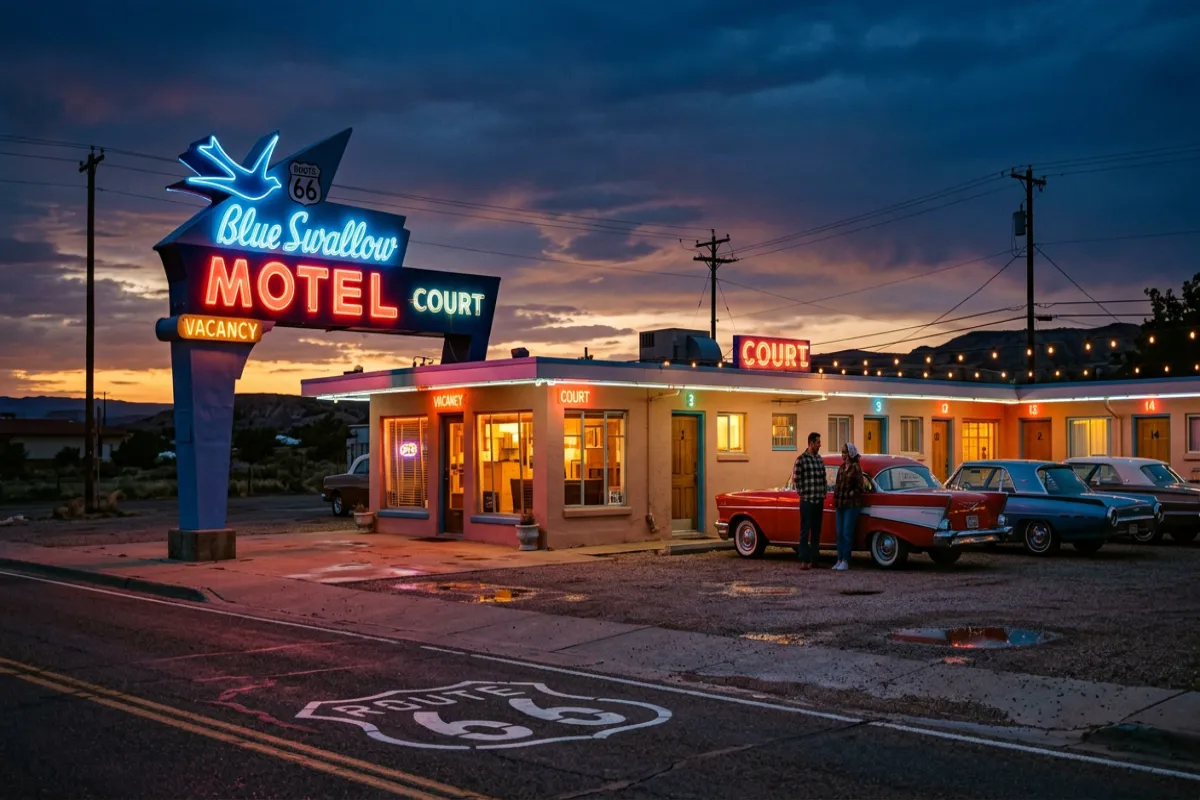
- Blue Swallow Motel (Tucumcari, New Mexico): A beautifully preserved 1939 motor court with neon signage that glows against the desert sky.
- El Rancho Hotel (Gallup, New Mexico): Hollywood stars including John Wayne, Katharine Hepburn, and Ronald Reagan stayed here during Western film shoots. Each room is named after a movie star.
- Munger Moss Motel (Lebanon, Missouri): Family-owned since 1946 with a classic neon sign that is a photographer’s dream.
- Campbell Hotel (Tulsa, Oklahoma): A boutique hotel in a 1927 building right on the Route 66 corridor.
Modern chain hotels are available in every city along the route if you prefer predictability. Camping is another option, with KOA campgrounds and state parks scattered along the highway. Budget travelers can alternate between motels and campgrounds to manage costs.
Food on Route 66: Diners, Drive-Ins, and Local Flavor
Eating at roadside diners is as much a part of Route 66 as the road itself. Here are restaurants worth building your schedule around:
- Cozy Dog Drive In (Springfield, Illinois): Home of the original “cozy dog” (corn dog on a stick) since 1949. A must-stop in the Land of Lincoln.
- Big Texan Steak Ranch (Amarillo, Texas): Famous for the 72-ounce steak challenge. Even if you do not attempt it, the atmosphere and regular-sized steaks are worth the visit.
- Midpoint Cafe (Adrian, Texas): Located at the exact midpoint of Route 66. Known for their “ugly crust” pies.
- Roadkill Cafe (Seligman, Arizona): The name is tongue-in-cheek, but the burgers are solid and the walls are covered in Route 66 memorabilia.
- El Tovar Dining Room (Grand Canyon): If you take the Grand Canyon detour, treat yourself to a meal at this historic lodge restaurant perched on the canyon rim.
As a general rule, skip the fast-food chains and eat at the locally owned spots. The food is better, the stories are better, and you are supporting the small-town economies that keep Route 66 alive.
Practical Tips for a Smooth Trip
- Vehicle reliability matters: Route 66 passes through remote areas where the nearest mechanic may be an hour away. Make sure your car is in good shape before you leave. Get an oil change, check your tires (including the spare), and top off all fluids.
- Gas up when you can: In rural stretches of New Mexico, Arizona, and the Mojave, gas stations can be 50 to 100 miles apart. Do not let your tank drop below a quarter.
- Carry water: In summer, always have at least a gallon of water per person in the car. Desert breakdowns happen, and dehydration is a real risk.
- Cell service is unreliable: Large portions of the route have weak or no cell signal. Download maps, music, and podcasts before you go. Consider carrying a paper road atlas.
- Some towns are ghost towns: Not every dot on the map has services. Some Route 66 towns are partially or fully abandoned. This is part of the experience, but do not count on finding gas, food, or lodging in every small town.
- Side trips are worth it: The Grand Canyon (detour from Williams, AZ), Santa Fe (detour from I-25 in NM), Carlsbad Caverns (detour from southern NM), and Las Vegas (detour from Kingman, AZ) are all reachable from the Route 66 corridor.
- Carry cash: Some smaller attractions, diners, and motels are cash-only or have unreliable card readers.
- Start early each day: The best light for photography and the coolest temperatures for desert driving are both in the morning.
For more general trip planning advice, our trip planning guide covers the fundamentals.
Sample 14-Day Route 66 Itinerary
This itinerary covers the full route at a comfortable pace, averaging about 170 miles per day with time for stops. Adjust based on your interests and energy level.
Day 1: Chicago, IL to Pontiac, IL (100 miles)
Start at the Route 66 Begin sign on Adams Street. Drive through Joliet and Wilmington (Gemini Giant). End in Pontiac at the Route 66 Museum.
Day 2: Pontiac, IL to Springfield, IL (120 miles)
Explore Bloomington-Normal and stop at historic diners along the way. Visit the Abraham Lincoln sites and Cozy Dog Drive In in Springfield.
Day 3: Springfield, IL to St. Louis, MO (100 miles)
Cross into Missouri. Spend the afternoon at the Gateway Arch and explore downtown St. Louis.
Day 4: St. Louis, MO to Springfield, MO (220 miles)
Visit Meramec Caverns. Drive through the Ozark foothills. Explore Springfield’s Route 66 landmarks.
Day 5: Springfield, MO to Tulsa, OK (190 miles)
Cross the Kansas 13-mile stretch. Stop at Cars on the Route in Galena. See the Blue Whale of Catoosa before arriving in Tulsa.
Day 6: Tulsa, OK to Oklahoma City, OK (110 miles)
Visit the Round Barn in Arcadia. Stop at Pops 66 Soda Ranch. Explore the Oklahoma City Route 66 corridor.
Day 7: Oklahoma City, OK to Amarillo, TX (260 miles)
Drive through western Oklahoma. Cross into the Texas panhandle. Visit Cadillac Ranch and eat at the Big Texan Steak Ranch.
Day 8: Amarillo, TX to Santa Fe, NM (290 miles)
Stop at the Midpoint Cafe in Adrian. Cross into New Mexico. Detour north to Santa Fe for the evening (worth it for the food and culture).
Day 9: Santa Fe, NM to Albuquerque, NM (65 miles)
Take a short drive south to Albuquerque. Explore Old Town, the Indian Pueblo Cultural Center, and the neon-lit Central Avenue (Route 66 through the city).
Day 10: Albuquerque, NM to Gallup, NM (140 miles)
Drive through the New Mexico landscape. Stop at Acoma Pueblo (Sky City) if open to visitors. Stay at the El Rancho Hotel in Gallup.
Day 11: Gallup, NM to Grand Canyon, AZ (250 miles)
Enter Arizona. Visit the Petrified Forest National Park. Detour north from Williams to the Grand Canyon South Rim.
Day 12: Grand Canyon to Kingman, AZ (180 miles)
Spend the morning at the Grand Canyon. Drive south to Seligman (birthplace of Route 66 preservation). Continue to Kingman.
Day 13: Kingman, AZ to Barstow, CA (200 miles)
Drive through Oatman and see the wild burros. Cross the Mojave Desert into California. Stop at the Mojave National Preserve if time allows.
Day 14: Barstow, CA to Santa Monica, CA (150 miles)
The final stretch through Victorville and San Bernardino into the Los Angeles metro. End at the Santa Monica Pier at the “End of the Trail” sign. You did it.
Want help building a custom version of this itinerary? Try our AI travel planner or grab our road trip itinerary template to organize your daily schedule.
Planning Tools and Resources
- EZ66 Guide by Jerry McClanahan: The essential turn-by-turn navigation guide. Available online and at bookstores.
- Route66RoadTrip.com: Comprehensive free resource with maps, attraction listings, and community forums.
- National Park Service Route 66 Corridor: The NPS maintains a Route 66 preservation program with historical context and resources.
- Yopki AI Travel Planner: Build a custom itinerary based on your dates, interests, and pace.
- Road Trip Itinerary Template: Download our template to map out your daily stops and driving times.
Frequently Asked Questions
Can you still drive Route 66?
Yes. While Route 66 was officially decommissioned in 1985, approximately 85% of the original alignment is still drivable. Some sections have been incorporated into the Interstate system, but most of the historic road exists and is maintained.
Is Route 66 safe to drive?
Route 66 is generally safe. The main risks are related to remote driving: limited cell service, long distances between gas stations, and extreme heat in summer. A reliable vehicle, plenty of water, and basic preparedness eliminate most concerns.
What is the best car for Route 66?
Any reliable car with good fuel economy works well. You do not need a 4WD or truck. The route is entirely paved, though some sections of original alignment may have rough pavement. A comfortable sedan or SUV with good air conditioning is ideal.
Can you drive Route 66 in an RV?
Yes, but some sections of original Route 66 have narrow roads and tight turns that are challenging for large RVs. Stick to the main alignments and you will be fine. RV parks and campgrounds are available throughout the route.
How much does a Route 66 road trip cost?
Budget $2,000 to $4,000 per person for a 14-day trip covering gas, motels, food, and attractions. Couples sharing expenses can lower the per-person cost. Camping and cooking some meals yourself can bring costs down further.
When is Route 66’s 100th anniversary?
Route 66 was commissioned on November 11, 1926, making 2026 the centennial year. Special events and celebrations are planned throughout the year in communities along the route.