
A destination wedding isn’t just a ceremony — it’s a multi-day event where guests travel somewhere unfamiliar, attend several gatherings, and need more logistical hand-holding than a local wedding. The couple (or the wedding planner) needs to communicate a clear schedule so guests know where to be, when, and what to wear.
This free destination wedding itinerary template is designed to share with guests. It covers the full wedding weekend (or week): arrival logistics, welcome events, ceremony details, reception info, post-wedding activities, and local recommendations for free time. It’s also useful as the couple’s master planning document — then trimmed into a guest-facing version.
What’s in This Template
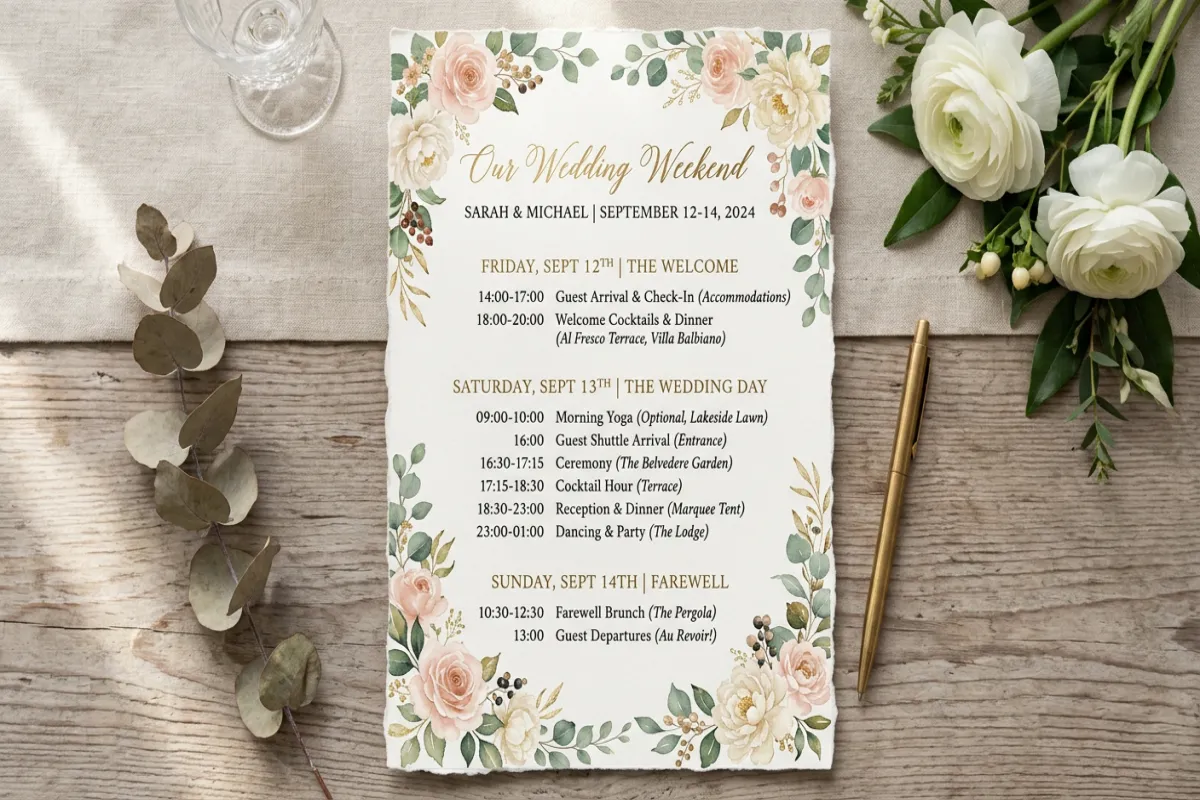
1. Welcome & Overview
A warm greeting with the essentials: couple’s names, wedding date, venue name and location, the full schedule of events at a glance (Thursday arrival through Sunday departure, for example), and a point-of-contact name and phone number for guest questions. This is the page guests read first — it sets the tone and tells them everything they need for initial planning.
2. Travel & Arrival Information
How to get there: nearest airport, recommended airlines or flights, airport-to-venue transportation (shuttle schedule, taxi estimate, rental car suggestions), and driving directions if applicable. Check-in time for the hotel or resort, room block details (group name, booking code, rate, deadline), and parking information. For international weddings, add visa requirements and passport reminders.
3. Accommodation Details
Hotel or resort information: property name, address, phone, website, room block code, nightly rate, included amenities (breakfast, pool, gym, spa), check-in and check-out times, and early arrival or late checkout options. If guests have multiple lodging options (resort vs. nearby hotels vs. Airbnb), list each with pros, cons, and distance to the venue.
4. Event Schedule
The heart of the template. Each event on its own entry: date, time, event name (welcome dinner, rehearsal dinner, ceremony, cocktail hour, reception, farewell brunch), location with address, dress code, transportation provided (yes/no, shuttle times), and notes (open bar, dietary accommodations, rain backup plan). Events marked as “all guests” vs. “wedding party only” to avoid confusion.
5. Ceremony & Reception Details
Expanded information for the main event: ceremony start time (with “please be seated by” time), venue address, parking or shuttle drop-off point, seating arrangement notes, ceremony length estimate, cocktail hour location and time, reception venue (if different), reception timeline (dinner, toasts, first dance, cake, open dancing), and end time. Enough detail that no guest asks “wait, where do we go after the ceremony?”
6. Dress Code Guide
Specific guidance for each event: welcome dinner (smart casual), ceremony (formal or semi-formal), reception (same as ceremony), farewell brunch (casual), and any theme elements (all white, beach formal, black tie). For outdoor or beach weddings, add practical notes: heel height on sand, sun protection, temperature expectations for evening events.
7. Local Recommendations
Guests will have free time — especially if the wedding is in a destination worth exploring. This section covers: restaurants (categorized by price and cuisine), activities and attractions, beaches or outdoor spots, nightlife, shopping areas, and transportation tips (how to get around, ride-share availability, taxi apps). Include a handful of recommendations, not an exhaustive list. Guests want curated suggestions, not a guidebook.
8. Practical Information
Weather expectations and what to pack, local currency and tipping customs, phone service and Wi-Fi availability, nearest pharmacy and hospital, time zone, and any cultural etiquette notes for international destinations. A small section that prevents a lot of guest questions.
Plan Your Trip Today!
Get a complete, personalized trip template in seconds.
Take full control to customize every detail. Or, skip the template and build your itinerary with AI
Plan My TripHow to Use It
- Start with the master version. Fill in every section with all details — including internal notes for the wedding party. This becomes your planning document.
- Create the guest version. Duplicate the document and remove any internal-only information (vendor contacts, payment details, behind-the-scenes logistics). The guest version should be polished and easy to read.
- Send it early. Share the guest itinerary 4-6 weeks before the wedding, ideally alongside or shortly after formal invitations. Guests need time to book flights and accommodations, especially if there’s a room block deadline.
- Include it in a welcome bag. Print copies for welcome bags or hotel room deliveries so guests have a physical reference when they arrive. Use the Yopki Travel Document Organizer to merge the itinerary with venue maps, travel confirmations, and local guides into one polished packet for each guest.
- Update as needed. If you’re sharing via Google Docs, guests always see the latest version. For printed versions, note the “last updated” date so guests know if their copy is current.
destination wedding travel guide Tips
Set the room block deadline clearly. The room block discount usually expires 30-60 days before the wedding. Put this deadline in bold in the Accommodation section and mention it in the Welcome section too. Guests who miss it pay full rate and may not get a room at the wedding hotel. For a deeper dive, check out our trip planning guide
Arrange group transportation for key events. Don’t assume guests will figure out how to get from the hotel to the ceremony venue. If the venue isn’t walking distance, organize a shuttle and include the schedule in the itinerary. This eliminates “we got lost” and “our taxi didn’t show up” problems.
Be specific about dress codes. “Cocktail attire” means different things to different people. Add a one-sentence description: “cocktail attire — think a nice sundress or slacks with a blazer, no jeans.” For beach ceremonies, mention that stilettos won’t work on sand.
Related Templates
- This Destination Wedding Itinerary — multi-day event schedule for wedding guests with travel logistics and local info. Best for any wedding where guests are traveling.
- Bachelorette Itinerary — group trip planning with shared budget and activity scheduling. Best for the pre-wedding celebration trip.
- Travel Planner — comprehensive personal trip planner. Best for guests who want to extend their stay and plan additional travel around the wedding.
- Vacation Itinerary — simple day-by-day schedule. Best for the honeymoon trip after the wedding.
FAQ
How do you create a wedding timeline?
Start with your ceremony date and time as the anchor, then work backward and forward. Add the rehearsal dinner (usually the night before), welcome event (the evening before that for destination weddings), and farewell brunch (the morning after). Fill in times for hair and makeup, photography, cocktail hour, reception milestones (first dance, toasts, cake), and send-off. For destination weddings, also include arrival day logistics and guest transportation between events. This template structures the full multi-day timeline so guests and the wedding party know exactly where to be and when.
Should I send this to all guests or just the wedding party?
Send a version to all guests. The wedding party may get an expanded version with additional details (rehearsal timing, photo session schedule, morning-of logistics), but every guest needs the event schedule, travel information, and accommodation details. Guests who don’t receive clear logistics information will ask you individually — multiplied by 50+ guests, that’s a lot of texts during wedding week.
When should I send the itinerary?
Send it 4-6 weeks before the wedding. This gives guests time to book flights, reserve hotel rooms before the block expires, plan outfits for each event, and request time off work if needed. For international destinations requiring visas, send it 2-3 months before.
How detailed should the local recommendations section be?
Include 5-8 restaurant recommendations across price ranges, 3-5 activities or attractions, and any practical transportation tips. Guests want curated suggestions from someone who knows the area — not a copy of TripAdvisor. If you’ve visited the destination, share your personal favorites.