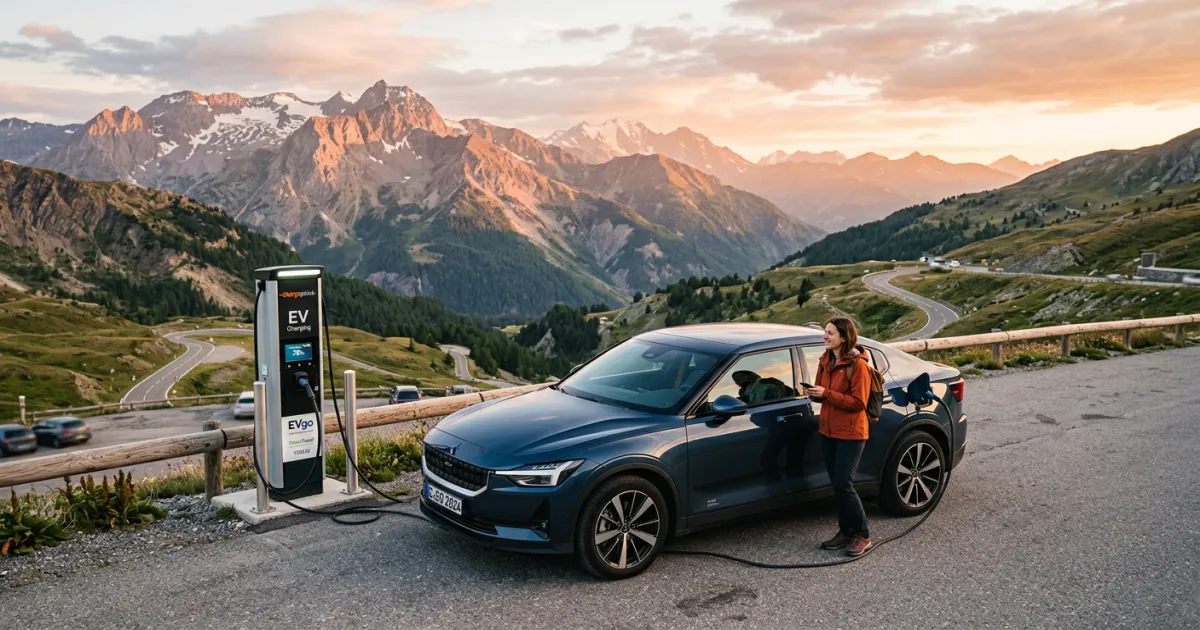
Quick Overview: EV Road Trips Are Now Practical
Electric vehicle road trips have gone from novelty to normal. As of early 2026, the United States has more than 241,000 public charging ports across 78,000+ stations, with over 70,000 of those being DC fast chargers. The charging network grew by 24% in just the last year alone, and nearly every major automaker now supports the NACS (North American Charging Standard) connector, giving non-Tesla EVs access to Tesla’s massive Supercharger network.
The bottom line: if you own an EV built in the last few years, you can road trip across the country with confidence. The planning process is different from a gas car, but the tools and infrastructure have caught up. This guide walks you through everything you need to know to plan your first (or next) EV road trip in 2026.
Already know you want to plan a trip? Start with our general trip planning guide for the big-picture steps, then come back here for EV-specific details.
Planning Your Route
Route planning is the single most important difference between an EV road trip and a gas-powered one. With a gas car, you can pull off at almost any exit and fill up in five minutes. With an EV, you need to think ahead about where you will charge, how long each stop will take, and how your battery level will look between stops.
Use an EV-Specific Route Planner
Do not rely on standard mapping apps alone. EV-specific route planners account for your vehicle model, battery size, current charge level, elevation changes along the route, weather conditions, and driving speed. They calculate exactly where you should stop and for how long.
The gold standard is A Better Route Planner (ABRP). It supports over 700 EV models and uses real-time data including wind, temperature, and elevation to predict your energy consumption with impressive accuracy. Tesla vehicles have excellent built-in navigation that automatically routes through Supercharger stops, but even Tesla owners often cross-reference with ABRP for longer trips.
Plan Charging Stops Every 150 to 250 Miles
Most modern EVs have a real-world highway range between 200 and 300 miles. You should plan charging stops before you hit empty. A good rule: plan a stop every 150 to 250 miles depending on your vehicle’s range, keeping a buffer of at least 15 to 20% battery when you arrive at each charger.
Factor In Elevation Changes
Driving through mountains can dramatically affect your range. Climbing a steep grade at highway speed can cut your range by 30% or more compared to flat terrain. The flip side: descending a long grade will regenerate energy and extend your range. ABRP handles elevation modeling automatically, which is one reason it is so valuable for mountain routes.
If you are planning a road trip itinerary from scratch, our road trip itinerary template can help you organize your stops and timing.
Understanding EV Charging Levels
Not all chargers are created equal. Understanding the three levels of EV charging will save you time and frustration on the road.
Level 1 Charging (120V Household Outlet)
This is the standard wall outlet in your home. It adds roughly 3 to 5 miles of range per hour. Level 1 is essentially useless for road tripping but fine for overnight top-ups if you are staying somewhere for multiple days.
Level 2 Charging (240V)
Level 2 chargers use a 240-volt connection (like a dryer outlet) and add about 20 to 30 miles of range per hour. Many hotels, restaurants, and destinations now have Level 2 chargers. These are ideal for overnight hotel charging or topping up during a long dinner stop.
Level 3 / DC Fast Charging (DCFC)
DC fast chargers are the backbone of EV road tripping. They can charge most EVs from 20% to 80% in 20 to 40 minutes, depending on the vehicle and charger power output. The fastest 800-volt EVs like the Hyundai Ioniq 5 can add 100 miles of range in under 6 minutes.
Charging Costs
DC fast charging typically costs $0.36 to $0.48 per kWh at public stations, which works out to roughly $10 to $20 per fast charge session (20% to 80%). That translates to about $0.09 to $0.14 per mile. For comparison, charging at home costs the equivalent of $5 to $7 for the same amount of range. Some hotels and destinations offer free Level 2 charging, which can significantly reduce your trip costs.
Tesla Supercharger Network Is Now Open
This is one of the biggest developments in EV road tripping. More than two-thirds of Tesla Superchargers in North America are now open to non-Tesla EVs. Nearly every major automaker has adopted the NACS connector standard, including Ford, Rivian, GM, Hyundai, Kia, BMW, Mercedes-Benz, Volkswagen, and many more. New 2025 and 2026 model year EVs from these brands are shipping with built-in NACS ports, eliminating the need for adapters entirely.
This effectively doubles the fast-charging options available to non-Tesla drivers and makes the Supercharger network’s 17,000+ locations available to nearly everyone.
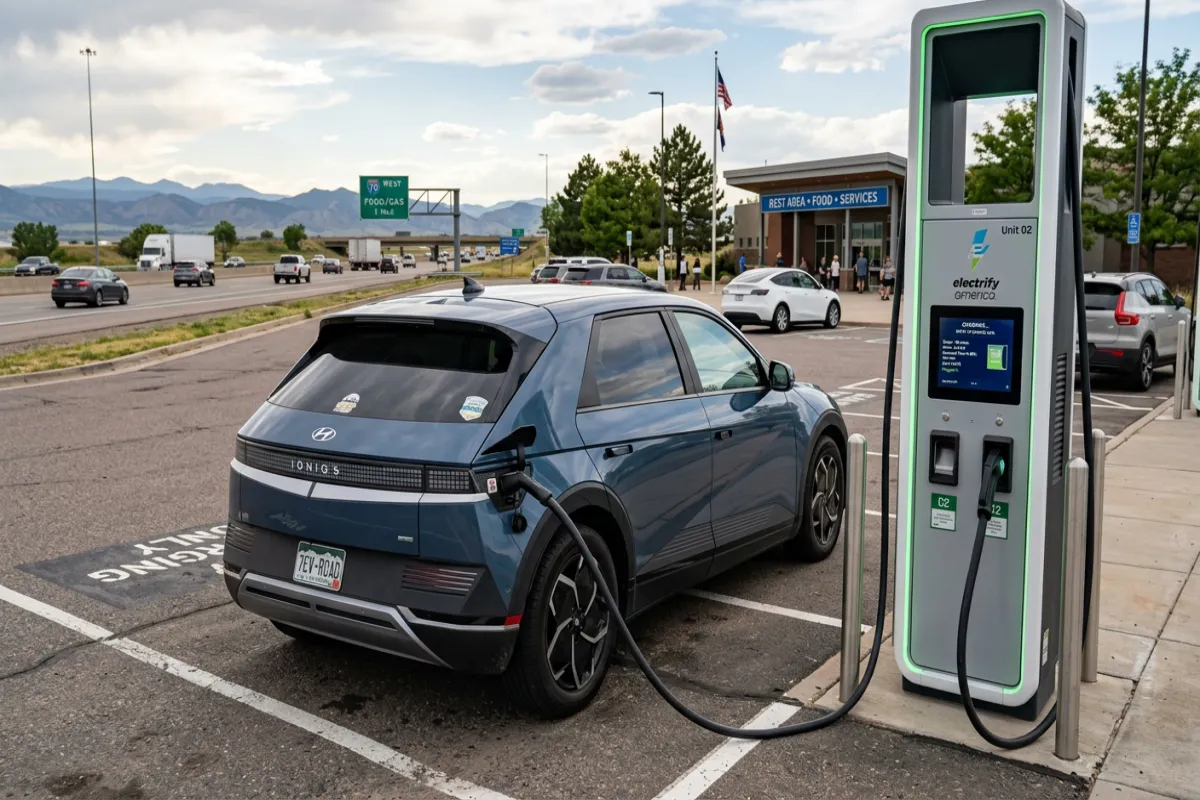
Best EV Road Trip Planning Apps
You will want at least two apps on your phone before hitting the road. Here are the essential ones:
A Better Route Planner (ABRP)
The most sophisticated EV route planner available. ABRP models your specific vehicle, accounts for weather and elevation, shows real-time charger availability, and optimizes your stops for minimum total travel time. Free with a premium tier for live vehicle data integration. Available on iOS, Android, and web.
PlugShare
Think of PlugShare as the Yelp of EV charging. It lists over 800,000 charging stations worldwide across all networks and its real strength is community-driven reviews. Drivers leave check-ins, photos, and status updates so you know whether a charger actually works right now, not just whether it exists on a map. This is invaluable for backup planning.
ChargePoint
ChargePoint operates one of the largest charging networks in North America. Their app shows station availability in real time, lets you start and pay for charging sessions, and tracks your charging history. Essential if you will be using ChargePoint stations.
Google Maps
Google Maps now shows EV charger locations, connector types, and real-time availability for many networks. It is not as detailed as ABRP for route optimization, but it is useful for quick searches when you need a charger nearby.
Network-Specific Apps
Download the apps for the charging networks along your route: Tesla (for Supercharger access), Electrify America, EVgo, and any regional networks. Some require you to create an account and add payment before you can charge, so set these up before your trip.
For help organizing all your trip details in one place, try our AI travel planner to build a custom itinerary that accounts for your stops and timing.
Range Anxiety Management
Range anxiety is real, but it is almost entirely a planning problem. Once you understand how range works and have a plan, the anxiety fades quickly.
Real Range vs. EPA Range
The EPA range number on your vehicle’s window sticker is based on a mix of city and highway driving in moderate weather. On a highway road trip, expect 15 to 30% less range than the EPA number. A car rated at 300 miles EPA might deliver 210 to 255 miles at sustained highway speeds.
What Affects Range
Speed: Highway speeds drain the battery faster than city driving. Going 80 mph vs. 65 mph can reduce range by 15 to 20%.
Weather: Cold weather is the biggest range killer. Temperatures below freezing can reduce range by 20 to 30% due to battery heating and cabin heating demands. Hot weather has a smaller but real effect from air conditioning.
Elevation: Climbing hills uses more energy. Descending regenerates some back, but not all of it.
Wind: Strong headwinds can noticeably reduce range, while tailwinds help.
Cargo and passengers: A fully loaded vehicle with passengers and luggage will see reduced range compared to driving solo.
The 20% Buffer Rule
Always plan to arrive at your next charging stop with at least 15 to 20% battery remaining. This gives you a cushion for unexpected detours, closed chargers, or worse-than-expected conditions. Non-Tesla charger reliability has improved to about 85.5% uptime, meaning roughly 1 in 7 chargers may have an issue at any given time. Having a buffer and a backup charger location keeps you stress-free.
Charging Etiquette
As more people hit the road in EVs, following basic charging etiquette keeps things running smoothly for everyone.
- Move your car when charging is complete. Do not leave your vehicle plugged in and parked at a charger after it finishes. Other drivers may be waiting. Some stations charge idle fees after your session ends.
- Do not unplug other vehicles. Never disconnect someone else’s vehicle from a charger, even if it looks fully charged. Their car may still be actively charging or conditioning the battery.
- Charge to 80%, not 100%. At busy stations, charging to 80% and moving on is both faster for you (charging slows dramatically above 80%) and more courteous to others waiting.
- Have a backup plan for broken chargers. If you arrive at a station and the chargers are down, do not panic. Check PlugShare or your backup app for the next nearest option. This is why the 20% buffer matters.
- Be patient and friendly. The EV community is generally helpful. If you are having trouble with a charger, ask nearby EV drivers for tips. Many have been in your shoes.
Best EVs for Road Trips in 2026
Not all EVs are equally suited for long-distance driving. Here are the top picks for road tripping in 2026, based on range, charging speed, and charging network access.
Tesla Model Y and Model 3
The Tesla Model Y remains the best overall road trip EV thanks to its combination of up to 320 miles of range, access to the largest fast-charging network (17,000+ Supercharger locations), and excellent built-in route planning. The Model 3 offers similar advantages in a smaller package. Tesla’s charging infrastructure advantage is still significant even as other networks grow.
Hyundai Ioniq 5 and Ioniq 6
Built on Hyundai’s 800-volt E-GMP platform, these are among the fastest-charging EVs on the road. The Ioniq 5 can charge from 10% to 80% in about 20 minutes and adds 100 miles of range in under 6 minutes. The 2025 and 2026 models come with native NACS ports for Tesla Supercharger access. The Ioniq 5 has won Kelley Blue Book’s Best EV award for three consecutive years.
Kia EV9
For families, the Kia EV9 is the standout. It is a three-row SUV with the same 800-volt fast charging as the Ioniq 5, charging from 10% to 80% in under 25 minutes. Generous cargo space and comfortable seating make it ideal for long family road trips.
Ford Mustang Mach-E
The Mach-E offers solid range (up to 312 miles on select trims), access to Tesla Superchargers via NACS, and Ford’s BlueOval Charge Network integration. It is a practical and fun-to-drive option for road tripping.
Rivian R1T and R1S
If your road trips take you off the beaten path, Rivian’s adventure-focused truck (R1T) and SUV (R1S) are purpose-built for it. With available ranges exceeding 300 miles and Rivian’s own Adventure Network of fast chargers at trailheads and national park gateways, these are the go-to EVs for outdoor enthusiasts.
Mercedes EQS
For luxury road tripping, the Mercedes EQS offers one of the longest ranges of any EV at over 350 miles, combined with a supremely comfortable cabin. If long-distance comfort is your priority, the EQS is hard to beat.
Lucid Air
The range king. Some Lucid Air trims exceed 400 miles of EPA-rated range, the highest of any production EV. If minimizing charging stops is your goal, the Lucid Air covers the most ground between plugs.

Cost Comparison: EV vs. Gas Road Trip
One of the most common questions about EV road trips is cost. Here is how it breaks down.
Fuel Cost Per Mile
A typical EV uses about 30 kWh per 100 miles on the highway. At public DC fast charging rates of $0.36 to $0.48 per kWh, that works out to $0.11 to $0.14 per mile. A gas car getting 30 mpg at $3.50 per gallon costs about $0.12 per mile. The costs are roughly comparable when using public fast chargers, but EVs win decisively when you can charge at home ($0.04 to $0.06 per mile) or at free hotel/destination chargers.
Sample 1,000-Mile Road Trip
| Cost Category | EV (Fast Charging) | Gas Car (30 mpg) |
|---|---|---|
| Fuel/Charging | $110 to $140 | $117 (at $3.50/gal) |
| With hotel overnight charging | $70 to $100 | $117 |
| Maintenance (prorated) | Lower (no oil changes) | Higher |
Free Charging Opportunities
Many hotels, shopping centers, national parks, and restaurants now offer free Level 2 charging. Planning your overnight stops at hotels with free charging can cut your trip charging costs by 30 to 50%. Apps like PlugShare let you filter specifically for free charging locations.
For a full breakdown of trip budgeting, check out our travel budget template to track all your expenses in one place.
Tips for EV Road Tripping
These practical tips come from experienced EV road trippers and will make your trip smoother.
Charge While You Eat and Explore
The best EV road trip strategy is to align charging stops with meals and sightseeing. A 20 to 30 minute fast charge is the perfect length for a quick lunch or coffee break. Instead of viewing charging as wasted time, use it as built-in rest stops that make your trip more enjoyable.
Plan for 30-Minute Charging Stops
Budget 25 to 35 minutes per fast charging stop in your trip timeline. This accounts for plugging in, waiting for the charge, and getting back on the road. On a typical 500-mile day, expect two to three charging stops adding roughly 60 to 90 minutes to your drive time compared to a gas car.
Download Offline Maps
Cell coverage can be spotty in rural areas, especially in the western United States. Download offline maps for your route in Google Maps or your preferred navigation app before you leave. Also save your planned charging stops as favorites so you can find them without data.
Carry the Right Adapters
Even with NACS becoming the standard, carry a CCS-to-NACS or NACS-to-CCS adapter (depending on your vehicle) as a backup. Some older charging stations still use CCS1 connectors. Tesla owners should carry a NACS-to-CCS adapter for non-Tesla DC fast chargers that have not been updated.
Check Charger Availability the Night Before
Before each driving day, review your planned charging stops in PlugShare and ABRP. Check recent user reviews and status reports. If a charger shows issues, adjust your route while you still have the flexibility to do so.
Charge Overnight at Hotels
Whenever possible, book hotels with Level 2 or destination charging. Waking up with a full battery means your first driving stint of the day requires no charging stop, and hotel charging is often free or very cheap. Filter for EV-friendly hotels on booking platforms or use PlugShare to find hotels with chargers.
Use the 10% to 80% Strategy
Charging from 10% to 80% is the sweet spot for time efficiency. Below 10%, your car may limit power for battery protection. Above 80%, charging speed drops dramatically as the battery management system slows the charge rate to protect battery health. Multiple quick charges are almost always faster than fewer long charges to 100%.
Monitor Your Energy Consumption
Most EVs display real-time energy consumption (measured in kWh per 100 miles or miles per kWh). Keep an eye on this, especially in challenging conditions like mountains, high winds, or cold weather. If your consumption is higher than expected, adjust your next charging stop accordingly.
Sample EV Road Trip Planning Checklist
Use this checklist before any EV road trip to make sure you are fully prepared.
One Week Before
- Plan your route in ABRP with your specific vehicle model
- Identify primary and backup charging stations for each stop
- Download charging network apps (Tesla, Electrify America, ChargePoint, EVgo) and set up accounts with payment methods
- Book hotels with EV charging when possible
- Check your tire pressure (low tires reduce range)
The Day Before
- Charge your vehicle to 100% overnight at home
- Check weather forecasts along your route (cold or extreme heat affects range)
- Review charger status on PlugShare for your first few planned stops
- Download offline maps for your route
- Pack charging adapters and your home charging cable (J1772/NACS portable charger)
Day Of
- Pre-condition your battery before departure (most EVs have a scheduled departure feature that warms or cools the battery for optimal charging speed)
- Confirm your first charging stop is operational
- Set your navigation to your first waypoint
- Keep your EV’s energy display visible on the dashboard
For a more detailed road trip planning framework, see our complete guide to planning a road trip.
Free Download: EV Charging Planner Spreadsheet
An Excel spreadsheet to plan charging stops for your electric vehicle road trip. Track station locations, charging times, costs, and range between stops.
More free templates at yopki.com/templates
Planning Tools and Resources
- A Better Route Planner (ABRP) – The best overall EV route planner, free to use
- PlugShare – Community-driven charging station reviews and real-time status
- ChargePoint – Large charging network with real-time availability
- Electrify America – Fast-growing DC fast charging network
- Alternative Fuels Station Locator (DOE) – Government database of all public charging stations
- Yopki AI Travel Planner – Build a custom trip itinerary with your stops and timing
Frequently Asked Questions
How long does it take to road trip in an EV compared to a gas car?
For a typical 500-mile driving day, expect to add 60 to 90 minutes of charging time compared to a gas car. On a 1,000-mile trip, that means roughly 2 to 3 extra hours total. Many EV road trippers find this is offset by the fact that charging stops force you to take breaks you probably should be taking anyway.
Can I road trip in an EV in winter?
Yes, but plan for 20 to 30% reduced range in cold weather. Space your charging stops closer together, pre-condition your battery before departing, and use seat heaters instead of the cabin heater when possible (seat heaters use less energy). Many experienced EV owners road trip through winter regularly with proper planning.
What happens if a charger is broken when I arrive?
This is why the backup charger strategy matters. About 85.5% of non-Tesla chargers are operational at any given time. Always have a secondary charging station identified within 15 to 30 miles of your primary stop. If you kept your 20% buffer, you will have plenty of range to reach the backup.
Do I need a special membership to use public chargers?
Most public charging networks let you pay per session with a credit card or through their app. However, membership plans from networks like Electrify America and ChargePoint often offer lower per-kWh rates. If you road trip frequently, a membership can save you 15 to 30% on charging costs.
Can I tow a trailer with an EV on a road trip?
You can, but expect range to drop by 30 to 50% depending on the trailer size and weight. EVs like the Rivian R1T and Tesla Model X are capable towers, but you will need to plan charging stops much more frequently. ABRP lets you add a trailer to your vehicle profile for accurate range predictions.
Is it cheaper to road trip in an EV or a gas car?
Using only public DC fast charging, costs are roughly similar to gas. But if you can charge overnight at hotels (often free) or at home before departure, an EV road trip typically costs 30 to 50% less than the same trip in a gas car. The more you can avoid fast charging and use Level 2 or home charging, the more you save.
How do I find hotels with EV charging?
PlugShare lets you filter for chargers at hotels specifically. Many booking platforms now include EV charging as an amenity filter. Hotel chains like Hilton, Marriott, and Best Western have been adding Tesla Universal Wall Connectors and Level 2 chargers across their properties. Always confirm charger availability when booking.