
A single-destination trip is simple. You fly somewhere, stay there, fly home. But the moment you add a second or third city, planning gets exponentially harder. Which order should you visit them? Should you fly between cities or take the train? How many days does each stop need?
These are real problems, and getting them wrong costs you time and money. Visit cities in the wrong order and you waste an entire day backtracking. Book round-trip flights instead of open-jaw and you pay for an extra leg you did not need. Spend too little time in a city and the visit feels rushed. Spend too much and you run out of days for your other stops.
This guide covers everything you need to plan a multi-city trip that actually flows well, from route optimization and flight booking to time allocation and packing for varied climates.
Why Multi-City Trips Need a Different Approach
A multi-city trip is not just several mini-trips strung together. The connections between cities are where most of the complexity lives, and where most of the planning mistakes happen.
Consider a trip to Italy with stops in Rome, Florence, and Venice. Seems simple. But the order matters. Rome to Florence is 1.5 hours by train. Florence to Venice is 2 hours. But Rome to Venice is 3.5 hours. So the route Rome, Florence, Venice flows north in a straight line, while Rome, Venice, Florence has you doubling back south.
That is with just three cities in one country. Add stops across multiple countries, different transportation systems, and varied climates, and you need a system. Here is that system.
Step 1: List Your Destinations (Then Cut the List)
Start with a brain dump. Write down every city and town you want to visit. Do not filter yet. Just get it all on paper.
Now comes the hard part: cut the list. For every week of travel, plan for 2-3 major cities. A 2-week trip fits 3-5 stops comfortably. A 3-week trip can handle 5-7.
Classify each destination:
- Must-see: The whole point of the trip. These stay on the list no matter what.
- Strong want: You would be disappointed to skip these. Include if the routing works.
- Nice-to-have: Would love to visit, but can wait for another trip.
Be ruthless with the nice-to-haves. Every destination you add means less time at your must-sees. A trip where you spend 4 days in each of 3 incredible cities is far more satisfying than 2 days each in 6 cities where you barely scratch the surface.
How Many Days Per City?
Here is a general framework that works for most travelers:
| City Type | Recommended Days | Examples |
|---|---|---|
| World capitals with tons to see | 4-5 days | Paris, London, Tokyo, New York, Rome |
| Major cities with rich culture | 3-4 days | Barcelona, Amsterdam, Prague, Bangkok, Lisbon |
| Mid-size cities and cultural hubs | 2-3 days | Florence, Bruges, Kyoto, Dubrovnik, Salzburg |
| Small towns and day-trip stops | 1-2 days | Cinque Terre, Hallstatt, Rothenburg, Colmar |
| Transit/layover cities | 0.5-1 day | Hub airports with a long layover |
These are full days, not counting arrival and departure days. When you arrive in a new city after a morning train or flight, that is a half-day at best. Factor that into your math.
Step 2: Optimize Your Route
This is the step that separates a smooth multi-city trip from a chaotic one. The goal: visit your cities in the order that minimizes total travel time and avoids backtracking.
The Map Test
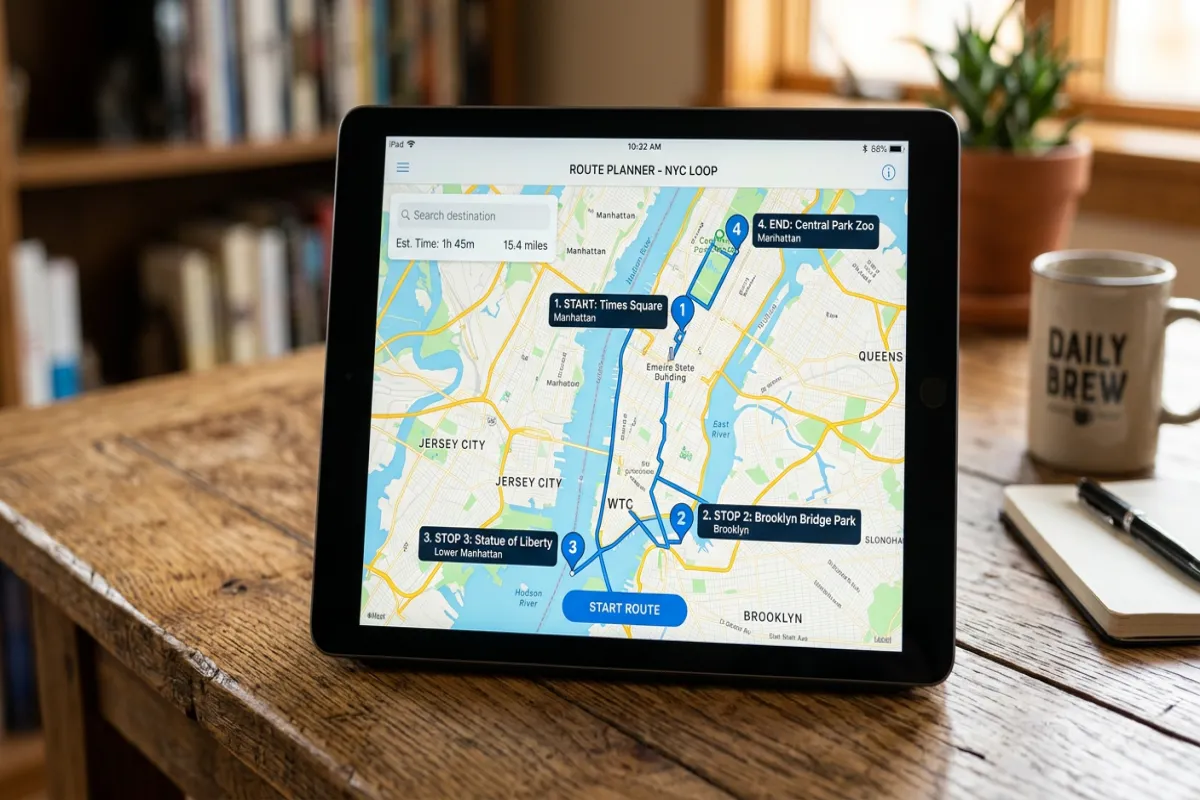
Open Google Maps (or better yet, Yopki’s visual map planner) and pin every city on your list. Look at the pins. Can you draw a line that connects them in a roughly logical path without crossing over itself? If yes, that is your route. If the pins are all over the map, you need to either cut some cities or accept longer transit days.
Common route patterns that work well:
- Linear: City A to B to C to D in a straight line. Works great for coast-to-coast or north-to-south routes.
- Loop: Start and end in the same city, hitting stops in a circle. Good when you need a round-trip flight.
- Hub and spoke: Base yourself in one central city and take day trips to surrounding towns. Good for regions with one major hub (like using Florence as a base for Tuscany).
- Figure eight: Two loops connected at a central city. Useful for longer trips covering two distinct regions.
Yopki’s Route Optimization
Here is where a dedicated multi-city trip planner saves you serious time. Yopki lets you add all your destinations, then its AI suggests the most efficient order based on geography, available transportation routes, and travel times.
You can see all your stops on an interactive map, drag them to rearrange the order, and instantly see how the total travel time changes. It also factors in which cities have direct train connections and which require transfers, so you are not stuck with a 7-hour journey that could have been 3 hours if you had swapped two stops.
For a trip with 4 or more stops, this visual approach is dramatically faster than manually checking routes on Google Maps. There are 12 possible orderings for 4 cities and 120 for 5 cities. You do not want to check all of those by hand.
The Open-Jaw Flight Strategy
If you are taking a linear route (which most multi-city trips should be), book open-jaw flights: fly into your first city and out of your last city.
Example: You are visiting London, Paris, and Barcelona. Instead of flying round-trip to London and then needing to get back from Barcelona to London for your return flight, book:
- Home to London (one-way)
- Barcelona to Home (one-way)
Or even better, search for this as a “multi-city” booking on Google Flights, which often prices it the same or cheaper than a round trip. You save the cost and time of a Barcelona-to-London flight on your last day.
Step 3: Book Your Flights
International Flights (Getting There and Back)
For your main international flights, use Google Flights multi-city search. Enter your departure city, first destination, last destination, and return city. The multi-city pricing is often surprisingly close to round-trip pricing, and sometimes even cheaper because each leg is priced independently.
Timing tips:
- Book international flights 2-3 months in advance for the best prices
- Set up price tracking on Google Flights for all your route options
- Be flexible with which city you fly into/out of. Flying into Amsterdam instead of Paris might save $200 if Amsterdam has more competition on your route.
Flights Between Cities
Not every leg of your multi-city trip should be a flight. But for distances over 4-5 hours by train, a budget flight is often faster and cheaper.
When to fly between cities:
- The cities are in different regions (London to Rome, Paris to Athens)
- No direct train connection exists
- Budget airlines serve the route for under $50
When to take the train instead:
- The journey is under 4 hours (city center to city center)
- The train route is scenic (Swiss Alps, Norwegian fjords, Italian Riviera)
- You want to avoid airport hassle (security, getting to/from airports)
When to take a bus:
- You are on a tight budget and the route is under 5 hours
- FlixBus or similar serves the route with a direct connection
- Overnight buses can save you a night of accommodation
Booking Multi-City Flights vs. Separate Legs
There are two approaches to booking your city-to-city transportation:
All-in-one multi-city booking: Some airlines let you book a multi-city itinerary as one ticket (e.g., New York to London to Paris to Barcelona to New York). This can be convenient but often costs more than piecing it together yourself.
Separate bookings (usually cheaper): Book your international flights as one multi-city ticket, then book city-to-city legs separately on budget airlines, trains, or buses. This gives you more flexibility and usually better prices, but you carry the risk if a delay on one leg causes you to miss another.
For most multi-city trips, the separate booking approach wins on price. Just build in buffer time between connections, especially at the beginning of your trip when jet lag might slow you down.
Step 4: Transportation Between Cities
Comparing Your Options
For each pair of consecutive cities on your route, compare these options:
| Transport Type | Best For | Typical Cost | Book How Far Ahead |
|---|---|---|---|
| High-speed train | 2-4 hour city pairs | $30-$150 | 1-2 months for best prices |
| Budget airline | 5+ hour distances, cross-region | $20-$80 (plus bags) | 1-3 months |
| Regional train | Under 2 hours, scenic routes | $15-$50 | Day of or 1 week ahead |
| Bus (FlixBus etc.) | Budget travelers, 2-5 hours | $5-$30 | 1-2 weeks |
| Rental car | Rural areas, flexible schedules | $30-$80/day | 2-4 weeks |
| Ferry | Island hopping, coastal routes | $20-$100 | 1-4 weeks |
Rome2Rio (rome2rio.com) is the best tool for comparing all transportation options between any two cities. It shows trains, buses, flights, and drives with estimated prices and travel times for each option.
Train Passes vs. Individual Tickets
If your multi-city trip involves 4 or more train legs across multiple countries, a rail pass (Eurail in Europe, JR Pass in Japan) might save you money. But do the math first.
Add up the cost of individual advance-purchase tickets for every train you plan to take. Compare that total to the rail pass price. If the individual tickets are cheaper (which they often are when booked 1-2 months ahead), skip the pass. The main advantage of a pass is flexibility, not necessarily savings.
Making Travel Days Work
Travel days do not have to be wasted days. Here is how to make them productive and even enjoyable:
- Morning departures: Take an early train or flight so you arrive at your next city by lunchtime with a half-day to explore.
- Scenic routes: Some train journeys are attractions in themselves. The Glacier Express in Switzerland, the Bergen Railway in Norway, and the Cinque Terre coastal train are all worth booking for the views alone.
- Overnight transport: Night trains or buses let you travel while you sleep, saving both time and a night of accommodation. The Nightjet trains in Europe connect major cities like Vienna to Rome and Zurich to Amsterdam overnight.
Step 5: Allocate Your Time Wisely
The Biggest Mistake in Multi-City Planning
The number one mistake is not accounting for arrival and departure time at each stop. When you arrive in a new city after a morning train, you still need to get to your hotel, drop bags, and orient yourself. That takes 2-3 hours minimum. So an “arrival day” is really a half-day.
Same for departure days. If you have a 2pm train, you need to check out by noon, get to the station, and allow buffer time. That morning is mostly logistics.
For accurate planning, count only full days (wake up in the city, go to bed in the city) as real sightseeing days. If you have 3 nights in a city, you likely have 2 full sightseeing days plus two half-days.
Front-Load Your Must-Sees
At each stop, do your most important activities on the first full day. If the Colosseum is your main reason for visiting Rome, go on day 1, not day 3. This protects you against weather changes, unexpected closures, or simply being too tired on later days.
Save flexible activities (wandering neighborhoods, shopping, trying restaurants, revisiting favorite spots) for later days when you have a better feel for the city.
Build in Buffer Days
For trips with 4 or more cities, schedule at least one buffer day, a day with nothing planned that you can use however you want. Maybe you will want an extra day in a city you fell in love with. Maybe you will need a rest day after a week of intense sightseeing. Maybe a rainy day will force you to reshuffle plans.
Without a buffer day, every schedule disruption creates a cascade of missed reservations and wasted bookings. With one, you have breathing room.
Step 6: Accommodation Strategy for Multiple Stops
Location Priority: Stay Near Transit
For multi-city trips, accommodation location matters more than it does for single-destination trips. At each stop, book a hotel or apartment within walking distance of the main train station or airport transit connection.
Why: You will arrive with luggage and leave with luggage. Every minute between the station and your hotel is a minute you are dragging bags through unfamiliar streets. Staying 5 minutes from the station instead of 25 minutes saves you nearly an hour of luggage-hauling per city, and across 4-5 stops, that adds up.
Mix Your Accommodation Types
You do not have to stay in the same type of accommodation at every stop. Mixing it up can save money and improve your experience.
A smart mix for a 2-week, 4-city trip:
- City 1 (3 nights): Central hotel for convenience when you first arrive and are fighting jet lag
- City 2 (3 nights): Apartment with a kitchen so you can cook a few meals and do laundry
- City 3 (2 nights): Boutique hotel or B&B for a different experience
- City 4 (3 nights): Nice hotel for your last stop, ending the trip on a high note
The Laundry Strategy
If your trip is longer than a week, plan to do laundry at one of your stops instead of packing 14 days of clothing. Book an apartment with a washing machine at your midpoint city, or locate a laundromat near your hotel.
This single strategy lets you pack half the clothes. For a 2-week trip, you can get by with 5-6 days of clothing if you do one laundry load midway through. That is the difference between needing a checked bag and fitting everything in a carry-on.
Step 7: Packing for Multiple Climates
Multi-city trips often span different climates. London might be 55F and rainy while Barcelona is 80F and sunny. Packing for both without overpacking requires strategy.
The Layering System
Build your wardrobe around layers that work in multiple combinations:
- Base layer: T-shirts and lightweight long-sleeve shirts that work in warm weather and under layers in cool weather
- Mid layer: A light fleece or sweater for cool evenings and air-conditioned spaces
- Outer layer: One packable rain jacket that doubles as a windbreaker
- Bottoms: One pair of versatile pants, one pair of shorts or a skirt, one pair of jeans
This system works from 50F to 90F. Below 50F, add a packable down jacket. Above 90F, you can drop the mid layer entirely.
Shoes: The Hardest Packing Decision
Shoes are the heaviest, bulkiest items in your bag. For a multi-city trip, limit yourself to two pairs:
- Walking shoes: Comfortable sneakers or walking shoes you can wear 10+ miles a day. Wear these on the plane.
- Dressier option: Loafers, clean sneakers, or sandals that work for nicer dinners and warmer weather. Pack these.
Two pairs of shoes is enough for any multi-city trip. Three pairs is the tipping point where your bag gets too heavy.
For a complete packing system, see our travel essentials checklist.
Best Multi-City Trip Planning Tools Compared
Here is how the main tools stack up for specifically planning multi-stop trips.
| Feature | Yopki | Google Flights | Rome2Rio | Wanderlog | TripIt |
|---|---|---|---|---|---|
| Visual map with all stops | Yes, interactive | No | Route map only | Yes | No |
| Route optimization | AI-powered | No | No | No | No |
| Multi-city flight booking | Research tool | Yes, direct booking | Redirect to airlines | No | No |
| Day-by-day itinerary builder | Drag-and-drop calendar | No | No | Yes | Timeline view |
| Transport comparison between cities | Suggestions | Flights only | All modes | No | No |
| AI itinerary generation | Yes | No | No | Limited | No |
| Document storage (tickets, confirmations) | Yes | No | No | Limited | Yes, email parsing |
| Collaborative sharing | Yes, real-time | No | No | Yes | Yes |
Recommended Workflow
No single tool does everything perfectly. Here is the workflow that works best for planning a multi-city trip:
- Start with Yopki: Add all your destinations, use the map to find the optimal route order, and let the AI generate a starting itinerary for each city.
- Book flights on Google Flights: Use the multi-city search for your international flights and compare prices for different city combinations.
- Compare city-to-city transport on Rome2Rio: For each leg between cities, check whether train, bus, or flight is the best option.
- Return to Yopki to finalize: Build your complete day-by-day plan, add all your bookings, and share with travel companions.
Multi-City Trip Templates
Here are three proven multi-city itineraries to use as starting points. Adjust the timing based on your interests and pace.
Classic Europe: 2 Weeks, 4 Cities
Route: London (3 nights) – Paris (4 nights) – Swiss Alps (2 nights) – Rome (3 nights)
Transport: Eurostar London to Paris (2h15), TGV Paris to Lausanne (3h40), train Lausanne to Rome via Milan (6h, or fly 1.5h)
Budget estimate: $4,000-$6,500 per person (mid-range)
Why this route works: Linear south-east trajectory with no backtracking. Mix of city and nature. Fly into London, out of Rome.
Southeast Asia: 3 Weeks, 5 Cities
Route: Bangkok (4 nights) – Chiang Mai (3 nights) – Luang Prabang (3 nights) – Hanoi (3 nights) – Ho Chi Minh City (3 nights)
Transport: Fly Bangkok to Chiang Mai (1h), fly Chiang Mai to Luang Prabang (1.5h), fly to Hanoi (1.5h), fly Hanoi to HCMC (2h)
Budget estimate: $2,500-$4,000 per person (mid-range)
Why this route works: North-to-south flow through two countries. Short, cheap flights between all stops. Fly into Bangkok, out of HCMC.
US Road Trip: 10 Days, 5 Stops
Route: Los Angeles (2 nights) – Joshua Tree (1 night) – Grand Canyon (2 nights) – Sedona (1 night) – Phoenix (1 night)
Transport: Rental car for the entire route (total driving: about 12 hours spread across 5 driving days)
Budget estimate: $2,000-$3,500 per person (mid-range, gas and car rental split between 2)
Why this route works: East-bound desert route with no backtracking. Each driving day is 2-3 hours. Fly into LAX, out of Phoenix.
Use Yopki’s free itinerary templates to start building your own multi-city plan from scratch.
Common Multi-City Trip Mistakes
Avoid these errors that derail otherwise great multi-stop itineraries.
Too many cities, not enough days: The most common mistake by far. Every city you add comes with arrival/departure overhead. Five cities in 10 days means you spend 5 of those days partly in transit. Three cities in 10 days gives you 7 full sightseeing days.
Booking round-trip flights instead of open-jaw: If your trip is linear (which it should be), flying back to your starting city is pure waste. Open-jaw costs the same or less and saves you a full travel day.
Not checking transportation before committing to cities: You might assume there is a quick train between two cities, only to discover it takes 8 hours with two transfers. Check transport options before finalizing your city list. Sometimes swapping one destination for a nearby alternative saves hours of travel.
Same pace at every stop: Not every city needs the same energy level. After 4 intense days in London, schedule a slower-paced stop next, maybe a beach town or a smaller city where you can decompress. Alternating intense and relaxed stops prevents burnout.
Ignoring time zones and jet lag: If you are traveling east-to-west across time zones, your first day or two will be rough. Plan easy, flexible activities at your first stop. Save the must-see attractions for day 2 or 3 when you are adjusted.
Overpacking: Multi-city trips punish overpacking more than any other type of travel. You will be hauling your bag onto trains, up metro stairs, across cobblestone streets, and through airports multiple times. Every pound matters. Pack light and do laundry at the midpoint.
Planning Your Multi-City Trip: Quick-Start Checklist
Here is the condensed version. Follow these steps in order.
- List all desired destinations. Cut to 3-5 for a 2-week trip.
- Plot destinations on Yopki’s map planner and find the optimal route order.
- Book open-jaw international flights on Google Flights (fly into first city, out of last).
- Research transport between each pair of consecutive cities on Rome2Rio.
- Allocate days: 3-4 for major cities, 1-2 for small towns, half-days for arrivals/departures.
- Book accommodation near transit hubs at each stop, with free cancellation.
- Build day-by-day itinerary, front-loading must-see attractions at each stop.
- Schedule one buffer day for flexibility.
- Pack light with layers. Plan to do laundry at the midpoint.
- Download offline maps for every city.
For a deeper dive on general trip planning principles, check out our complete how to plan a trip guide.
Frequently Asked Questions
How do you plan a multi-city trip?
Start by listing your must-visit cities, then plot them on a map to find a logical route that avoids backtracking. Book open-jaw flights (into your first city, out of your last). Research the best transportation between each pair of consecutive cities, comparing trains, buses, and budget flights. Allocate 3-4 full days per major city and 1-2 days per smaller stop. Use a visual trip planner like Yopki to see all your stops on a map and build a day-by-day itinerary that accounts for travel time between destinations.
What is the best app for multi-city trips?
For planning the full trip, Yopki is the best option because it combines map-based route visualization, AI-powered itinerary generation, and a day-by-day calendar planner in one tool. You can see all your stops on an interactive map, optimize the route order, and plan activities at each destination. For booking multi-city flights specifically, Google Flights is the best tool. For comparing transportation options between cities, Rome2Rio covers trains, buses, flights, and ferries in one search.
How to plan a trip with multiple stops?
The key to a multi-stop trip is route optimization. Arrange your cities in geographic order so you move in one direction without doubling back. Use open-jaw flights to avoid returning to your starting city. Build in buffer time for arrivals and departures. Count only full days as sightseeing days. Stay near transit hubs for easy bag-carrying between stops. And pack light, because you will be moving your luggage between cities multiple times.
Is it cheaper to book multi-city flights?
Yes, in most cases. Multi-city (open-jaw) flights are frequently the same price or cheaper than round-trip tickets because each leg is priced independently based on demand. Flying New York to London and then Rome to New York, for example, is often cheaper than a round trip to London plus a separate one-way Rome to London flight to get back. Use Google Flights multi-city search to compare. The savings are largest on international routes where different gateway cities have different fare levels.