Download the Free Checklist
Save it, print it, check items off as you go.
Why You Need a Travel Planning Checklist
You booked the flights. You packed the bags. You made it to the airport on time. And then you realized your passport expires in two months, the hotel needs a printed confirmation, and nobody arranged for the dog.
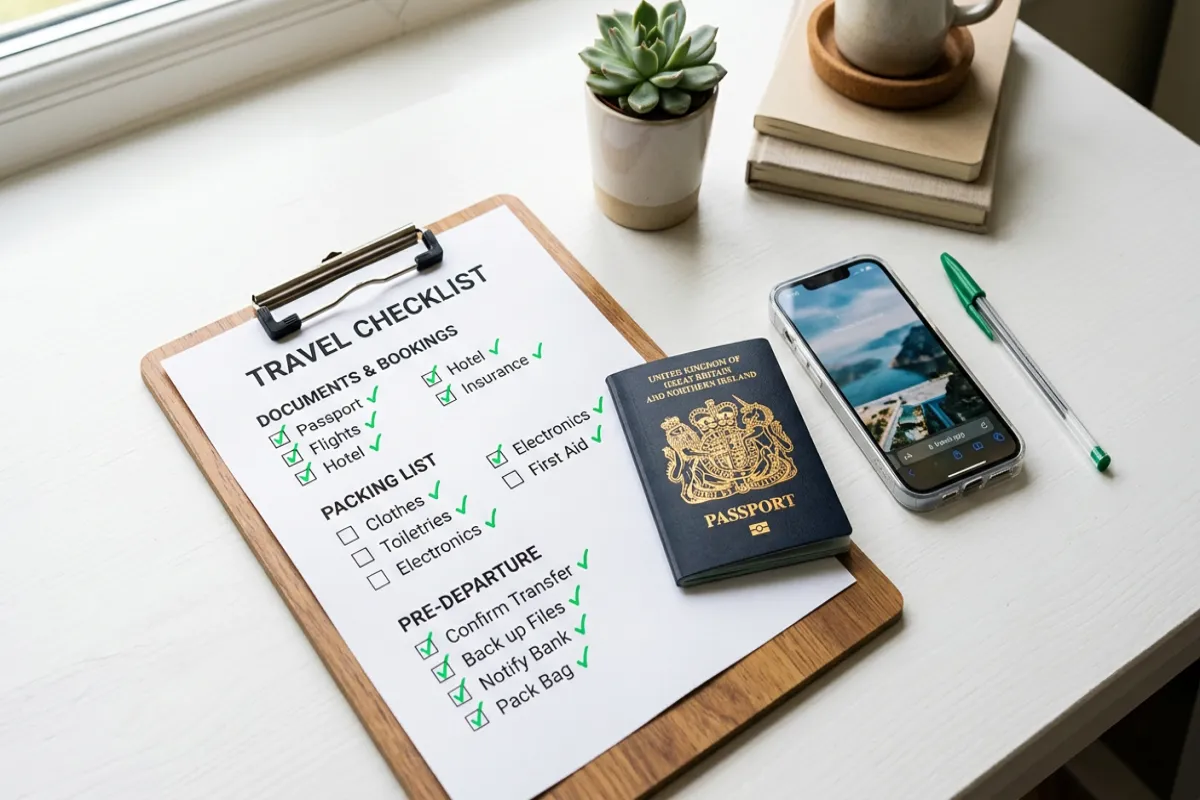
Every traveler has a version of this story. The details change, but the root cause is always the same: trip planning involves dozens of moving pieces spread across weeks or months, and your brain is not built to track all of them.
A checklist fixes that. Not because it makes planning exciting, but because it keeps the boring-but-critical tasks from slipping through the cracks. Missed vaccinations, forgotten chargers, an expired driver’s license for a rental car pickup. These are the things that turn a good trip into a stressful one.
This is the checklist we wish we had before every trip. It is organized by timeline, starting 3 months before departure and running through post-trip wrap-up. Use it as-is, or adapt it to your travel style. If you want to keep everything in one place, Yopki’s AI travel planner can build your itinerary and store all your documents alongside it.
3 Months Before Departure: Big Picture Planning
This is where the fun happens. You are picking the destination, dreaming about what you will do, and locking in the big-ticket items. Do not skip ahead. The decisions you make now set the budget and pace for everything that follows.
Choose Your Destination and Dates
- Research destinations based on your budget, time off, and travel goals. Are you looking for relaxation, adventure, culture, or all three?
- Check seasonal factors. Monsoon season, extreme heat, school holidays, and local festivals all affect your experience and costs.
- Lock in dates. Flexible dates save money, but at some point you need to commit so everything else can fall into place.
- Confirm time off work. Submit your PTO request before you book anything non-refundable.
Set Your Budget
- Estimate total trip cost. Include flights, hotels, food, activities, transportation, souvenirs, and a 10-15% buffer for surprises.
- Decide on splurges vs. savings. Maybe you want a nice hotel but will eat street food. Maybe flights are economy but you want a private tour. Knowing your priorities prevents overspending on things that do not matter to you.
- Set up a trip savings plan if needed. Even setting aside $200 per paycheck for 3 months adds up to $1,200.
Book Flights
- Compare prices across Google Flights, Skyscanner, and airline direct sites. Booking direct often gives better cancellation policies.
- Set fare alerts if prices are higher than expected. Domestic flights are cheapest 1-3 months out. International flights hit their sweet spot 2-6 months before departure.
- Book seats if you have a preference. Window or aisle seats fill up fast on popular routes.
- Save confirmation emails immediately. Better yet, upload them to a travel document organizer so they are accessible offline.
Book Accommodations
- Compare hotels, vacation rentals, and hostels. Location matters more than star ratings. A 3-star hotel in the center of town often beats a 5-star hotel 45 minutes away.
- Read recent reviews. Filter for reviews from the past 6 months. Hotels change management, renovate, or decline.
- Check cancellation policies. Book refundable rates when possible, especially this far out. You can always re-book if prices drop.
- Consider location relative to your plans. If you know you want to visit certain neighborhoods, museums, or parks, pick a hotel that reduces daily commuting.
Check Travel Documents
- Verify your passport expiration date. Many countries require at least 6 months of validity beyond your travel dates. If yours is close, renew now. Passport renewals take 6-8 weeks by mail and 2-3 weeks expedited.
- Research visa requirements. Some countries offer visa on arrival or e-visas, while others require applications weeks in advance.
- Check if you need an international driving permit for your destination.
- Confirm your name on bookings matches your passport exactly. Even a missing middle name can cause issues at check-in.
1 Month Before Departure: Details and Documents
The excitement is building, but this phase is about locking down details. Think of it as the “adulting” phase of trip planning. Insurance, health prep, and reservations all happen here.
Get Travel Insurance
- Buy a policy that covers trip cancellation, medical emergencies, and lost luggage. For international trips, medical coverage is non-negotiable. A broken ankle abroad can cost tens of thousands without insurance.
- Check your credit card benefits. Some premium cards include trip cancellation and rental car insurance. Know what is already covered before you buy a separate policy.
- Read the fine print. Understand what counts as a covered reason for cancellation. “Changed my mind” is almost never covered.
Book Activities and Tours
- Reserve popular attractions early. Museums with timed entry (like the Louvre or Uffizi), popular tours, and seasonal activities sell out weeks ahead.
- Book restaurant reservations for any must-visit spots. In food-centric cities like Tokyo, Barcelona, or New York, top restaurants fill up a month or more in advance.
- Plan your day-by-day itinerary. You do not need every minute scheduled, but knowing what you will do each day helps you group activities by neighborhood and avoid wasted transit time. Our complete trip planning guide walks through this in detail.
Handle Health Preparations
- Check CDC travel health notices for your destination. Some countries require proof of yellow fever vaccination or other immunizations.
- Schedule vaccinations if needed. Some vaccines (like Japanese Encephalitis or Rabies series) require multiple doses over several weeks.
- Refill prescriptions. Get a 90-day supply if your trip overlaps with a refill date. Carry medications in original labeled containers.
- Get a dental and eye checkup. Nobody wants a toothache in a country where they do not speak the language.
- Research local health risks. Do you need malaria medication? Is the tap water safe? Are there altitude concerns?
Handle Finances
- Notify your bank and credit card companies of your travel dates and destinations. Fraud alerts on foreign transactions are the last thing you need.
- Order foreign currency if your destination is cash-heavy. Airport exchange rates are terrible. Order from your bank or use an ATM at your destination instead.
- Check ATM and credit card fees. Cards with no foreign transaction fees save 3% on every purchase.
- Make copies of all financial cards. Store copies separately from the originals, both physical and digital.
2 Weeks Before Departure: Packing and Prep
Two weeks out is when planning becomes doing. You are packing bags, prepping your home, and making sure nothing gets forgotten in the rush.
Start Packing
- Check the weather forecast for your destination during your travel dates. Pack accordingly.
- Lay out everything you think you need, then remove 30%. Overpacking is the most common travel mistake. You can buy a t-shirt anywhere.
- Pack versatile clothing that mixes and matches. Neutral colors, layers, and one “nice” outfit cover most situations.
- Use packing cubes to organize by type (tops, bottoms, underwear, accessories). They compress clothes and make repacking easier.
- Check airline baggage limits. Know the carry-on dimensions and checked bag weight limits for every airline on your itinerary, including connections.
Pack Your Tech Bag
- Universal power adapter (check your destination’s plug type).
- Portable charger/power bank (at least 10,000 mAh for a full day of phone use).
- Charging cables for every device. Bring a spare.
- Headphones or earbuds for flights and transit.
- Camera and memory cards if you shoot beyond your phone.
- Download offline maps in Google Maps or Apple Maps for your destination.
Prepare Your Home
- Arrange pet care. Confirm dates, drop off supplies, and share emergency vet info.
- Set up a mail hold with USPS or ask a neighbor to collect packages.
- Arrange plant watering if you will be gone more than a week.
- Set light timers or smart plugs to make the house look occupied.
- Clean out the fridge of perishables. Nobody wants to come home to a science experiment.
- Take out trash and recycling.
Pack Essentials You Cannot Forget
These are the items that cannot be replaced easily at your destination:
- Prescription medications in original containers.
- Passport and visa documents.
- Travel insurance policy printout or digital copy.
- Driver’s license (and international driving permit if applicable).
- Glasses or contact lenses with a backup pair.
- Any medical devices (CPAP, insulin pump, hearing aids).
For a deeper dive into what to bring, check out our guide on travel essentials for every trip.
1 Week Before Departure: Final Details
You are in the home stretch. This week is about confirming, finalizing, and double-checking. No new bookings. Just tightening up the plan.
Confirm All Reservations
- Reconfirm hotel bookings. Log in to the hotel or booking site and verify dates, room type, and any special requests.
- Check flight status. Airlines occasionally change schedules. Make sure your departure time has not shifted.
- Confirm rental car pickup details including location, hours, and required documents.
- Review activity and tour bookings. Check meeting points, cancellation deadlines, and what to bring.
- Confirm airport transfers or know exactly how you are getting to and from the airport at both ends.
Organize Your Documents
- Print or save offline copies of all confirmations: flights, hotels, car rentals, tours, and restaurant reservations.
- Make photocopies of your passport, ID, and insurance cards. Store one set in your luggage and one digitally. Yopki’s document organizer keeps everything accessible even without internet.
- Share your itinerary with a trusted friend or family member who is not traveling with you.
- Save emergency contacts for your destination: local emergency number, nearest embassy or consulate, hotel address in the local language.
Finalize Packing
- Do a final weather check and adjust layers or rain gear.
- Weigh your luggage with a luggage scale. Overweight bag fees are $50-100 per bag.
- Pack your carry-on as if your checked bag might not arrive. Include one change of clothes, all medications, valuables, chargers, and toiletries in your carry-on.
- Check TSA rules for any questionable items. Liquids must be 3.4 oz or smaller in a quart-sized bag.
Handle Last-Minute Logistics
- Download entertainment for the flight: movies, podcasts, books, playlists. Do not rely on in-flight Wi-Fi.
- Check in online as soon as check-in opens (usually 24 hours before departure).
- Charge all devices fully the night before.
- Set an out-of-office reply on your work email.
- Confirm pet sitter, house sitter, or neighbor check-in schedules.
Day of Departure: Last Checks
Travel day is not the time to wing it. A short checklist keeps you calm and on schedule.
Before You Leave the House
- Do a final sweep of the house. Check bathrooms, nightstands, and charger outlets for forgotten items.
- Unplug unnecessary appliances.
- Set the thermostat to an away temperature (or turn off A/C entirely if you will be gone long).
- Lock all doors and windows. Activate your security system if you have one.
- Verify you have your passport, wallet, phone, and keys. Everything else can be bought or borrowed.
Getting to the Airport
- Arrive 2 hours early for domestic flights, 3 hours for international. If you are flying out of a busy hub during peak hours, add 30 minutes.
- Check real-time traffic and transit conditions.
- Have your boarding pass ready on your phone or printed.
- Keep liquids bag accessible for security screening.
Carry-On Essentials
- Snacks. Airport food is overpriced and options might be limited during layovers.
- Empty water bottle to fill after security.
- Headphones, charger, and portable battery.
- Neck pillow and eye mask for flights over 3 hours.
- A change of clothes in case checked luggage is delayed.
- Pen for customs and immigration forms (yes, many countries still use paper forms).
Post-Trip: Wrap Up Like a Pro
The trip is over, but there are a few things worth doing in the first week home to save money and preserve memories.
Financial Wrap-Up
- Review credit card and bank statements for any unauthorized charges.
- File expense reports if any portion was work-related.
- Submit travel insurance claims promptly if anything went wrong (delayed flights, lost luggage, medical expenses).
- Convert leftover foreign currency back or save it for a future trip.
Memories and Reviews
- Back up photos and videos to cloud storage. Do not wait. Phones die, get lost, or break.
- Leave reviews for hotels, tours, and restaurants that earned it. The travel community relies on honest, recent reviews.
- Write down trip highlights while they are fresh. What worked, what you would skip next time, and what surprised you.
Loyalty and Rewards
- Check that airline miles and hotel points posted correctly. Missing points are common and usually fixable if you contact the loyalty program within 30 days.
- Submit any receipts for credit card travel credits or reimbursement programs.
- Update your travel wishlist. Where do you want to go next?
Printable Travel Planning Checklist Summary
Here is the condensed version you can print, screenshot, or copy into your notes app. Use it as a quick reference alongside the detailed sections above.
3 Months Out
- Choose destination and dates
- Set trip budget
- Book flights
- Book accommodations
- Check passport expiration (renew if needed)
- Research visa requirements
- Request time off work
1 Month Out
- Buy travel insurance
- Book activities and tours
- Make restaurant reservations
- Schedule vaccinations
- Refill prescriptions
- Notify bank of travel dates
- Order foreign currency
- Build day-by-day itinerary
2 Weeks Out
- Start packing (check weather forecast)
- Pack tech bag and chargers
- Arrange pet and plant care
- Set up mail hold
- Set light timers
- Clean out fridge
- Download offline maps
1 Week Out
- Confirm all reservations
- Print or save documents offline
- Share itinerary with emergency contact
- Weigh luggage
- Check in online (24 hrs before)
- Charge all devices
- Set work out-of-office reply
Day Of
- Final home sweep
- Unplug appliances, set thermostat
- Lock up, activate security
- Passport, wallet, phone, keys check
- Arrive at airport 2-3 hours early
Post-Trip
- Review bank statements
- File insurance claims if needed
- Back up photos
- Leave reviews
- Check loyalty points posted
Tips for Using This Checklist Effectively
Customize it for your trip type. A weekend road trip does not need the 3-month phase. A month-long international trip might need even more lead time. Adjust the timeline to fit your situation.
Share it with your travel partners. If you are traveling with a group or family, divide tasks. One person handles flights, another handles accommodations, someone else manages the activity calendar.
Use a planning tool to keep everything together. Spreadsheets work, but a dedicated tool like Yopki lets you store your itinerary, documents, reservations, and checklists in one place, accessible from any device.
Do not aim for perfection. No trip goes 100% according to plan, and that is fine. The point of a checklist is not to control every detail. It is to handle the essentials so you can relax and enjoy the unexpected parts.
Frequently Asked Questions
What should be on a travel checklist?
A complete travel checklist covers six categories: booking (flights, hotels, rental cars), documents (passport, visa, insurance), health (vaccinations, prescriptions, medical devices), packing (clothes, tech, toiletries), home prep (pets, mail, security), and finances (bank notifications, foreign currency, credit cards). The key is organizing these by timeline so you handle everything in the right order. Start with big decisions 3 months out and work down to day-of essentials.
How do I organize my travel plans?
The most effective approach is working backward from your departure date. Three months out, lock in destination, flights, and hotels. One month out, handle documents, activities, and health prep. Two weeks before, start packing and prepping your home. One week before, confirm everything and finalize details. Using a travel planning app keeps all your confirmations, itineraries, and documents in one place instead of scattered across email, text messages, and browser bookmarks.
What are the steps to plan a vacation?
The 10 core steps are: pick a destination, set dates, establish a budget, book transportation, book accommodations, check documents (passport, visa), get travel insurance, plan activities, handle health prep, and pack. Within each step, there are sub-tasks. For example, “book transportation” includes comparing prices, setting fare alerts, choosing seats, and saving confirmations. A detailed checklist breaks every step into specific, actionable items so nothing slips through.
How far in advance should I start planning a trip?
For domestic trips, 1-2 months is usually enough. For international trips, start 3-6 months ahead. The main driver is passport and visa processing times. If you need to renew a passport (6-8 weeks) or apply for a visa (2-8 weeks depending on the country), you need that lead time. Flight prices also favor early booking: domestic flights are cheapest 1-3 months out, while international flights are best 2-6 months ahead.
What is the most commonly forgotten travel item?
Phone chargers and adapters top every “forgotten items” list, followed by medications, sunscreen, and comfortable walking shoes. The fix is simple: pack electronics and medications first, before clothes. These are the items you cannot easily replace at your destination, especially prescription medications and specific power adapters.