Download the Free Checklist
Save it, print it, check items off as you go.
Your Complete International Travel Checklist
Traveling internationally is exciting, but the preparation can feel overwhelming. Passports, visas, vaccines, insurance, currency, packing, and a dozen other details all need attention before you board that flight.
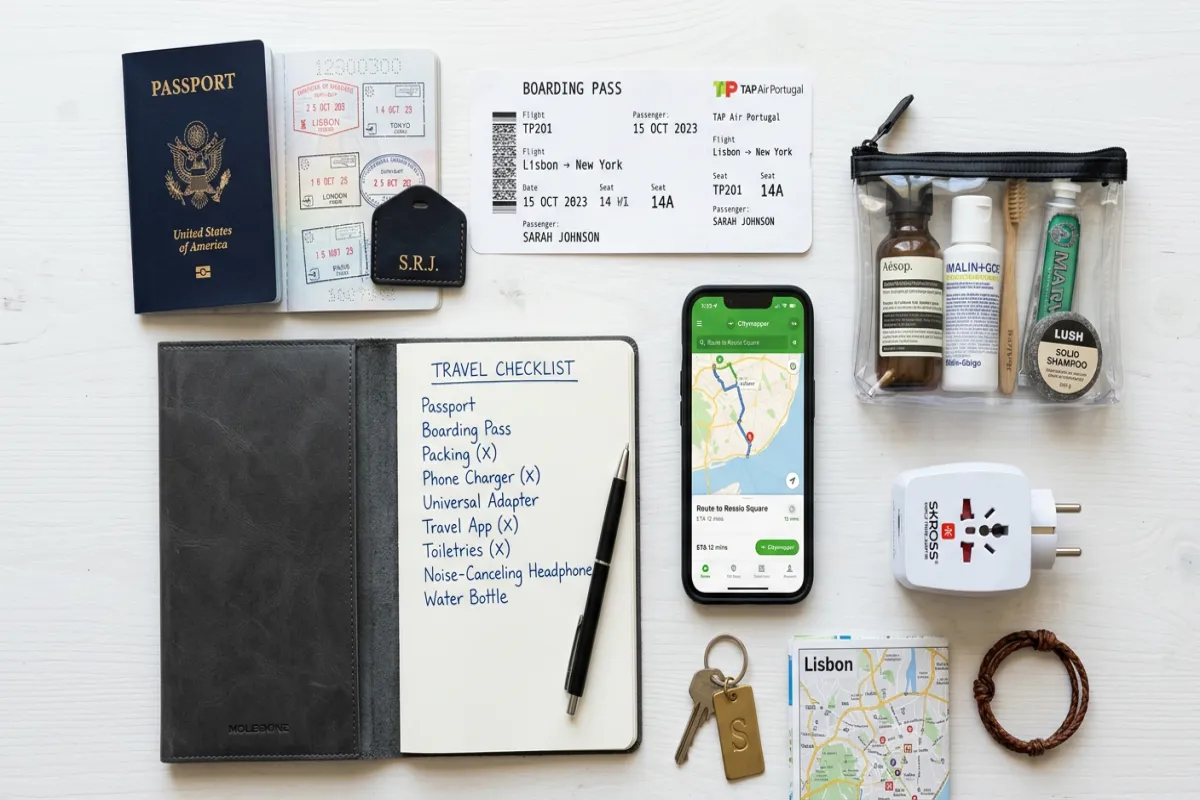
This checklist organizes everything by timeline. Start three months before your trip and work through each phase. By departure day, you will have every document, every reservation, and every essential item handled. No last-minute scrambles, no forgotten passports, no expensive surprises.
Print this page, bookmark it, or save it to your travel document organizer. Check off each item as you go.
3 Months Before Departure
This is the foundation phase. Everything here involves lead time, so starting early is not optional. It is necessary.
Passport
- Check expiration date. Most countries require your passport to be valid for at least 6 months beyond your planned return date. If yours expires within 9 months of your trip, renew now.
- Check blank pages. Some countries require 1-2 blank pages for entry stamps. If you are running low, renew or add pages.
- Renewal timeline. In 2026, routine passport renewals take 6-8 weeks. Expedited processing takes 2-3 weeks and costs an additional $60. For true emergencies, you can visit a regional passport agency in person, but appointments are limited.
- First-time passport. If you do not have a passport, apply at an acceptance facility (many post offices and county clerk offices). First-time applications cannot be done by mail and require an in-person appointment.
- Passport cost. A new adult passport book costs $130 (application fee) plus $35 (execution fee). Renewals by mail cost $130.
Visa Requirements
Visa rules vary dramatically by destination and your nationality. Here is how to check:
- Step 1: Visit the US State Department’s country information page for your destination.
- Step 2: Check whether you need a visa, an electronic travel authorization (ETA/ETIAS), or nothing beyond a passport.
- Step 3: If a visa is required, check processing times. Some visas (India, China, Brazil) take 2-8 weeks to process.
Common Visa Situations for US Passport Holders (2026)
- No visa needed (up to 90 days): Most of Europe (Schengen Area), UK, Japan, South Korea, Australia (with ETA), Canada, Mexico, most of South America, most of the Caribbean.
- Electronic authorization required: Europe (ETIAS, launching 2026), UK (ETA), Australia (ETA), New Zealand (NZeTA), Canada (eTA for air travel).
- Visa required before arrival: China, India, Russia, Brazil, many African and Middle Eastern countries.
- Visa on arrival available: Turkey, Egypt, Cambodia, Laos, Nepal, Jordan, and others. These are convenient but still cost $20-80 at the airport.
Important for Europe in 2026: The European Travel Information and Authorization System (ETIAS) is being implemented. US citizens traveling to the Schengen Area will need to apply online and pay a small fee (approximately 7 euros) before travel. Processing is expected to take minutes in most cases, but apply at least 72 hours before departure to be safe.
Vaccinations and Health Prep
Some countries require specific vaccinations for entry. Others do not require them but strongly recommend them.
- Check the CDC’s Traveler’s Health page for your destination. It lists required and recommended vaccines by country.
- Schedule a travel health appointment. Many vaccinations require multiple doses spread over weeks. Hepatitis A and B, typhoid, and Japanese encephalitis all need advance planning.
- Yellow fever vaccine. Required for entry to many countries in sub-Saharan Africa and parts of South America. You will receive a yellow card (International Certificate of Vaccination) as proof. Some countries require this card at immigration.
- Malaria prevention. If traveling to malaria-risk areas, your doctor can prescribe prophylactic medication. Start the course before you depart, as some medications need to build up in your system.
- Routine vaccines. Make sure your standard vaccinations are up to date: MMR, Tdap, flu, and COVID-19.
- Cost. Some travel vaccines are not covered by insurance. Budget $100-300 for a full set of travel vaccinations if needed.
Travel Insurance
Travel insurance is one of those things you resent paying for until you need it. A medical emergency abroad without insurance can cost $10,000-100,000+ depending on the situation. A trip cancellation without coverage means you eat the cost of non-refundable flights and hotels.
What Travel Insurance Covers
- Emergency medical care: Doctor visits, hospital stays, surgery, and prescription medication abroad.
- Medical evacuation: If you need to be transported to a hospital or flown home for treatment. This alone can cost $50,000-100,000 without insurance.
- Trip cancellation: Reimburses non-refundable trip costs if you cancel for a covered reason (illness, injury, family emergency, severe weather).
- Trip interruption: Covers additional costs if your trip is cut short.
- Lost or delayed baggage: Reimburses essentials if your luggage is delayed and covers lost items up to a set limit.
- Travel delay: Covers meals and hotel if your flight is significantly delayed.
How to Choose a Policy
- Basic coverage: $50-100 for a week-long trip. Covers medical emergencies and trip cancellation. Good enough for low-risk trips to developed countries.
- Comprehensive coverage: $100-250 for a week-long trip. Adds baggage protection, travel delay coverage, and higher medical limits. Best for expensive trips or destinations with limited healthcare.
- “Cancel for any reason” (CFAR): 40-60% more expensive but lets you cancel for any reason and receive 50-75% reimbursement. Worth it for expensive, non-refundable trips where your plans might change.
Recommended providers: World Nomads (good for adventure travelers), Allianz (strong medical coverage), and SafetyWing (affordable monthly subscription for frequent travelers).
Pro tip: Check your credit card benefits before buying a separate policy. Many premium credit cards include trip cancellation protection, lost baggage coverage, and rental car insurance. You might already be partially covered.
1 Month Before Departure
By now, your passport is valid, your visa is handled, and your vaccinations are underway. This phase is about booking, banking, and communication logistics.
Flights and Lodging
- Book flights if you have not already. For tips on getting the best price, see our guide on when to book flights.
- Book lodging for at least your first and last nights. Having a confirmed place to stay when you land reduces stress enormously.
- Confirm all reservations. Double-check dates, names (must match your passport exactly), and cancellation policies.
- Save confirmation emails in a dedicated folder or in your digital travel documents system.
Banking and Money
- Notify your bank and credit card companies. Tell them your travel dates and destinations so they do not freeze your cards for suspicious foreign activity. Most banks let you set a travel notice through their app.
- Check foreign transaction fees. Many credit cards charge 3% on foreign purchases. Cards with no foreign transaction fees (Chase Sapphire, Capital One Venture, and others) save you real money abroad.
- Get a debit card with no ATM fees. Charles Schwab and some credit unions reimburse international ATM fees worldwide. Withdrawing local currency from ATMs abroad gives you the best exchange rate.
- Do NOT exchange currency at the airport. Airport exchange counters charge 5-12% in fees and poor exchange rates. Use a local ATM instead.
- Carry a backup card. Bring at least two cards from different networks (one Visa, one Mastercard). If one gets lost, frozen, or does not work at a specific ATM, you have a backup.
- Carry a small amount of local currency. $50-100 worth in local currency covers taxis, tips, and small purchases when you first land, before you find an ATM.
Phone and Communication
- Option 1: International phone plan. T-Mobile and Google Fi include international data in many plans. Check what your carrier offers. AT&T and Verizon charge $10-12/day for international use, which adds up fast.
- Option 2: eSIM. Buy an eSIM through Airalo, Holafly, or similar providers. You get a local data plan without swapping physical SIM cards. Prices start at $5-15 for a week of data in most countries.
- Option 3: Local SIM card. Buy a prepaid SIM at the airport or a local shop when you arrive. Often the cheapest option for long trips (2+ weeks).
- Download offline maps. Google Maps and Maps.me both allow offline map downloads. Download the entire region you are visiting while on Wi-Fi.
- Download a translation app. Google Translate allows offline language pack downloads. Grab the languages you need before you go.
Copies of Important Documents
Make both physical and digital copies of:
- Passport photo page
- Visa or travel authorization
- Flight confirmations
- Hotel reservations
- Travel insurance policy and emergency phone number
- Credit and debit card numbers (with the bank’s international phone number on the back)
- Driver’s license
- Vaccination records
Physical copies: Print a set and keep them in a separate bag from your passport. If your passport is lost or stolen, these copies speed up the replacement process at the nearest US embassy.
Digital copies: Scan or photograph everything and store it in a secure cloud folder (Google Drive, iCloud, Dropbox). You can also email a set to yourself so you can access them from any device. For more on organizing your documents, see our guide on digital travel documents.
Build Your Itinerary
One month out is the ideal time to build a day-by-day plan. You do not need every minute scheduled, but having a framework prevents wasted time and missed must-dos.
Yopki’s AI trip planner can generate a complete itinerary based on your destination, dates, interests, and pace. It creates a visual calendar with mapped activities, suggested restaurants, and transit times between stops. You can customize everything and share the plan with travel partners.
1 Week Before Departure
The logistics are handled. Now it is about packing, home prep, and final confirmations.
Packing Checklist
Clothing
- Check the weather forecast for your entire trip and pack accordingly
- Pack layers, not bulk. A light jacket, a rain shell, and layers you can add or remove work better than heavy coats
- Comfortable walking shoes (broken in, not brand new)
- One nicer outfit for restaurants or events
- Swimsuit (even if you do not plan to swim, many hotels have pools and many cities have spas)
- Quick-dry underwear and socks for easy hand-washing
Toiletries
- All liquids in 3.4 oz (100ml) containers or smaller for carry-on
- Clear quart-sized bag for TSA
- Prescription medications in original containers with your name on the label
- Sunscreen (often expensive abroad)
- Basic first aid: bandages, pain relievers, anti-diarrheal medication, allergy medication
- Hand sanitizer
- Insect repellent (if traveling to tropical destinations)
Electronics
- Universal power adapter (one adapter works in all countries)
- Phone charger and a portable battery pack
- Headphones or earbuds
- Camera and memory cards (if not using your phone)
- Kindle or e-reader (optional, but saves space over physical books)
Documents (Physical)
- Passport
- Printed visa or travel authorization
- Printed flight and hotel confirmations
- Copies of important documents (in a separate bag)
- Travel insurance card or printout
- Two passport-sized photos (useful if you need an emergency passport replacement)
For a deeper breakdown of exactly what to bring, see our complete list of travel essentials and must-have items.
Home Prep
- Mail: Put a hold on your mail through USPS or ask a neighbor to collect it.
- Bills: Pay any bills that will come due while you are away, or set up autopay.
- Home security: Set light timers, lock all windows and doors, and ask a neighbor or friend to check on the house.
- Pets: Confirm pet sitting or boarding arrangements.
- Plants: Water thoroughly before you leave or ask someone to water them.
- Thermostat: Adjust to an energy-saving temperature.
- Perishable food: Use up or dispose of anything in the fridge that will expire while you are away.
Travel Apps to Download
- Google Maps (with offline maps downloaded)
- Google Translate (with offline language packs)
- Your airline’s app (for mobile boarding passes and flight updates)
- XE Currency (for quick currency conversions)
- Uber or local ride-hailing app (Grab in Southeast Asia, Bolt in Europe, DiDi in China)
- Yopki (for your itinerary, maps, and travel documents in one place)
- WhatsApp (the default messaging app in most of the world, essential for communicating with hotels, guides, and local contacts)
Final Confirmations
- Confirm flight times (check for schedule changes)
- Confirm hotel check-in time and any special requests
- Confirm any pre-booked tours, restaurants, or activities
- Check passport validity one more time (yes, really)
- Verify you have the correct power adapter for your destination
Day of Departure
Everything is booked, packed, and confirmed. Here is what to focus on the day you leave.
Carry-On Essentials
Pack these items in your personal item or carry-on, not your checked bag. If your luggage gets delayed (and it happens more often on international flights), you will have everything you need to survive the first 24 hours.
- Passport and boarding pass
- Phone, charger, and portable battery
- One change of clothes (underwear, socks, and a fresh shirt at minimum)
- Prescription medications (never put these in checked luggage)
- Toothbrush and basic toiletries
- Headphones
- Snacks
- A pen (you will need one to fill out customs and immigration forms on the plane)
- Travel pillow and eye mask for long flights
- Printed copies of your hotel reservation and travel insurance
Airport Tips for International Flights
- Arrive 3 hours early. International check-in, security, and customs take longer than domestic.
- Check in online. Most airlines open online check-in 24 hours before departure. Check in and download your boarding pass to avoid the check-in counter line.
- Have your documents ready. At the check-in counter, you may be asked for your passport, visa, return flight confirmation, and proof of vaccination depending on the destination.
- Go through security and passport control early. International terminal security lines are often longer. Clear security first, then relax at the gate.
- Buy water after security. You cannot bring liquids through security, but you need water for a long flight. Buy a large bottle after clearing TSA.
- Fill out immigration forms on the plane. The flight crew will distribute arrival cards for many countries. Fill them out during the flight so you are not scrambling at immigration.
Visa Requirements: A Deeper Look
Visa rules are the single most confusing part of international travel. Here is a more detailed breakdown.
Visa-Free vs. Visa-on-Arrival vs. Visa Required
- Visa-free: You present your passport at immigration and get stamped in. No pre-application needed. This is how US citizens enter most of Europe, the UK, Japan, and South Korea.
- Electronic travel authorization: A lightweight online application (ETIAS, ETA, eTA, NZeTA). Usually approved in minutes, costs $5-15, and is valid for multiple trips over 2-3 years. You must apply before you travel.
- Visa on arrival: You apply and pay at the airport when you land. Common in Turkey, Egypt, Cambodia, and others. Bring cash in USD for the fee, as many visa-on-arrival counters do not accept cards.
- Visa required before travel: You must apply at a consulate or through an online portal weeks before your trip. Required for China, India, Russia, and many African nations. Processing times vary from 1-8 weeks.
Schengen Zone Rules for US Citizens
The Schengen Area covers 27 European countries with no internal border controls. US citizens can stay for up to 90 days within any 180-day period without a visa. This means:
- You can spend 90 days total across all Schengen countries combined, not 90 days per country.
- After 90 days, you must leave the Schengen Area for at least 90 days before returning.
- The clock starts on your first entry stamp and resets after 180 days from that date.
Countries outside the Schengen Area (UK, Ireland, Croatia until recently, and others) have their own separate entry rules and do not count toward your 90-day Schengen limit.
Currency and Money Tips
Money management abroad is simpler than most people think, but a few mistakes can cost you hundreds in unnecessary fees.
The Best Way to Get Local Currency
- Use ATMs abroad. Withdraw local currency from bank-branded ATMs (not the independent ones in tourist areas, which charge higher fees). Choose the “debit” option and decline the ATM’s offer to convert currency for you.
- Pay with a no-foreign-transaction-fee credit card. Visa and Mastercard are accepted almost everywhere. Use your credit card for larger purchases (hotels, restaurants, tours) and cash for small purchases (street food, taxis, tips).
- Always pay in local currency. When a merchant asks “Do you want to pay in USD or local currency?” always choose local currency. Paying in USD triggers Dynamic Currency Conversion (DCC), which adds a 3-7% markup.
How Much Cash to Carry
Carry enough local currency for 1-2 days of small purchases. In most developed countries, that is $50-100 equivalent. In cash-heavy countries (Japan, Germany, many Southeast Asian countries), carry $100-200 equivalent.
Keep cash in two separate locations. Wallet in your front pocket with daily spending money, and a backup stash in a zippered pocket or hidden in your luggage. If your wallet is lost or stolen, you still have emergency cash.
Tipping Abroad
Tipping norms vary dramatically by country:
- Japan: No tipping. It is considered rude. Seriously.
- Western Europe: Service charge usually included. Round up or leave 5-10% for excellent service.
- UK: 10-15% at sit-down restaurants if service is not included.
- Southeast Asia: Not expected but appreciated. 10% is generous.
- Mexico and Central America: 10-15% at restaurants. Similar to US norms.
- Middle East: 10-15% at restaurants. Check if service is already included.
Health Preparation
Beyond vaccinations, a few health-related preparations can prevent common problems abroad.
Prescription Medications
- Bring enough medication for your entire trip plus 7 extra days in case of delays.
- Keep all medications in original, labeled containers.
- Carry a letter from your doctor listing your medications and dosages. Some countries have strict rules about certain medications (especially controlled substances).
- Pack medications in your carry-on, never in checked luggage.
Travel Health Kit
Pack a small kit with:
- Pain relievers (ibuprofen, acetaminophen)
- Anti-diarrheal medication (Imodium) – traveler’s diarrhea affects 30-70% of travelers to developing countries
- Oral rehydration salts (for dehydration from illness or heat)
- Antihistamine (for allergies or unexpected reactions)
- Motion sickness medication (if you are prone to it)
- Bandages, antiseptic wipes, and blister pads
- Insect repellent with DEET (for tropical destinations)
Food and Water Safety
- Research water safety. In many countries (most of Europe, Japan, Australia, Canada), tap water is safe. In others (much of Southeast Asia, Africa, Central America), drink only bottled or filtered water.
- Ice can be risky. In countries where tap water is not safe, ice in drinks may also be unsafe unless it is commercially produced.
- Street food is usually fine if you follow one rule: eat where locals eat. High turnover means fresh food. If a street stall has a long line of locals, the food is probably safe and delicious.
Emergency Contacts and Safety
Prepare for the worst while expecting the best.
Essential Numbers to Save
- Local emergency number: 112 works across Europe. Research the number for your specific destination.
- Nearest US Embassy or Consulate: Save the address and phone number. The embassy can help with lost passports, emergency evacuations, and legal issues.
- Travel insurance emergency line: Save the 24/7 number. Many policies require you to call before seeking non-emergency medical care.
- Bank’s international collect-call number: Found on the back of your card. Use this to report lost or stolen cards.
- Your emergency contact at home: Someone who knows your itinerary and can be reached if something happens.
Register with STEP
The Smart Traveler Enrollment Program (STEP) is a free service from the US State Department. Register your trip at step.state.gov and you will receive:
- Security alerts for your destination
- Information about safety conditions
- Help from the nearest embassy or consulate in an emergency
- Assistance during natural disasters, civil unrest, or family emergencies
Registration takes 2 minutes and could be invaluable in a crisis.
The Complete Checklist (Quick Reference)
3 Months Before
- Check passport validity (6+ months beyond return date)
- Research and apply for visas or travel authorizations
- Schedule travel health appointment and vaccinations
- Research and purchase travel insurance
- Start an itinerary with Yopki or your preferred planning tool
1 Month Before
- Book flights and lodging (confirm names match passport)
- Notify bank and credit card companies of travel dates
- Get a no-foreign-transaction-fee credit card if you do not have one
- Set up international phone plan or buy an eSIM
- Make physical and digital copies of all documents
- Research local customs, tipping norms, and basic phrases
1 Week Before
- Check weather forecast and finalize packing
- Download offline maps and translation apps
- Confirm all reservations (flights, hotels, tours)
- Prepare home (mail hold, bills, pet care, security)
- Charge all electronics
- Get a small amount of local currency ($50-100 equivalent)
Day Of
- Passport, boarding pass, and phone in your carry-on
- Arrive at airport 3 hours before international departure
- Carry essential medications, a change of clothes, and a pen in your carry-on
- Check in online and download your mobile boarding pass
- Fill out immigration/customs forms on the plane
- Share your itinerary with an emergency contact at home
Frequently Asked Questions
What if my passport expires while I am abroad?
Contact the nearest US Embassy or Consulate immediately. They can issue an emergency passport, usually within 24-72 hours. Having copies of your passport (physical and digital) speeds up this process significantly. This is one of the main reasons to keep copies separate from your actual passport.
Can I use my US driver’s license abroad?
Your US license is valid for driving in many countries, but some require an International Driving Permit (IDP) in addition to your license. IDPs are available from AAA for $20 and are valid for one year. Countries that commonly require an IDP include Italy, Japan, Greece, and Austria. Even where not required, an IDP provides a translation of your license that local police can read.
Do I need a COVID vaccine for international travel in 2026?
Most countries have dropped COVID vaccination requirements as of 2026. However, entry rules can change. Check your destination’s requirements on the relevant government website or the US State Department’s country page within 2 weeks of departure to confirm current rules.
What is the cheapest way to get internet abroad?
An eSIM from providers like Airalo is usually the cheapest option. Plans start at $5-15 for a week of data. If you need more data or a longer plan, a local SIM card purchased at the airport is often cheaper than any US carrier’s international plan. Wi-Fi is also widely available in hotels, cafes, and restaurants throughout most of the world.
Start Your Trip Preparation Today
International travel preparation is not complicated. It just requires starting early enough. The three-month timeline gives you plenty of room for passport renewals, visa processing, and vaccination schedules without any last-minute stress.
Use this checklist to work through each phase systematically. And when you are ready to build your actual travel itinerary, our trip planning guide walks you through the process step by step.
The world is waiting. Get your documents in order and go see it.