Every trip has two budgets: the one you set before you leave and the one you actually spend. The gap between them is where financial stress lives. This template closes that gap by giving you a structured way to plan your budget realistically, track spending as it happens, and see exactly where your money goes. For a deeper dive, check out our how to save money on travel
This free travel budget template covers the full financial picture of a trip — from pre-trip expenses (flights, insurance, gear purchases) through daily spending (meals, activities, transportation) to a post-trip reconciliation that shows your total actual cost. It’s a budget spreadsheet with formulas that do the math for you — a budget tracker that works before, during, and after your trip.
What’s in This Template
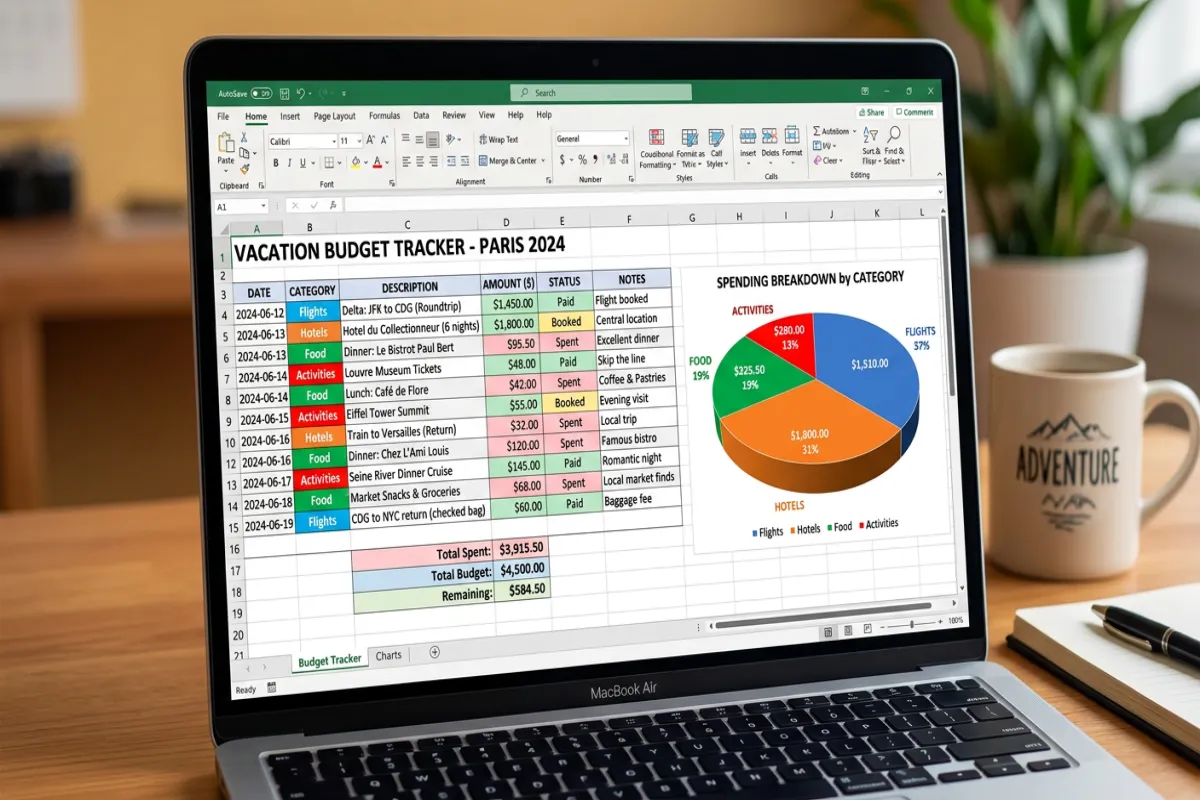
1. Budget Overview
Your financial dashboard: total trip budget, total estimated cost (sum of all category budgets), total actual spend (updates as you log expenses), remaining budget, and a budget health indicator showing whether you’re on track. All formula-driven — the numbers update as you fill in the other sections. Or skip the spreadsheet and use our interactive trip cost calculator instead.
2. Pre-Trip Expenses
Money spent before departure: flights, travel insurance, visa fees, vaccinations, new luggage or gear, guidebooks, prepaid tours or attraction tickets, and travel-size toiletries. These costs are easy to forget when calculating your “trip budget” because you paid for them weeks or months before traveling. This section makes sure they’re counted.
3. Category Budget Planner
Set your budget by category: flights, accommodation, food and dining, local transportation, activities and excursions, shopping, communication (SIM card, Wi-Fi), tips, and emergency fund. Each category has a budgeted amount and a formula-linked actual amount that pulls from the Daily Spending Log. The variance column (actual minus budget) shows where you’re over or under.
4. Daily Spending Log
The main tracking tool: date, description, category (dropdown matching the budget categories), payment method (cash, credit, debit), currency, local amount, converted amount (in your home currency), and notes. One row per transaction. Designed to be filled in daily — ideally each evening when you review your receipts and remember what you spent.
5. Accommodation Cost Breakdown
Dedicated section for lodging: property name, dates, number of nights, nightly rate, taxes and fees, total cost, and payment status (deposit paid, paid in full, pay on arrival). For trips with multiple accommodations, each property gets its own row. Subtotal feeds into the Category Budget Planner automatically.
6. Food & Dining Tracker
Since food is typically the most variable expense category, it gets its own detailed section: date, meal type (breakfast, lunch, dinner, snacks, drinks), restaurant or location, cost, tip, and total. Daily food totals and a running average cost per meal help you see if you’re trending over budget — and adjust before it’s too late.
7. Currency Conversion Reference
For international trips: your home currency, destination currency, exchange rate at time of budgeting, and columns for updating the actual exchange rate during the trip. If you’re visiting multiple countries, each currency gets its own row. Conversion formulas in the Daily Spending Log reference this section.
8. Post-Trip Summary
After the trip: total budgeted, total spent, variance, breakdown by category, biggest single expense, daily average spend, and lessons learned (categories where you overspent, categories where you could’ve spent more, and adjustments for next trip). This section turns your budget data into actionable insight for future travel.
Plan Your Trip Today!
Get a complete, personalized trip template in seconds.
Take full control to customize every detail. Or, skip the template and build your itinerary with AI
Plan My TripHow to Use It
- Set your total budget first. Before researching anything, decide what you can afford for the entire trip. This number goes in the Budget Overview. Everything else fits within it.
- Allocate by category. Use the Category Budget Planner to divide your total budget across categories. A common split for a mid-range international trip: 25% flights, 30% accommodation, 20% food, 15% activities, 10% other. Adjust based on your trip type.
- Log pre-trip expenses immediately. As you when to book for the best prices, buy insurance, or purchase gear, log them in Pre-Trip Expenses. Your budget starts decreasing before you leave — and knowing that prevents overspending during the trip.
- Track daily during the trip. Spend 5 minutes each evening logging the day’s expenses. The daily review habit catches budget drift early — if you’ve spent 40% of your food budget by day 3 of a 10-day trip, you know to adjust.
- Complete the post-trip summary. When you get home, finalize your Daily Spending Log (add any missed items from your credit card statement), and review the Post-Trip Summary. The insights will make your next trip’s budget more accurate.
- Combine with your itinerary. Use the Yopki Travel Document Organizer to merge your budget PDF with your itinerary and booking confirmations into one travel document packet.
Budgeting Tips
Budget meals as a daily amount, not per-meal. Instead of $15 breakfast, $20 lunch, $40 dinner, set a daily food budget of $75. Some days you’ll have a cheap street food lunch and a fancy dinner. Other days you’ll splurge at brunch and eat light at night. A daily total gives you flexibility without losing control.
Add a 10-15% emergency buffer. Unexpected costs happen on every trip: a taxi because you missed the bus, a doctor visit, a lost item that needs replacing, a meal that cost twice what you expected. A buffer prevents these surprises from derailing your budget.
Track cash separately. Cash spending is the hardest to track because there’s no automatic record. Withdraw a set amount of local currency each day and log the withdrawal. When you spend cash, note it immediately or save the receipt. Cash leaks are the #1 reason travelers overspend.
Related Templates
- This Travel Budget Template — dedicated budget planning and expense tracking. Best as a standalone financial tool for any trip.
- Travel Expense Report — corporate expense tracking for business travel reimbursement. Best for work trips where you need to submit expenses to your company.
- Trip Planning Spreadsheet — six-tab planner with a built-in budget tab plus itinerary, flights, and packing. Best if you want budgeting combined with full trip planning.
- Travel Planner — comprehensive planning document with a budget section. Best if you prefer documents over spreadsheets.
FAQ
How do you make a travel budget spreadsheet?
Create a spreadsheet with categories across the top (flights, accommodation, food, activities, transportation, shopping, emergency fund) and three columns for each: budgeted amount, actual amount, and variance. Add a daily spending log tab where you record every expense with date, description, category, and amount. Use SUM formulas to auto-total each category and calculate remaining budget. Or download this template which has all of that pre-built with formulas, currency conversion, and a post-trip summary.
How do I set a realistic travel budget?
Research the average daily cost for your destination (sites like Budget Your Trip publish averages by country and travel style). Multiply by your number of days, add flights and accommodation, then add 10-15% buffer. If the total exceeds what you can afford, adjust the trip length or destination rather than cutting your daily budget too thin — an unrealistically low budget just means you’ll overspend it.
Should I track expenses in local currency or my home currency?
Track both. Log the local currency amount (what you actually paid) and the converted amount (what it costs in your home currency). The Currency Conversion section helps with this. Tracking local currency lets you negotiate and compare prices on the ground. Tracking home currency lets you monitor your actual budget impact.
What’s the best way to track expenses while traveling?
The easiest method: photograph every receipt, then spend 5 minutes each evening entering the day’s expenses into this template. If you’re traveling with a partner, designate one person to track expenses (or split responsibility by day). The key is doing it daily — reconstructing a week of spending from memory is inaccurate and frustrating.