The average American spent $2,400 on travel in 2025. Some of that money was well spent. A lot of it was not. After planning dozens of trips and tracking every dollar, I have found that most travelers overspend in the same predictable ways, and the fixes are surprisingly simple.
These are 37 specific tips that save real money. No vague advice like “be flexible.” Every tip includes a dollar amount or percentage so you know exactly what is at stake.
I organized these tips by category so you can jump to the section that matters most for your next trip. The biggest savings come from flights and accommodation (where most people overspend), but the food and planning tips add up fast too.
Step 1: Set a Realistic Travel Budget
Before you book anything, decide how much you can spend. Then split it using this formula: For baseline numbers, see our breakdown of the average vacation cost by trip type.
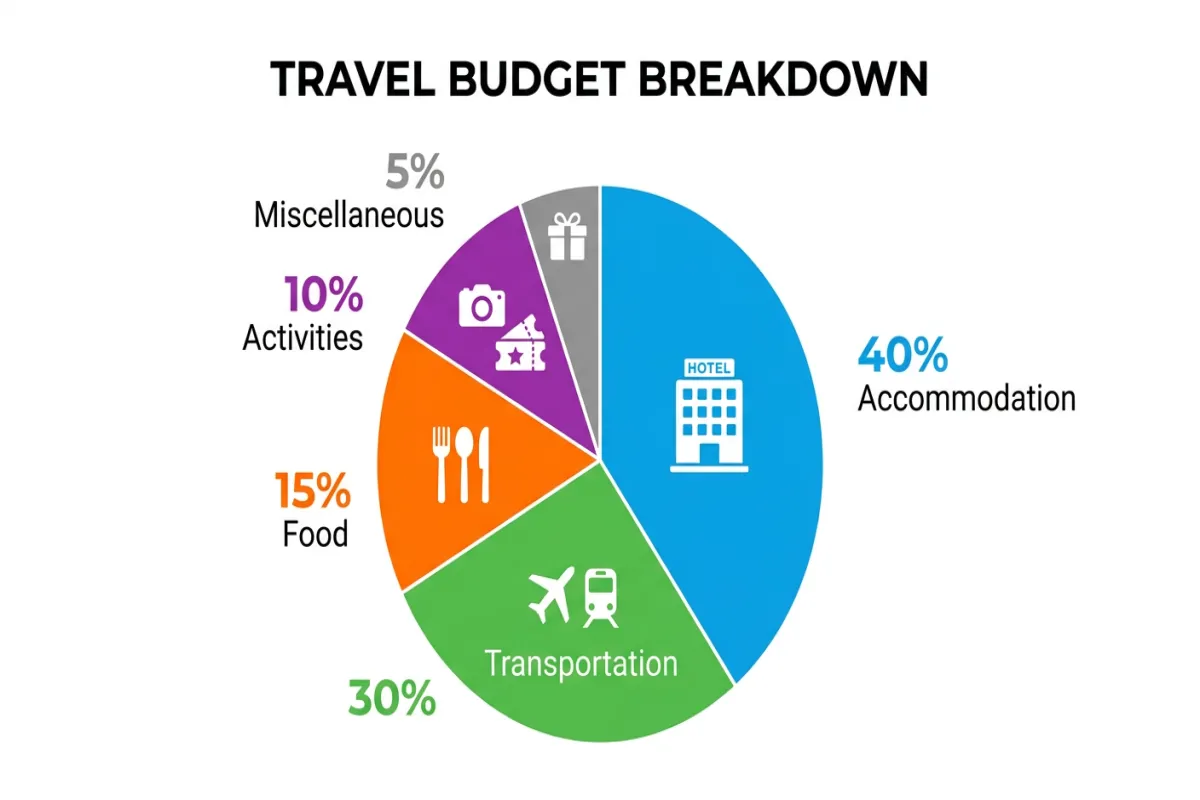
- 40% on flights/transportation – This is typically your biggest expense
- 30% on accommodation – Hotels, vacation rentals, or hostels
- 15% on food and drinks – Three meals a day plus snacks and coffee
- 10% on activities and attractions – Tours, museums, parks, experiences
- 5% on miscellaneous – Tips, souvenirs, unexpected costs
For a $3,000 domestic trip for two, that is roughly $1,200 on flights, $900 on hotels, $450 on food, $300 on activities, and $150 as a buffer. Use a travel budget template to track these categories as you book.
Tip #1: Set your total budget before you start browsing. Browsing without a number leads to “well, it is only $50 more” decisions that add up to hundreds. See our cheap vacation ideas. Heading abroad? Our guide on where to exchange money can save you on conversion fees.
Step 2: Book Flights Strategically (Tips #2-12)
Flights are where you save or waste the most money. These strategies consistently shave 15-40% off airfare.
Tip #2: Book domestic flights 1-3 months ahead. Data from Hopper and Google Flights shows that domestic fares hit their lowest point 1-3 months before departure. Booking 6 months early is not better. Booking 2 weeks out is almost always more expensive, sometimes by 40% or more.
Tip #3: Book international flights 2-5 months ahead. International fares have a wider sweet spot. For Europe, 2-4 months is ideal. For Asia or South America, 3-5 months tends to yield the best prices.
Tip #4: Search on Tuesday or Wednesday afternoon. Airlines frequently release sales and adjust prices mid-week. While the difference is not always dramatic, searching Tuesday through Thursday consistently shows lower average fares compared to weekend searches. Typical savings: $20-50 per ticket.
Tip #5: Use Google Flights price tracking. Set a price alert for your route and dates. Google will email you when fares drop. I have saved over $300 on a single round-trip ticket by waiting for an alert instead of booking on the first search.
Tip #6: Check nearby airports. Flying into a secondary airport can save 20-35%. For example, flying into Oakland instead of SFO, or Fort Lauderdale instead of Miami, often saves $50-150 per ticket. The extra 30-minute drive is usually worth it.
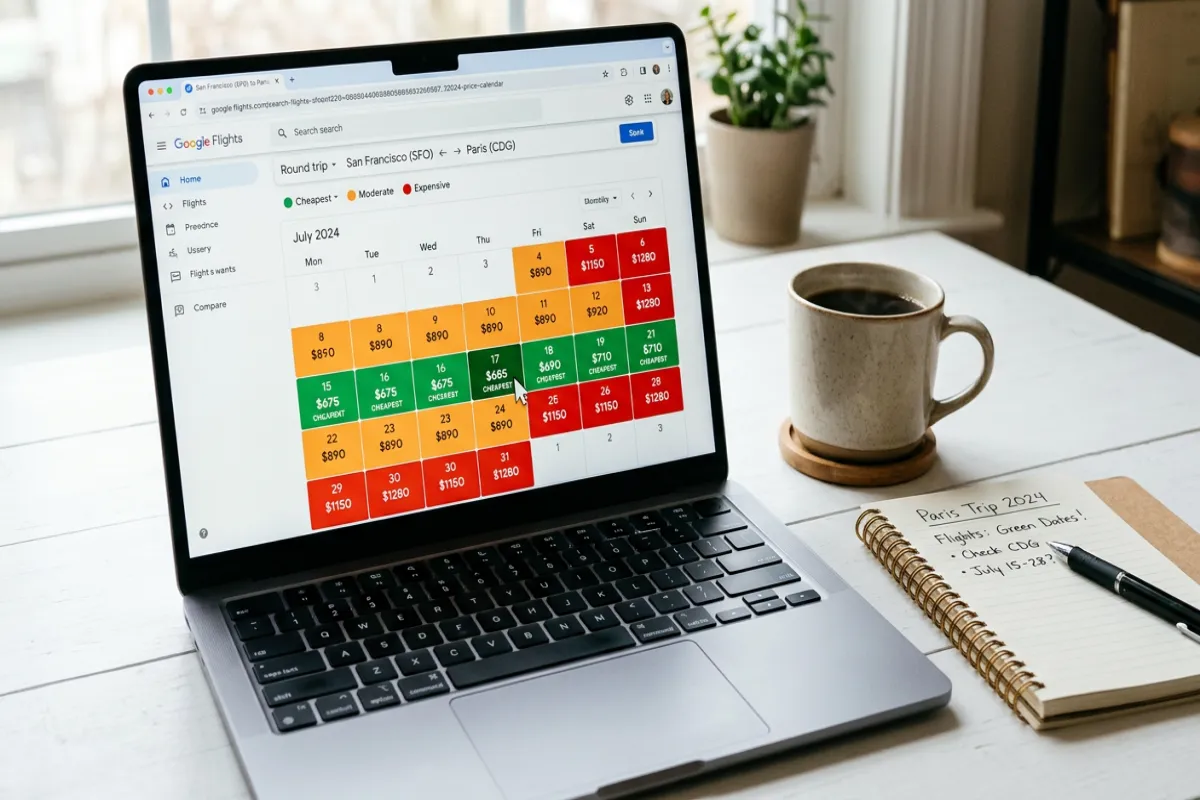
Tip #7: Be flexible by one or two days. Google Flights has a “date grid” view that shows prices across an entire month. Shifting your trip by just one or two days can sometimes save $100+ per person. A Wednesday departure is almost always cheaper than a Friday one.
Tip #8: Consider one-way tickets. Sometimes booking two one-way tickets on different airlines is cheaper than a round-trip on the same airline. Check both options. Southwest, in particular, often has competitive one-way fares.
Tip #9: Skip the seat upgrade unless it is a 5+ hour flight. Comfort Plus or extra legroom seats typically add $30-80 each way. For a 2-3 hour domestic flight, that money is better spent on your destination. Save upgrades for long-haul flights where the comfort genuinely matters.
Tip #10: Pack carry-on only. Checked bag fees are $35-70 per bag, per direction. For a couple making a round trip, that is $140-280 in bag fees alone. A good carry-on and packing cubes solve this for any trip under 10 days.
Tip #11: Use airline travel credit cardss strategically. Most airline credit cards offer 40,000-75,000 sign-up bonus miles after meeting a spending requirement. That is enough for 1-2 free domestic round-trip flights. The annual fee ($95-99 typically) pays for itself with the first redemption.
Tip #12: Fly basic economy if you can handle it. Basic economy fares are typically $30-60 cheaper than regular economy. The trade-offs are no seat selection, last boarding group, and sometimes no carry-on. If you are a solo traveler who packs light, this is free money.
One more flight tip worth mentioning: always check the airline’s own website after finding a fare on Google Flights or a comparison site. Occasionally airlines run direct-booking promotions or bundle deals (flight + checked bag) that are not reflected on aggregators. It takes 30 seconds and sometimes saves another $20-40.
Step 3: Reduce Accommodation Costs (Tips #13-21)
Tip #13: Travel during shoulder season for 20-40% savings. Shoulder season is the sweet spot between peak and off-season. For example, Europe in September-October or April-May gives you good weather and hotel rates that are 20-40% below July-August. Check the best time to travel for specific destinations.
Tip #14: Book hotels directly for best-price guarantees. Most major hotel chains (Marriott, Hilton, IHG) offer a best-rate guarantee when you book on their website. If you find a lower price elsewhere, they will match it and sometimes give you an additional discount or points. You also earn loyalty points only on direct bookings.
Tip #15: Compare hotels vs. vacation rentals for your group size. For 1-2 people, hotels are usually cheaper. For 4+ people, vacation rentals almost always win because you split one nightly rate instead of booking multiple rooms. A $200/night Airbnb split four ways is $50 per person, while two hotel rooms at $150 each is $75 per person.
Tip #16: Stay slightly outside the city center. Hotels one neighborhood over from the tourist core are often 25-40% cheaper. In most cities, a 10-15 minute subway or bus ride puts you in much more affordable areas. The money you save on the room covers the transit costs many times over.
Tip #17: Use hotel loyalty programs even if you travel once a year. Signing up is free. Even basic-tier members often get perks like late checkout, free Wi-Fi, and room upgrades when available. After 10-15 nights in a year, you hit mid-tier status with meaningful benefits like free breakfast.
Tip #18: Check for AAA, AARP, military, or corporate rates. These membership discounts are often 10-20% off the standard rate and they stack with loyalty programs. Always check the “special rates” dropdown when booking. Corporate rates are sometimes available even without verification.
Tip #19: Book refundable rates, then rebook if prices drop. Hotel prices fluctuate. Book a refundable rate now, then check back a week or two later. If the price drops, rebook at the lower rate and cancel the original. I have saved $50-100 per night doing this on several trips.
Tip #20: Consider hostels even if you are not 20 anymore. Modern hostels offer private rooms with en-suite bathrooms for $50-80 per night in cities where hotels start at $150+. Many now have co-working spaces, bars, and clean, design-forward interiors. Private hostel rooms are often the best value in expensive cities.
Tip #21: Book accommodations with a kitchen for trips over 4 days. A kitchen saves $30-60 per day on meals. Breakfast and lunch from a grocery store costs a fraction of eating out every meal. Even making just breakfast in your rental saves $10-15 per person daily.
Step 4: Cut Food and Transportation Expenses (Tips #22-30)
Tip #22: Eat your big meal at lunch, not dinner. Many restaurants offer lunch specials or prix fixe menus that are 30-50% cheaper than dinner. In cities like New York, a lunch special at a top restaurant might be $25-35, while the same dinner menu runs $60-80. You get the same food, same kitchen, smaller bill.
Tip #23: Use Google Maps to find where locals eat. Sort restaurants by rating and look for places with lots of reviews from locals rather than tourists. Restaurants within one block of major attractions charge a premium. Walk three blocks in any direction and prices typically drop 20-30%.
Tip #24: Buy a transit day pass on activity-heavy days. Most cities offer 1-day, 3-day, or weekly transit passes. In New York, a 7-day unlimited MetroCard is $34 versus $2.90 per ride. If you are taking more than 4 rides a day (which is common when sightseeing), the day pass pays for itself by early afternoon.
Tip #25: Book airport transportation in advance. Ride-share surge pricing at airports can be 2-3x normal rates during peak hours. Pre-booking a shuttle or shared ride saves $15-40 compared to an on-demand Uber at baggage claim. Many hotels also offer free airport shuttles if you ask.
Tip #26: Walk when the distance is under a mile. Obvious, but worth stating. Urban attractions are often closer together than you think. Use an AI travel planner to cluster activities by neighborhood, and you can walk between most stops. You save on transit and see more of the city.
Tip #27: Skip hotel breakfast unless it is included free. Hotel breakfast buffets charge $15-25 per person for mediocre food. A local bakery or coffee shop within walking distance is usually half the price and twice the quality. Search “breakfast near [your hotel]” on Google Maps the night before.
Tip #28: Bring a reusable water bottle. Buying bottled water adds up quickly, especially at tourist sites where a single bottle costs $3-5. A reusable bottle filled at water fountains or your hotel saves $5-10 per person per day. That is $70-140 for a family of four on a 5-day trip.
Tip #29: Use grocery store delis for quick, cheap meals. Chains like Whole Foods, Publix, and H-E-B have hot food bars, made-to-order sandwiches, and salad bars that run $8-12 for a full meal. Compare that to $18-25 at a sit-down restaurant. Great option for lunches between activities.
Tip #30: Avoid tourist-trap restaurants near major landmarks. The restaurant directly facing the Eiffel Tower, Times Square, or the Grand Canyon viewpoint charges a 30-50% markup for the view. Walk 5-10 minutes away and you will find better food at normal prices.
Step 5: Save on Activities and Attractions (Tips #31-35)
Tip #31: Buy city attraction passes only if you will use 4+ attractions. City passes like CityPASS or Go City cards offer 25-45% savings, but only if you actually visit enough attractions to break even. Do the math first. If you only want 2-3 attractions, buying individual tickets is usually cheaper.
Tip #32: Take advantage of free activities. Every destination has free options that are genuinely excellent. Free walking tours (tip-based), public parks, free museum days, neighborhood markets, hiking trails, and self-guided architecture walks cost nothing and are often the most memorable parts of a trip.
Tip #33: Book tours and activities directly, not through your hotel. Hotel concierges earn commissions for referrals. The same tour booked directly on the operator’s website is typically 15-25% cheaper. Check Viator or GetYourGuide for reviews, then book on the operator’s own site for the best price.
Tip #34: Visit major attractions early in the morning. Beyond avoiding crowds, morning visits are often cheaper. Some attractions have lower “early bird” pricing. Others simply let you move through faster, giving you more time for free activities later in the day instead of waiting in lines.
Tip #35: Check Groupon and local deal sites before booking activities. Groupon still offers legitimate 20-40% discounts on tours, restaurants, and experiences in most major travel destinations. Check it a week before your trip. The deals change frequently, so checking close to your travel date gets you the freshest options.
Step 6: Use Smart Planning to Save More (Tips #36-37)
Tip #36: Use an AI trip planner to optimize your routing. An AI travel planner clusters activities by neighborhood and time of day, reducing unnecessary transit. Poor routing on a 5-day trip can cost $50-100 in extra ride-shares or wasted transit passes. Let the AI handle the logistics so every dollar goes further.
Tip #37: Plan (at least loosely) before you go. The most expensive way to travel is to figure everything out on the spot. Last-minute restaurant choices, impulse attraction tickets, and unplanned transportation add up. Even a rough day-by-day plan saves 15-20% compared to fully winging it. Use a travel planning app to build a flexible framework that keeps you on budget without being rigid.
The goal is not to plan every minute. It is to have a structure that prevents the expensive improvisation that happens when you have no plan at all. Know where you are sleeping, how you are getting there, and what 2-3 things you want to do each day. Leave room for spontaneity within that framework.
If planning feels overwhelming, start with the free tools that do the heavy lifting for you. An AI travel planner can generate a budget-optimized itinerary in minutes, grouping free activities together and routing your day to minimize transit costs. You can then adjust the plan to match your priorities. The 15 minutes you spend planning can easily save $200-400 over a week-long trip.
Quick-Reference Budget Cheat Sheet
| Category | Budget Move | Typical Savings |
|---|---|---|
| Flights | Book 1-3 months ahead | 20-40% off last-minute fares |
| Flights | Fly carry-on only | $70-280 per trip |
| Hotels | Shoulder season travel | 20-40% off peak rates |
| Hotels | Stay one neighborhood out | 25-40% off central rates |
| Food | Big meal at lunch | 30-50% per meal |
| Food | Kitchen in your rental | $30-60 per day |
| Activities | Free walking tours + parks | $20-50 per day |
| Transport | Transit day pass + walking | $10-25 per day |
Real-World Budget Examples
Here is what these tips look like when you put them all together on real trips.
5-Day Trip to New York City (Couple)
- Flights: $380 round-trip (booked 6 weeks ahead, midweek departure) vs. $540 weekend departure. Saved: $160
- Hotel: $180/night in Long Island City instead of $290/night in Midtown. 10-minute subway ride. Saved: $550 over 5 nights
- Food: Lunch specials at nice restaurants, grocery store breakfast. $85/day vs. $140/day eating out every meal. Saved: $275
- Activities: Free walking tour of Lower Manhattan, free Brooklyn Bridge walk, Central Park. Paid only for the Met ($30/person) and a Broadway show ($120/person). Saved: ~$150 vs. doing 5 paid attractions
- Total saved: ~$1,135 – enough to fund a second weekend trip
7-Day Family Beach Vacation (Family of 4)
- Accommodation: Vacation rental with kitchen ($195/night) vs. two hotel rooms ($320/night). Saved: $875
- Food: Breakfast and lunch at the rental, dinner out. $110/day vs. $180/day eating every meal at restaurants. Saved: $490
- Flights: Booked 2 months ahead, carry-on only for the adults. Saved: $200 on bag fees, $120 on fare timing
- Total saved: ~$1,685
These are not extreme frugality examples. You still eat well, stay somewhere comfortable, and do everything you want. The savings come from making smarter choices about when, where, and how you book.
The Biggest Money Wasters to Avoid
Some expenses are more wasteful than others. These are the ones I see travelers regret most often.
- Airport food and drinks: A sandwich and coffee at the airport costs $18-25. Eat before you leave home or pack snacks. Savings: $15-20 per person, per direction.
- Hotel minibar: A $7 bottle of water and a $9 bag of chips. Buy snacks and drinks at a nearby convenience store instead. Savings: $10-20 per night.
- Overpriced airport parking: Airport lots charge $15-25 per day. Off-site lots with shuttle service run $8-12 per day. For a week-long trip, that is $50-90 saved. Or take a ride-share to the airport for a flat fee.
- Foreign ATM fees: Using a regular bank card at foreign ATMs costs $3-5 per withdrawal plus a 2-3% conversion fee. Get a no-foreign-fee debit card (Charles Schwab and many online banks offer them). Savings: $20-50 per trip.
- Buying travel-size toiletries: A 3 oz bottle of shampoo at the airport costs $4-6. Buy reusable travel bottles for $10 once and refill them from your regular products. Pays for itself after two trips.
Frequently Asked Questions
What is the best way to save money on travel?
The single biggest way to save money on travel is booking flights 1-3 months in advance for domestic trips and 2-5 months for international trips. Flight timing alone can save 20-40% compared to last-minute bookings. After that, traveling during shoulder season (the weeks just before or after peak season) typically saves 20-30% on both flights and hotels while still offering good weather and fewer crowds.
What is the most forgotten item when traveling?
The most commonly forgotten travel items are phone chargers, toiletries, and adapters for international trips. But the most expensive forgotten item is travel insurance. Skipping it can cost thousands if something goes wrong. The second most costly oversight is forgetting to notify your bank about international travel, which can lead to frozen cards and expensive emergency fees abroad.
Will travel be cheaper in 2026?
Domestic U.S. airfares in 2026 have stabilized slightly below 2025 levels, with average round-trip fares running $280-340 for domestic routes. Hotel prices remain elevated in major cities but have softened in secondary markets. The best deals in 2026 are in shoulder-season international travel, where competition among low-cost carriers on transatlantic routes has pushed Europe round-trip fares below $400 from many East Coast cities.
What travel trend will dominate in 2026?
AI-powered trip planning is the dominant travel trend in 2026. Travelers are using AI tools to build optimized itineraries that balance cost, time, and experience quality. Other major trends include slow travel (staying longer in fewer places to reduce per-day costs), workcation travel (combining remote work with travel for extended stays), and value-focused luxury, finding high-end experiences at mid-range prices through strategic timing and booking.