
Month-by-Month Overview: When to Visit the USA
The U.S. is so geographically diverse that there’s no single “best month” to visit. January is terrible for the Midwest but perfect for southern Florida. August is peak season in Yellowstone but miserably hot in Phoenix. The trick is matching the month to the region.
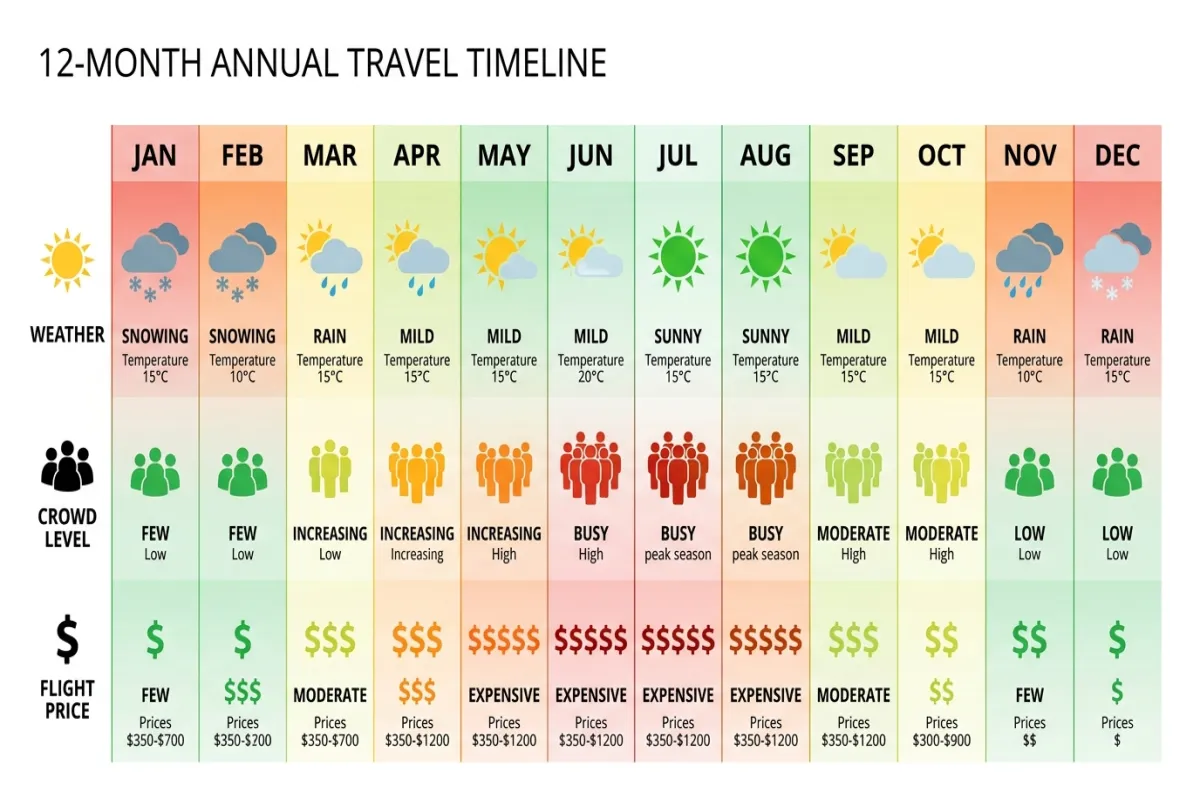
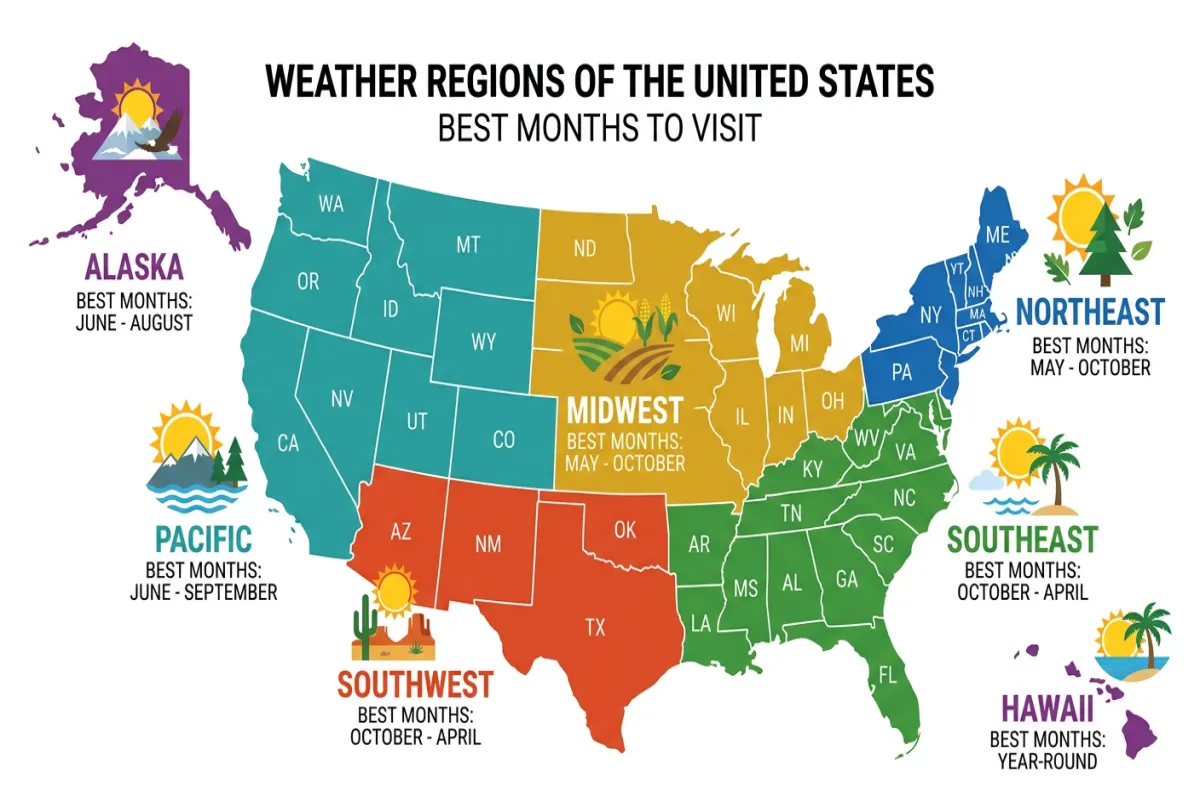
Here’s a quick-reference table, then we’ll break down each region in detail.
| Month | Best Regions | Crowds | Flight Prices | Highlights |
|---|---|---|---|---|
| January | Southeast, Hawaii, Southwest (ski) | Low | Cheapest of the year | Florida beaches, ski season, low hotel rates |
| February | Southeast, Hawaii, Southwest (ski) | Low (except Presidents’ Day) | Very low | Mardi Gras in New Orleans, ski conditions peak |
| March | Southeast, Southwest, Hawaii | Moderate (spring break) | Rising | Cherry blossoms in D.C., spring break beaches |
| April | Southeast, Mid-Atlantic, Southwest | Moderate | Moderate | Wildflower season, pleasant temps nationwide |
| May | Northeast, Southeast, Pacific NW | Moderate | Moderate | National parks opening, pre-summer sweet spot |
| June | Northeast, Mountain West, Alaska | High | High | Long days, summer festivals, Alaska access |
| July | Mountain West, Alaska, Pacific NW | Peak | Peak | National parks fully accessible, July 4th events |
| August | Mountain West, Pacific NW, Alaska | Peak | High | Last month of summer travel, state fairs |
| September | Northeast, Midwest, Southwest, Pacific | Dropping fast | Low | Early fall foliage, warm days, empty parks |
| October | Northeast, Southeast, Southwest | Moderate | Low | Peak fall foliage, Halloween events, wine harvest |
| November | Southeast, Southwest, Hawaii | Low (except Thanksgiving) | Low (except holiday week) | Warm-weather escapes, holiday markets start |
| December | Southeast, Hawaii, Mountain West (ski) | High (holidays) | High (Dec 18-Jan 2) | Holiday markets, ski season, Florida/Hawaii escapes |
Northeast: New England, New York, Mid-Atlantic
States: Maine, Vermont, New Hampshire, Massachusetts, Connecticut, Rhode Island, New York, New Jersey, Pennsylvania, Maryland, Washington D.C.
Best months: May through October
The Northeast has the most dramatic seasonal shifts in the country. Winters are cold and gray (often below freezing from December through February). Summers are warm and lively. But the real magic happens in the shoulders.
May and June bring comfortable temperatures in the 60s and 70s, blooming gardens, and manageable crowds. It’s the best window for cities like New York, Boston, and D.C. Cherry blossom season in Washington peaks in late March to early April, but the crowds are intense.
September and October are arguably the best time to visit the entire region. Fall foliage transforms Vermont, New Hampshire, and Maine into a postcard. Temperatures sit in the 50s-70s. Tourist crowds thin out after Labor Day. Hotel rates drop 15-25% from summer peaks.
Avoid: January through March unless you’re skiing in Vermont or visiting a specific event. The cold and short days make outdoor sightseeing unpleasant.
Southeast: Florida, Carolinas, Georgia, Gulf Coast
States: Florida, Georgia, South Carolina, North Carolina, Virginia, Louisiana, Mississippi, Alabama, Tennessee
Best months: March through May, October through November
The Southeast is a year-round destination, but humidity and hurricane season narrow the ideal window.
March through May is the sweet spot. Temperatures range from the mid-60s to low 80s. Humidity hasn’t ramped up yet. Azaleas bloom in Charleston and Savannah. Spring break crowds hit Florida beaches in March but thin by mid-April.
October and November bring a second ideal window. Hurricane season is winding down (it officially ends November 30), temperatures cool to the 60s-70s, and hotel rates drop significantly from summer.
Summer (June-August) is hot and humid across the region, often above 90 degrees with high humidity. Florida and the Gulf Coast also sit in peak hurricane season. It’s not a dealbreaker, but be prepared for afternoon thunderstorms almost daily.
Winter (December-February) is excellent for Florida (especially South Florida and the Keys) but cool and damp farther north. New Orleans in February offers Mardi Gras if you don’t mind crowds.
Midwest: Great Lakes, Plains, Upper Midwest
States: Illinois, Michigan, Wisconsin, Minnesota, Ohio, Indiana, Iowa, Missouri, Kansas, Nebraska, South Dakota, North Dakota
Best months: June through September
The Midwest has a short but excellent travel season. Winters are brutal (Minnesota and Wisconsin regularly dip below zero). But summer and early fall are genuinely wonderful.
June through August is peak season for good reason. Temperatures sit in the 70s-80s. The Great Lakes are warm enough for swimming by July. Chicago‘s outdoor festivals (Lollapalooza, Taste of Chicago, street fests in every neighborhood) run all summer. Michigan’s coastline, Wisconsin’s Door County, and Minnesota’s Boundary Waters are at their best.
September is the under-the-radar pick. The heat breaks, mosquitoes die off, and early fall color starts in the northern reaches. State fairs wrap up, and you get warm days without the summer crowds.
Avoid: November through March for casual travel. If you want to see the Badlands or drive the Great River Road, wait until May at the earliest.
Southwest and Mountain West: Desert, Canyons, Rockies
States: Arizona, New Mexico, Utah, Nevada, Colorado, Wyoming, Montana, Idaho
Best months: April through May, September through October (desert); June through September (mountains)
This region splits into two zones with opposite ideal seasons.
Desert Southwest (Arizona, southern Utah, New Mexico): Visit in spring (April-May) or fall (September-October) when temperatures are in the 60s-80s. Summer in Phoenix, Tucson, and the Grand Canyon South Rim regularly exceeds 100 degrees. Winter is mild but can bring snow to higher elevations like Flagstaff and Santa Fe.
Mountain West (Colorado, Montana, Wyoming, Idaho): Summer (June-September) is prime time. High-altitude trails in Glacier, Yellowstone, and Grand Teton are only fully accessible from late June through September. Going-to-the-Sun Road in Glacier doesn’t typically open until late June or early July.
Ski season runs December through March across Colorado, Utah, Montana, and Wyoming. If that’s your goal, January and February offer the best snow conditions.
Use Yopki’s AI planner to build a road trip itinerary across the Southwest. The AI factors in drive times between parks, which is critical when distances are measured in hundreds of miles. See our road trip planning guide for route-specific strategies.
Pacific: California, Oregon, Washington
States: California, Oregon, Washington
Best months: June through October (overall); year-round for Southern California
Southern California is a genuine year-round destination. Los Angeles and San Diego average 60-75 degrees even in winter. Summer is warm and dry (75-85 degrees). The “worst” month is June, when a marine layer called “June Gloom” brings overcast mornings that burn off by noon.
Northern California, Oregon, and Washington are best from June through September. The Pacific Northwest gets heavy rain from October through May, and many mountain roads and trails are closed or muddy. But summer in the PNW is spectacular: 70s, low humidity, long daylight hours, and almost no rain.
September and October are the sweet spot for wine country (Napa, Sonoma, Willamette Valley). Harvest season means winery events, warm days, and fewer tourists than summer.
Highway 1 along the California coast is best driven in September or October. Summer fog can obscure the views along Big Sur. Fall brings clearer skies and lighter traffic. For more must-see stops, check our guide to USA attractions.
Alaska and Hawaii: The Outliers
Alaska
Best months: June through August
Alaska has a narrow travel window. Most lodges, tours, and roads (including Denali Park Road) operate from late May through mid-September. June through August gives you the longest daylight hours (up to 20+ hours near the solstice), the warmest temperatures (55-70 degrees in most areas), and full access to wildlife viewing, glacier tours, and backcountry hiking.
September brings fall colors and northern lights viewing, but temperatures drop fast and some facilities start closing.
Hawaii
Best months: April through May, September through November
Hawaii is comfortable year-round (75-85 degrees), but there are meaningful differences in price and crowds. Winter (December-March) is peak season, with the highest hotel rates and most crowded beaches. It’s also whale watching season on Maui, which is a legitimate reason to visit despite the crowds.
The shoulder seasons, April-May and September-November, offer the best value. Rates drop 20-30% from peak, the weather is virtually identical, and you’ll have an easier time booking popular restaurants and activities.
The Cheapest Time to Fly Domestically in 2026
Flight prices follow predictable patterns. Here’s what the booking data shows for domestic U.S. flights in 2026:
Cheapest months to fly:
- January (after the 7th) and February: Average domestic round-trips run $150-250 on many routes. Airlines discount heavily to fill seats after the holidays.
- September (after Labor Day) through early November: The second cheapest window. Fares run 15-20% below the annual average.
- Tuesdays and Wednesdays are consistently the cheapest days to fly, regardless of month.
Most expensive times to fly:
- Thanksgiving week: The single most expensive domestic travel week of the year.
- December 18 through January 2: Holiday premium adds 30-50% to base fares.
- Mid-June through mid-August: Summer fares average 25-40% above baseline.
- Spring break (mid-March through mid-April): Especially routes to Florida, California, and Hawaii.
Booking timing: For domestic flights, the sweet spot is 3-8 weeks before departure. Booking too early (3+ months) or too late (under 2 weeks) typically costs more. Set fare alerts on Google Flights and buy when the price drops below the predicted range.
For more ways to cut travel costs, see our guide on saving money on USA travel.
Shoulder Season Strategies: Best Value for Your Money
Shoulder seasons, the weeks just before and after peak season, consistently deliver the best combination of weather, crowds, and price. Here are the specific windows worth targeting:
- Late April to mid-May: National parks are open but not yet slammed. Hotels are 15-25% cheaper than June. Weather is warm across most of the country.
- September (after Labor Day): The single best shoulder month in the U.S. Summer crowds vanish, flights get cheap, and weather holds strong in every region except Alaska.
- Early to mid-October: Perfect for the Northeast (fall foliage), Southwest (cooling temps), and wine country (harvest season).
- Early December (before the 15th): Holiday markets are open but holiday crowds haven’t arrived. Flights are still at off-peak pricing.
The practical trick is to shift your trip by just one to two weeks. Flying out on September 3rd instead of August 20th can save you $100-200 per person on flights alone, with noticeably fewer crowds at every stop.
Holiday Travel: Planning Around Peak Dates
If you have to travel during holidays, these tips minimize the pain:
- Thanksgiving: Fly on Thanksgiving Day itself (cheapest day of the week) or the Saturday before. The Wednesday before Thanksgiving is the most expensive and congested travel day of the year.
- Christmas/New Year’s: Book flights by early October. Prices jump 5-10% every week after that. If you’re flexible on destination, search “Explore” on Google Flights to find the cheapest option from your airport.
- Spring break: Shift your dates one week before or after the core window (typically the third and fourth weeks of March). Same destinations, 20-30% cheaper.
- Fourth of July: Fly on the 4th itself rather than the days surrounding it. Consider destinations that aren’t traditional July 4th hotspots. The Oregon Coast, for example, is far less crowded than Myrtle Beach.
Use Yopki’s trip planner to compare itineraries across different date ranges. Seeing the full plan side by side makes it easier to decide if shifting by a week is worth the savings.
Frequently Asked Questions
What is the cheapest month to travel in the USA?
January and February are consistently the cheapest months to travel domestically. Average domestic airfares drop 20-30% below the annual mean, hotel rates fall significantly outside ski destinations, and most attractions have minimal wait times. Mid-September through early November is the second-cheapest window, with fares averaging 15-20% below peak summer prices.
What is the best month for a US road trip?
September and early October are the best months for a US road trip. Summer crowds have dissipated, gas prices typically dip after Labor Day, weather is pleasant across most of the country, and fall foliage adds scenic value in the Northeast, Midwest, and mountain regions. May is the runner-up, offering comfortable temperatures before peak summer pricing kicks in.
When is peak travel season in the US?
Peak travel season runs from mid-June through mid-August, with secondary peaks during Thanksgiving week, the December holidays (December 18 through January 2), and spring break (mid-March through mid-April). During peak summer, domestic flights average 25-40% more than off-peak months, and popular destinations like national parks can see two to three times normal visitor volumes.
Will travel be cheaper in 2026?
Domestic airfares in 2026 are trending 3-5% lower than 2025 levels on many routes, driven by increased airline capacity and competitive fare matching. Hotel prices remain relatively flat. The best strategy for cheap travel in 2026 is targeting shoulder seasons (April to mid-May and September to October) when you can find domestic round-trip flights for $150-$250 on many routes.
Plan Your Trip Around the Right Dates
Timing is the single biggest lever you have for controlling both the cost and quality of a U.S. trip. The difference between visiting Yellowstone in mid-July versus mid-September is hundreds of dollars in savings, half the crowd, and arguably better weather.
Start by picking your region, then match it to the best month from the table above. Use Yopki’s AI travel planner to generate a full itinerary for your dates and see exactly what a day-by-day plan looks like. From there, adjust timing based on your budget and schedule.