I’ve lost count of how many packing lists I’ve made over the years. And honestly, most of the ones floating around the internet are either way too long (nobody needs 80 items for a week in Portugal) or painfully vague (“bring comfortable shoes” – thanks for nothing).
This is the travel essentials packing list I actually use. It’s organized by category, covers every trip type from a weekend away to a month abroad, and skips the filler. Bookmark it, print it, whatever works for you.
Download the Free Checklist
Save it, print it, check items off as you go.
The Non-Negotiables: Items That Should Never Leave Home Without You
Before we get into full categories, here’s the short list. If you pack nothing else, pack these:
- Passport or government-issued ID (check the expiration date – many countries require 6 months of validity)
- Phone + charger + portable battery pack
- One credit card and one debit card (from different banks, in case one gets frozen)
- Prescription medications in their original bottles
- One complete change of clothes in your carry-on (because checked bags get lost)
That’s it. Everything else on this list matters, but those five things are the ones that will actually ruin your trip if you forget them.
Travel Documents and Money
Lost documents are the fastest way to turn a vacation into a headache. Here’s what to bring and how to keep it organized.
Documents to Pack
- Passport (plus a photocopy stored separately from the original)
- Visa or electronic travel authorization (ETIAS for Europe kicks in soon – check before you go)
- Driver’s license or secondary ID
- Travel insurance card or policy number
- Boarding passes and hotel confirmations
- Emergency contact list (on paper, not just in your phone)
- Vaccination records if required (still needed for some destinations)
Money Essentials
- Primary credit card (one with no foreign transaction fees)
- Backup debit card from a different bank
- Small amount of local currency for arrival (taxis, tips, vending machines)
- Money belt or hidden pouch for high-theft areas
Pro tip: Instead of juggling paper printouts, use a travel document organizer to keep your boarding passes, confirmations, and itinerary details in one place. Yopki’s organizer lets you pull everything up offline, which is a lifesaver when you’re standing at a hotel check-in with no cell signal.
Clothing: What to Pack (and What to Leave Behind)
Clothing is where most people overpack. You don’t need a different outfit for every day. You need a small set of versatile pieces that work together.
The Core Clothing List
- 3-5 tops (mix casual and one slightly nicer option)
- 2-3 bottoms (jeans or travel pants that dress up or down)
- 1 light jacket or layering piece
- 7 pairs of underwear and socks
- 1 swimsuit (even if you’re not planning on swimming – hotel pools happen)
- 1 pair of comfortable walking shoes
- 1 pair of sandals or flip-flops (doubles as shower shoes in hostels)
- Sleepwear
Weather-Specific Additions
- Cold weather: Thermal base layer, warm hat, gloves, scarf, insulated jacket
- Hot weather: Linen or moisture-wicking fabrics, wide-brim hat, UV-protection shirt
- Rainy season: Packable rain jacket (not an umbrella – your hands will be full)
If you’re gone longer than a week, plan to do laundry. Every city has laundromats, and most hotels offer laundry service. Packing for 14 days is a trap.
Toiletries and Personal Care
The TSA 3-1-1 rule still applies for carry-on: each liquid container must be 3.4 oz (100 ml) or less, all fitting in one quart-sized clear bag. Here’s what to prioritize. See our carry-on packing guide.
Toiletries Checklist
- Toothbrush and toothpaste
- Deodorant
- Shampoo and conditioner (solid bars save space and avoid spill risk)
- Face wash and moisturizer with SPF
- Sunscreen (SPF 30 minimum – buy the good stuff before you leave; airport sunscreen is $18 for 2 oz)
- Lip balm with SPF
- Razor
- Contact lenses and solution (plus backup glasses)
- Any prescription skincare
Health and First Aid
- Prescription medications (pack more than you think you need – delays happen)
- Pain reliever (ibuprofen or acetaminophen)
- Antihistamine (Benadryl or similar)
- Anti-diarrhea medication (Imodium – don’t learn this lesson the hard way)
- Band-aids and antibiotic ointment
- Motion sickness medication if you need it
- Hand sanitizer
- Insect repellent (for tropical destinations)
Skip the giant first-aid kit. A few basics tucked into a small ziplock bag will cover 99% of situations.
Tech and Electronics
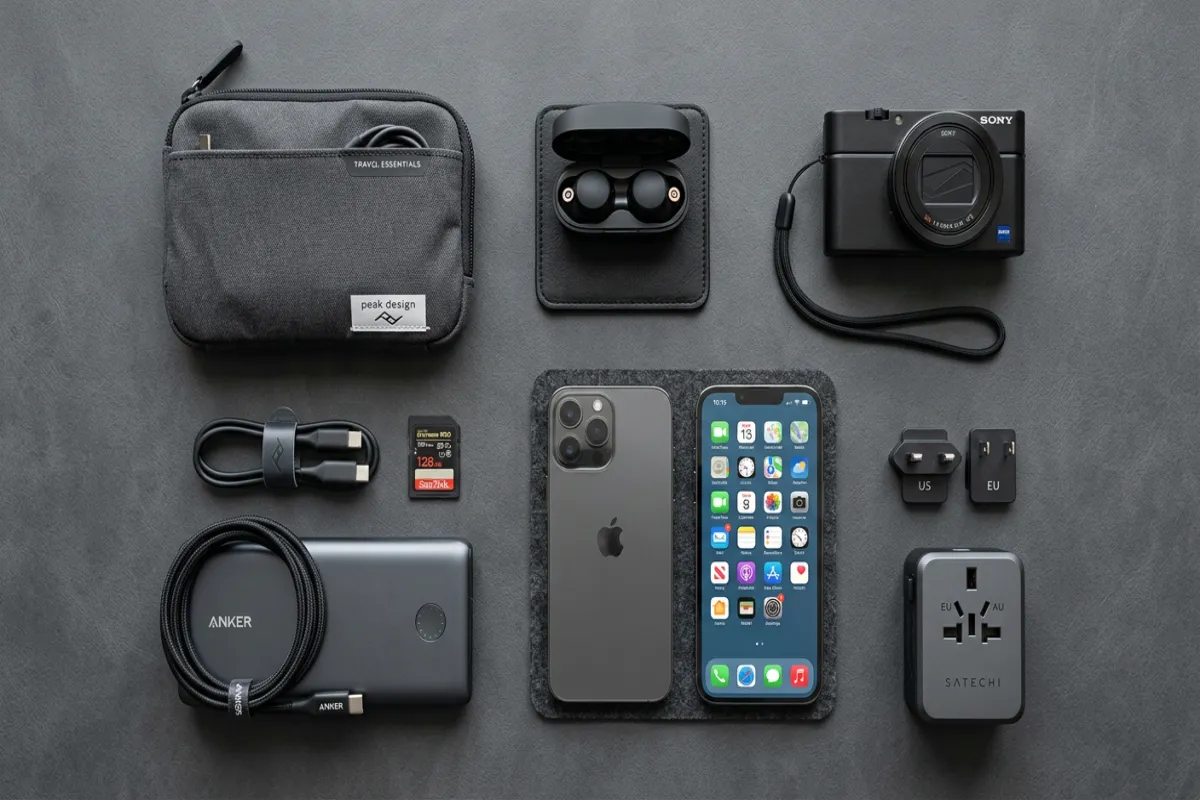
This category has grown a lot in the last few years. Here’s what’s actually worth the bag space.
Must-Have Tech
- Phone + charging cable (obvious, but I’ve seen people forget the cable)
- Portable battery pack (10,000 mAh minimum – enough for 2-3 full phone charges)
- Universal power adapter (get one that handles US, EU, UK, and AU plugs)
- Noise-canceling headphones or earbuds (game-changer on flights and in hostels)
- E-reader (weighs less than one paperback but holds thousands of books)
Nice-to-Have Tech
- Laptop or tablet (only if you actually need it)
- Camera (if your phone camera isn’t enough)
- AirTag or Tile tracker in your checked bag
- Small power strip or multi-port USB charger (hotel rooms never have enough outlets)
- eSIM or local SIM card (check if your phone supports eSIM before you go – Airalo and Holafly are popular options)
One more thing: download offline maps, your printable itinerary, and any translation apps before you leave. Airport Wi-Fi is unreliable, and data plans don’t always kick in immediately.
Carry-On Essentials: Your In-Flight Survival Kit
Your carry-on is your insurance policy. If your checked bag disappears, you should be able to survive 24-48 hours with what’s in your carry-on.
Always in the Carry-On
- All documents, cards, and cash
- All medications
- Phone, charger, and battery pack
- One full change of clothes (including underwear and socks)
- Toiletries bag
- Headphones
- Snacks (airport food is expensive and boarding delays are real)
- Empty reusable water bottle (fill after security) See our current TSA rules.
- Pen (for customs forms – yes, they still exist)
- Neck pillow or compressible pillow for flights over 4 hours
Some travelers also pack a lightweight scarf or sarong. It works as a blanket on cold planes, a cover-up for visiting temples, or a beach towel in a pinch. High versatility per gram.
Packing Accessories That Actually Help
I’m not a gear junkie, but a few accessories genuinely make packing easier:
- Packing cubes – Worth every penny. They compress clothes, keep your bag organized, and make repacking at each stop faster. Get a set of 3-4 in different sizes.
- Compression bags – For bulky items like jackets. Roll out the air and reclaim half the space.
- Shoe bags – Keep dirty soles off your clean clothes.
- Dry bag – A small waterproof bag (5-10L) for beach days, water activities, or just keeping electronics safe in rain.
- Packable day bag – A lightweight backpack that folds into its own pocket. Use it for day trips so you’re not hauling your main bag around.
- Luggage scale – Costs $10, saves you the $50-$100 overweight bag fee.
The Packing Rules That Actually Work
You’ve probably seen a dozen “packing rules” on social media. Here are the two that are actually useful, plus one that’s overhyped.
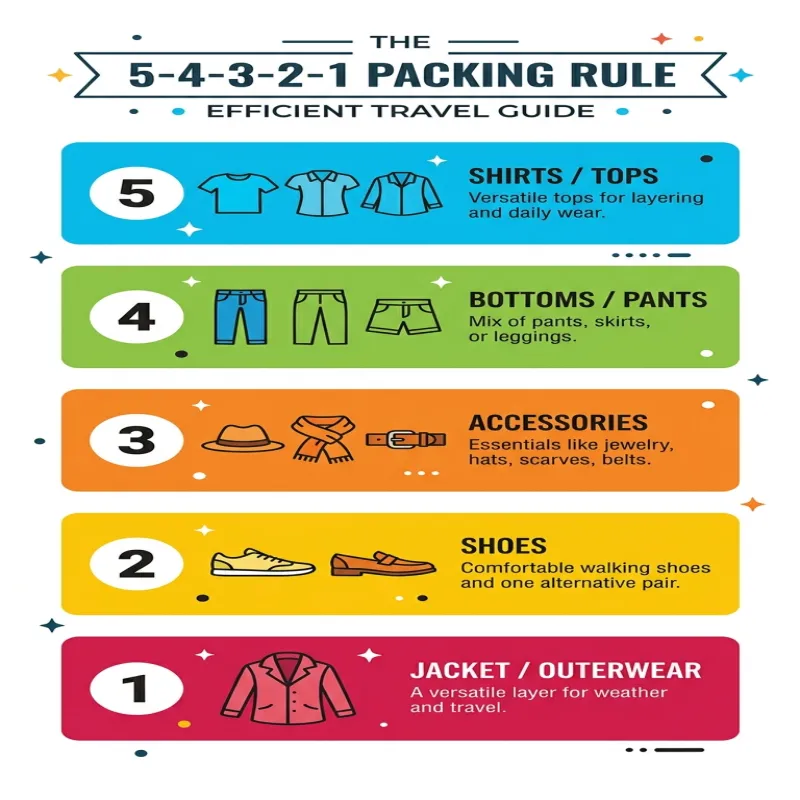
The 5-4-3-2-1 Packing Rule
This one works great for a week-long trip:
- 5 tops
- 4 bottoms
- 3 accessories (scarf, hat, belt, jewelry – whatever you’ll use)
- 2 pairs of shoes
- 1 hat or outerwear piece
The genius of this rule is the constraint. When you have to pick only 4 bottoms, you automatically choose versatile ones. It eliminates the “but what if I want to wear this specific dress to a restaurant I haven’t booked yet” spiral.
The 3-5-7 Rule for Packing
A simpler version: pack 3 bottoms, 5 tops, and 7 pairs of underwear/socks – no matter how long the trip. The idea is you’ll do laundry if you’re gone more than a week.
This rule works best for minimalist packers and carry-on-only travelers. If you’re the type who checks a bag regardless, the 5-4-3-2-1 rule gives you a bit more flexibility.
The “Lay It Out, Then Remove 30%” Rule
Put everything you want to pack on your bed. Look at it. Now put 30% of it back. You probably won’t miss any of it. This is less a rule and more a gut check, but it’s surprisingly effective if you tend to overpack.
5 Biggest Packing Mistakes to Avoid
I’ve made all of these at least once. Learn from my pain.
- Packing “just in case” outfits. That formal blazer for a dinner you might attend? Leave it. If you need something specific, buy it there. It’s usually cheaper and doubles as a souvenir.
- Putting essentials in checked luggage. Medications, documents, a change of clothes, and electronics should always be in your carry-on. Airlines lose about 7 bags per 1,000 passengers. Don’t gamble on yours.
- Ignoring your airline’s size and weight limits. Carry-on dimensions vary by airline. A bag that fits on Delta might not fit on Ryanair. Check before you’re standing at the gate being told to check your bag for $60.
- Leaving document organization to the last minute. Scrambling to find your hotel confirmation at midnight before a 5 AM flight is not fun. Get your documents sorted at least a day before departure. A travel document organizer makes this painless.
- Overpacking toiletries. Hotels provide shampoo, conditioner, and soap. Many destinations sell familiar brands. You don’t need full-size bottles of everything.
Packing List by Trip Type
Not every trip needs the same gear. Here’s a quick breakdown of what to add or subtract based on where you’re going.
Beach Vacation
Add: 2 swimsuits, reef-safe sunscreen, waterproof phone case, cover-up, sunglasses with UV protection. Skip: heavy shoes, jackets, formal clothes.
City Break (3-5 Days)
Add: one nicer outfit for restaurants, comfortable walking shoes (break them in before the trip), small crossbody bag. Skip: bulky outdoor gear, too many “options.”
Adventure / Hiking Trip
Add: moisture-wicking layers, hiking boots (worn in), rain shell, headlamp, quick-dry towel, water purification tablets. Skip: cotton anything, heavy jeans, nice shoes.
Planning an outdoor adventure? Our camping trip planning guide and hiking trip planning guide include detailed gear checklists specific to each activity.
Business Travel
Add: wrinkle-resistant blazer, dress shoes, laptop and accessories, business cards if you still use them, portable steamer or wrinkle-release spray. Skip: excess casual clothes – you’ll be in meetings most of the time.
Long-Term Travel (1 Month+)
Pack the same as a one-week trip, plus: laundry supplies (a sink stopper and travel detergent), extra zip-lock bags, a small sewing kit, and backup copies of important documents stored in the cloud. Seriously – the 3-5-7 rule was made for this. Don’t pack 30 days of clothes.
Your Pre-Trip Checklist (Don’t Skip This)
Packing the bag is only half the job. Here’s what to do in the 24-48 hours before departure:
- Confirm all flights, hotels, and car rentals
- Check in online and save boarding passes
- Notify your bank about international travel
- Download offline maps for your destination
- Charge all devices and battery packs
- Set up an out-of-office email reply
- Share your itinerary with someone at home
- Take a photo of your packed bag contents (useful for insurance claims)
- Double-check passport expiration date
- Confirm visa requirements for your destination
- Arrange pet care, mail holds, or house-sitting if needed
If you’re the kind of person who wants all of this in one place, Yopki’s trip planning guide walks through the full process from booking to boarding.
And once your bags are packed, find activities at your destination so you know exactly what to do when you arrive.
Frequently Asked Questions
What is the 5 4 3 2 1 packing rule?
The 5-4-3-2-1 packing rule limits you to 5 tops, 4 bottoms, 3 accessories, 2 pairs of shoes, and 1 hat or jacket. It works well for trips of about one week and forces you to pick versatile pieces that mix and match.
What is the basic travel essentials checklist?
A basic travel essentials checklist includes: passport or ID, phone and charger, credit/debit cards, medications, a change of clothes in your carry-on, toiletries, a reusable water bottle, and any booking confirmations. Everything else is secondary to these core items.
What is the 3 5 7 rule for packing?
The 3-5-7 rule says you should pack for a maximum of 3 bottoms, 5 tops, and 7 pairs of underwear and socks – regardless of trip length. The idea is that you can do laundry during the trip rather than packing a fresh outfit for every day.
What are the 5 biggest packing mistakes to avoid?
The five biggest packing mistakes are: (1) packing “just in case” outfits you’ll never wear, (2) not putting essentials in your carry-on, (3) forgetting to check luggage size limits for your airline, (4) leaving document organization to the last minute, and (5) overpacking toiletries when travel-size versions or hotel supplies will do.
The Bottom Line
The best travel essentials packing list is one you actually follow. Print this out, tape it inside your closet door, and go through it every time you pack. After two or three trips, you’ll have it memorized – and you’ll be the person calmly walking through the airport with one well-packed bag while everyone else is dragging three overstuffed suitcases.
Pack less, stress less, travel better.