A personalized travel itinerary is a day-by-day trip plan built around your specific interests, travel style, budget, and pace. It is the opposite of a generic “Top 10 Things to Do” list copied from a travel blog. Instead of visiting the same attractions as everyone else in the same order, a personalized itinerary reflects how you actually want to travel.
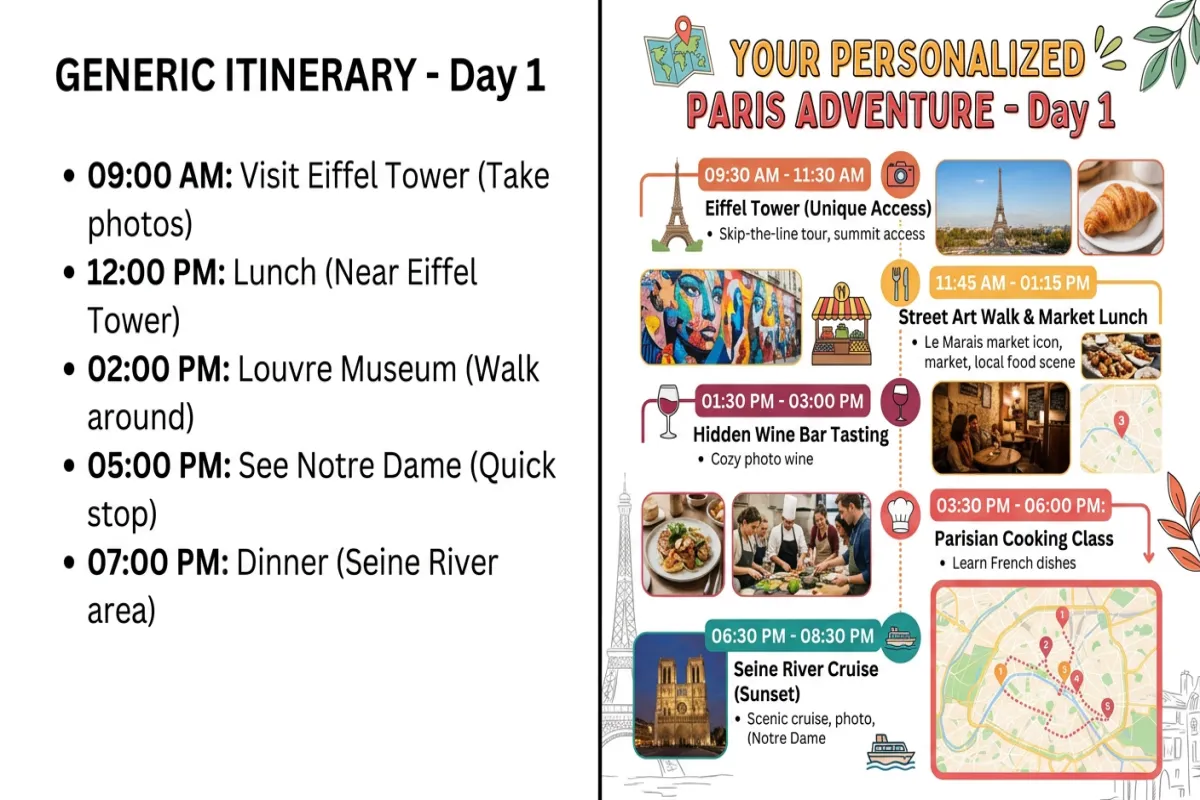
The difference matters more than most people realize. A generic Paris itinerary sends every traveler to the Eiffel Tower on Day 1 and the Louvre on Day 2. A personalized itinerary for a food-obsessed couple skips the tourist-heavy restaurants, clusters bakery visits and market tours by arrondissement, and schedules the Louvre for a quiet Wednesday evening instead of a packed Saturday morning.
Why Generic Itineraries Fail
Generic itineraries are designed for no one in particular, which means they work poorly for almost everyone. Here are the most common problems.
They Ignore Your Pace
Most template itineraries pack 6-8 activities into every day. That works for a 25-year-old solo backpacker. It does not work for a family with a toddler, a couple who likes long lunches, or anyone over 50 who does not want to walk 10 miles a day. Pace is personal, and generic plans ignore it completely.
They Assume Everyone Has the Same Interests
A standard Rome itinerary includes the Colosseum, Vatican, and Trevi Fountain. But what if you have already visited Rome and want to explore the Trastevere food scene, vintage shops in Monti, and sunset drinks on a rooftop? Generic itineraries optimize for first-time visitors doing the obvious things.
They Do Not Account for Your Group
A solo traveler, a couple, a family with kids, and a group of friends all need fundamentally different plans for the same destination. Walking distances, restaurant choices, activity types, and daily schedules all change based on who is traveling. A one-size-fits-all itinerary fits none of these groups well.
They Waste Time with Bad Routing
Generic itineraries often list attractions without considering geography. You end up zigzagging across a city, spending 30-45 minutes in transit between stops that could have been sequenced in a 10-minute walk. Poor routing wastes 1-2 hours per day on a typical sightseeing trip.
The Personalization Spectrum: Three Approaches
There are three ways to create a personalized itinerary, each with different trade-offs in time, cost, and quality.
| Approach | Time Required | Cost | Personalization Level | Best For |
|---|---|---|---|---|
| DIY (manual research) | 8-15 hours | Free | High (if you put in the work) | Experienced travelers who enjoy planning |
| AI Travel Planner | 15-30 minutes | Free to low cost | High | Most travelers |
| Human Travel Agent | 1-2 hours of calls + wait time | $200-500+ per trip | Very high | Luxury travelers, complex multi-country trips |
DIY Planning
You research everything yourself using Google, travel blogs, Reddit, and guidebooks. You build a spreadsheet or document with your day-by-day plan, manually checking distances, opening hours, and restaurant reviews.
Pros: Complete control. Free. You learn a lot about your destination in the process.
Cons: Takes 8-15 hours for a week-long trip. Easy to miss logistics issues like bad routing or closed-on-Monday attractions. Can feel overwhelming for complex or unfamiliar destinations.
AI Travel Planner
You tell an AI travel planner about your destination, dates, interests, pace, and budget. The AI generates a complete day-by-day itinerary in seconds. You then customize it by swapping activities, adjusting times, and adding your own picks.
Pros: Fast (15-30 minutes total). Handles routing and logistics automatically. Good at balancing activity types throughout the day. Free or low cost.
Cons: May occasionally suggest a closed venue or outdated information. Requires some manual verification of key details.
Human Travel Agent
A professional travel advisor interviews you about your preferences and builds a custom itinerary. The best agents have visited the destinations themselves and can recommend specific rooms at specific hotels, off-the-beaten-path restaurants, and experiences you would never find on your own.
Pros: Deepest personalization. Insider knowledge. Someone to call if things go wrong during your trip.
Cons: Costs $200-500+ per trip. Requires back-and-forth communication. Turnaround time is days, not minutes. Hard to find a good agent who knows your specific destination.
Traveler Types: What Personalization Looks Like for You
Personalization means different things for different travelers. Here is how the same destination changes based on who is visiting.
The Family Traveler
Personalization priorities: kid-friendly restaurants, shorter walking distances, activities that hold children’s attention (60-90 minute maximum), built-in rest time after lunch, early dinners, and proximity to playgrounds or parks for energy breaks.
A personalized family itinerary for Barcelona might include morning beach time at Barceloneta, a mid-morning visit to Park Guell (arriving before the crowds), lunch at a family-friendly spot in Gracia, a rest break at the hotel, and an evening stroll down Las Ramblas with gelato. That is 3-4 activities, not the 7-8 that generic guides suggest.
The Foodie Traveler
Personalization priorities: market visits, cooking classes, restaurant reservations at specific places (booked weeks in advance), neighborhood food tours, and a daily schedule that builds around meal times rather than treating food as an afterthought between attractions.
A personalized foodie itinerary for Tokyo might dedicate an entire morning to Tsukiji Outer Market, schedule a sushi-making class for early afternoon, and reserve a counter seat at a 6-seat omakase spot for dinner. Sightseeing happens between meals, not the other way around. The daily budget also shifts, spending more on food and less on museum admission.
The Adventure Traveler
Personalization priorities: outdoor activities, hiking difficulty matched to fitness level, gear rental logistics, weather-dependent scheduling (with indoor backup plans), and enough recovery time between physically demanding days.
A personalized adventure itinerary for Patagonia might alternate strenuous hike days with lighter kayaking or horseback riding days, include gear pickup logistics, and have weather-contingent backup plans. It also accounts for altitude, building in acclimatization days before high-elevation treks.
The Culture and History Traveler
Personalization priorities: guided tours with knowledgeable guides (not bus tours), museum visits timed to avoid crowds, historical neighborhoods for walking exploration, local performing arts or music, and reading recommendations to enhance understanding of each site.
A personalized cultural itinerary for Rome might skip the Vatican on Saturday (peak crowds) in favor of the Borghese Gallery, schedule a private walking tour of the Forum with an archaeologist, and include a lesser-known church with Caravaggio paintings that most tourists miss entirely.
The Relaxation Traveler
Personalization priorities: no more than 1-2 scheduled activities per day, spa or wellness options, scenic spots for reading or sitting, leisurely meal pacing, and a plan that feels like a loose framework rather than a rigid schedule.
A personalized relaxation itinerary might list just one activity per morning, leave every afternoon completely open, and include a curated list of cafes and viewpoints to choose from based on mood. The key is structure without pressure.
The Solo Traveler
Personalization priorities: safety-conscious neighborhood recommendations, activities that work well alone (food tours where you meet other travelers, museum audio guides, walking routes through interesting neighborhoods), flexible timing since you answer to no one, and budget optimization for single occupancy.
How Yopki’s AI Personalizes Your Itinerary
Here is what happens under the hood when you use Yopki’s AI planner to create a personalized itinerary.
Step 1: It asks the right questions. Not just “where are you going?” but also your interests (food, culture, outdoors, nightlife), your daily pace (relaxed, moderate, packed), your group composition (solo, couple, family with kids), your budget range, and any constraints (mobility needs, dietary restrictions, must-see spots).
Step 2: It builds around your constraints. Fixed points like flights, hotel check-in times, and pre-booked reservations go in first. Everything else is scheduled around them.
Step 3: It clusters by geography. Activities near each other are grouped on the same day. This eliminates the zigzag problem that wastes hours on transit. The map view lets you verify the routing visually.
Step 4: It balances your day. The AI alternates between high-energy and low-energy activities, mixes indoor and outdoor options, and schedules meals at realistic times. A morning museum visit is followed by a relaxed lunch, not another museum.
Step 5: You customize and own it. The AI output is a starting point. You drag activities on the calendar, swap restaurants, add your own finds, and adjust the pace. The result is a plan that is 80% AI-optimized and 20% personally curated.
Step-by-Step: Creating Your Personalized Itinerary
Whether you use AI or build manually, follow these steps to create an itinerary that genuinely fits how you travel.
Step 1: List Your Non-Negotiables
Write down the 3-5 things you absolutely must do or see. These are your anchors. Everything else gets built around them. Be honest about what matters to you, not what Instagram says you should do.
Step 2: Define Your Travel Style
Answer these questions:
- How many activities per day feel comfortable? (2-3 for relaxed, 4-5 for moderate, 6+ for packed)
- Do you prefer structured plans or loose frameworks?
- What time do you realistically wake up on vacation?
- Do you want to eat at notable restaurants, or is food fuel between activities?
- How much walking per day is comfortable for your group?
Step 3: Choose Your Planning Method
For most travelers, starting with an AI travel planner and then customizing the output is the best balance of speed and personalization. If you prefer full control, use a vacation itinerary template as your starting structure.
Step 4: Build and Sequence Your Days
Place your non-negotiables first. Fill in around them with activities that match your interests. Check the map to make sure each day’s activities are geographically sensible. Add meals, transit time, and rest periods.
Step 5: Reality-Check the Plan
For each day, ask: “Would I actually enjoy this pace?” If a day has 7 stops and 12 miles of walking, it is probably too much. Trim until every day feels exciting, not exhausting.
Step 6: Share and Get Input
Send the itinerary to your travel companions. Get their feedback. Adjust based on their interests and constraints. This is where collaborative tools shine, since everyone can see the plan and suggest changes in one place.
When Personalization Matters Most
Not every trip needs deep personalization. A quick overnight business trip or a simple beach weekend does not require much customization beyond booking the right hotel.
But certain trips benefit enormously from a personalized approach:
- First international trip: Unfamiliar customs, languages, and logistics make personalized guidance especially valuable
- Multi-generational family trips: Balancing grandparents, parents, and kids requires careful attention to pace and interests
- Anniversary or milestone celebrations: When the trip needs to feel special, not generic
- Trips to complex destinations: Cities like Tokyo, Istanbul, or Marrakech reward personalized routing and local knowledge
- Extended trips (10+ days): Longer trips have more room for burnout if the pace is wrong, making personalization critical
Before customizing, make sure your foundation is solid. Our complete trip planning guide covers the essential steps every itinerary needs.
Common Personalization Mistakes to Avoid
- Over-planning. Scheduling every 30-minute block leaves no room for spontaneity. The best travel memories often come from unplanned discoveries. Leave 60-90 minutes of free time each day.
- Ignoring travel time. A “15-minute walk” on Google Maps becomes a 25-minute walk with a stroller, a photo stop, and a bathroom break. Build in generous transit buffers.
- Planning for your ideal self. If you sleep until 9 AM at home, you will not wake up at 6 AM on vacation to “maximize the day.” Plan for how you actually behave, not how you wish you did.
- Copying someone else’s itinerary. A travel blogger’s “Perfect 5 Days in Tokyo” was perfect for them. Your perfect 5 days might look completely different. Use others’ itineraries for inspiration, not as a template.
- Forgetting to account for jet lag. If you are crossing 6+ time zones, your first day should be light. Do not schedule a 9 AM museum visit after a red-eye flight.
Personalized vs. Generic: What the Difference Looks Like
| Aspect | Generic Itinerary | Personalized Itinerary |
|---|---|---|
| Activities per day | 6-8 (one-size-fits-all) | Matched to your pace and energy |
| Routing | Listed by popularity, not geography | Clustered by neighborhood |
| Restaurants | Generic “top rated” picks | Matched to your food preferences and budget |
| Flexibility | Rigid schedule | Anchors + free time |
| Group needs | Assumes solo adult traveler | Accounts for kids, mobility, dietary needs |
| Time investment | 5 minutes to copy | 15-30 minutes with AI, or 8-15 hours DIY |
Ready to create your personalized itinerary? Try our AI travel planner to generate a custom plan in minutes.
Frequently Asked Questions
What is a personalized travel itinerary?
A personalized travel itinerary is a day-by-day trip plan built around your specific interests, travel style, budget, and pace. It accounts for factors like how much walking you prefer, whether you want cultural experiences or outdoor adventures, dietary needs, and how much downtime you like between activities. It is the opposite of a generic attraction list that treats every traveler the same.
How do I create a custom travel plan?
Start by listing your non-negotiables (must-see places, dietary needs, mobility considerations), then define your travel style and daily pace. Use an AI travel planner like Yopki to generate a structured itinerary based on these preferences, or build one manually using Google Maps to cluster activities by neighborhood and minimize transit time.
What apps create personalized itineraries?
Several apps offer personalized itinerary creation. Yopki uses AI to ask about your interests and pace before generating a custom day-by-day plan. Wanderlog and TripIt help organize bookings into a timeline. For deeper personalization that adapts to your travel style, dedicated AI planners like Yopki tend to deliver the most tailored results.
How does AI personalize travel recommendations?
AI personalizes travel by analyzing your stated preferences (interests, pace, budget, group composition) and cross-referencing them with destination data including opening hours, distances between attractions, seasonal events, and crowd patterns. The best AI planners also factor in logistics like transit time and meal breaks so the itinerary is actually doable, not just a wish list of places.
Is a personalized itinerary worth the effort?
Yes. Travelers who use personalized itineraries consistently report higher satisfaction and less stress during their trips. The time investment is minimal if you use an AI tool (15-30 minutes), and the payoff is a trip that matches how you actually want to travel. You spend less time at places that do not interest you and more time on experiences you genuinely enjoy. For family vacations especially, personalization makes the difference between a stressful trip and a great one.
Can I personalize a group trip when everyone has different interests?
Absolutely. The best approach for group trips is to identify 2-3 shared activities per day that everyone agrees on, then build in free time where individuals or sub-groups can pursue their own interests. For example, on a trip with friends, you might all do a morning walking tour together, then split up for the afternoon (some go to a museum, others go shopping), and regroup for dinner. A shared digital itinerary makes this easy to coordinate since everyone can see the group schedule and the free-time options.
How detailed should a personalized itinerary be?
The right level of detail depends on your travel style. If you like structure, include times, addresses, and booking confirmations for every activity. If you prefer flexibility, list 1-2 anchors per day (a morning activity and a dinner reservation) and leave the rest open. Most travelers are happiest somewhere in the middle, with morning plans, a flexible afternoon, and a dinner reservation. The goal is enough structure to avoid wasted time, but enough flexibility to say yes to unexpected discoveries.