
Why Family Vacation Planning Feels So Hard (and How to Fix It)
Planning a trip for two adults is straightforward. Planning a trip for a family with kids of different ages, different sleep schedules, different food preferences, and wildly different ideas of fun? That is a different challenge entirely.
Family vacation planning breaks down when you try to wing it. The families who actually enjoy their vacations are the ones who planned just enough: a loose structure, realistic expectations, and a shared plan that everyone can see. Not a rigid hour-by-hour schedule, but a framework that keeps the trip moving without anyone melting down (kids or parents).
This guide walks through the entire process in seven steps. Whether you are traveling with a toddler who naps twice a day or a teenager who thinks everything is boring, you will find practical advice that works for your specific situation. We include real budget numbers, age-specific strategies, and the mistakes that trip up even experienced family travelers.
Step 1: Choose a Destination That Works for Every Age
The destination sets the tone for everything. Pick the wrong one and no amount of planning will save the trip. The right family vacation destination has three things: activities for every age group, manageable logistics, and enough variety to fill your days without exhausting everyone.

What Makes a Destination Family-Friendly
Look beyond the marketing. A destination is genuinely family-friendly when it has short distances between attractions, restaurants that welcome kids without dirty looks, accommodations with enough space for everyone, and outdoor areas where children can burn energy. Theme parks check these boxes by design, but so do beach towns, mountain resorts, and walkable cities with good public transit.
Top Destination Categories for Families
Beach destinations work for nearly every age. Toddlers play in the sand, elementary kids bodyboard, tweens snorkel, and teens surf. Myrtle Beach, Gulf Shores, San Diego, and Outer Banks are strong domestic options. For international beach trips, Cancun, Turks and Caicos, and the Algarve region of Portugal offer family-friendly infrastructure.
National parks are excellent for families with kids ages 5 and up. Yellowstone, Acadia, Great Smoky Mountains, and Zion have ranger programs designed for children. Most parks offer Junior Ranger programs that give kids a badge and a mission, which keeps them engaged on hikes they would otherwise complain about.
Cities with strong family infrastructure include Orlando (beyond just Disney), San Diego, Washington D.C., London, and Tokyo. These cities have reliable public transit, a dense concentration of kid-friendly attractions, and restaurants that expect families.
Getting Buy-In from the Whole Family
For kids ages 7 and up, involve them in the decision. Give them two or three pre-vetted options and let them vote. This tiny act of inclusion dramatically reduces the “I didn’t want to come here” complaints. For teenagers, let them pick one activity or day trip within the destination. Ownership of even one piece of the itinerary changes their attitude about the whole trip.
Tools like Yopki’s AI travel planner can help here. Tell it your family’s ages and interests, and it generates kid-friendly itinerary suggestions for your destination. It is a good starting point when you are stuck between options or do not know what a destination offers for children.
You can also browse kid-friendly activities by city to see what each destination has to offer for families before you commit.
Step 2: Pick Your Dates Strategically
Timing affects everything: price, crowds, weather, and your sanity. The dates you choose can be the difference between a $3,000 trip and a $5,000 trip for the same destination.
School Calendar Strategy
Most families are locked into school break windows, but there is more flexibility than you think. Spring break dates vary by district. Some districts break in early March, others in late April. If you have any flexibility, aim for the edges of these windows. The first and last days of summer vacation ideas are significantly cheaper than the peak weeks of late June and July.
For families with preschool-age children who are not yet in the K-12 system, take advantage of off-peak travel. September through November (excluding Thanksgiving week) and January through March offer the lowest prices and smallest crowds at nearly every destination.
Shoulder Season Savings
Shoulder season is the sweet spot between peak and off-peak. For most U.S. destinations, that means: For realistic spending numbers, check our family vacation cost breakdown.
- Beach destinations: Late May or early September. Water is warm enough, crowds are thin, prices drop 20-30%.
- National parks: September and early October. Weather is often better than summer, crowds are a fraction of July.
- Theme parks: Late January through mid-February, or the first two weeks of September. Orlando temperatures are still pleasant, wait times drop dramatically.
- European cities: Late September through October. Perfect weather, school groups are gone, airfare drops.
How Far in Advance to Book
The booking window matters more for families than for couples because you need specific room configurations and family-friendly properties that fill up fast.
- Domestic flights: 6-8 weeks before departure for the best prices. Set fare alerts early.
- International flights: 3-4 months out. Family-friendly seat configurations (bulkhead rows, seats together) disappear quickly.
- Vacation rentals: 3-6 months for peak season. Good family homes with pools, enough bedrooms, and fenced yards go fast.
- Disney/Universal: 6+ months for on-property hotels. Dining reservations open 60 days out and fill within hours for popular restaurants.
Step 3: Set a Realistic Budget
Budgeting is where family vacation planning either succeeds or falls apart. The number one regret families report after a trip is spending more than they planned. The fix is simple: build a budget with real numbers before you book anything.
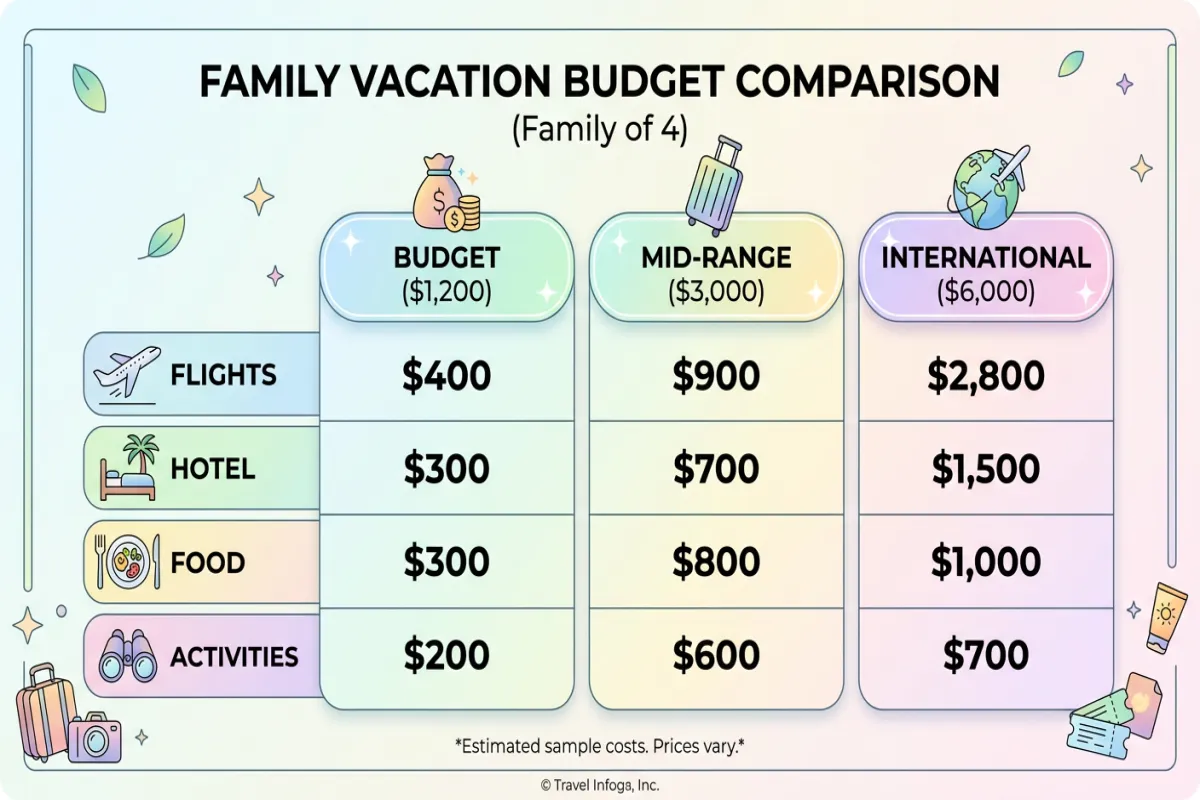
Family of 4 Budget Breakdown (7-Day Trip)
| Category | Budget Domestic | Mid-Range Domestic | International |
|---|---|---|---|
| Flights/Transport | $400-$600 (driving) | $800-$1,400 | $2,000-$4,000 |
| Accommodation (7 nights) | $500-$900 | $1,200-$2,100 | $1,400-$2,800 |
| Food (3 meals/day) | $350-$500 | $600-$900 | $700-$1,200 |
| Activities/Attractions | $200-$400 | $400-$800 | $500-$1,000 |
| Local Transport | $50-$100 | $100-$250 | $200-$400 |
| Souvenirs/Snacks/Extras | $100-$200 | $200-$350 | $300-$500 |
| Total Estimate | $1,600-$2,700 | $3,300-$5,800 | $5,100-$9,900 |
Where to Save Without Sacrificing the Experience
Accommodation: Vacation rentals with kitchens can save $100-$150/day on food alone. A family of four eating three restaurant meals a day at a tourist destination will spend $120-$180. Cooking breakfast and lunch at your rental cuts that to $40-$60, and you only eat out for dinner.
Attractions: Look for city passes (CityPASS, Go City) that bundle attractions at 30-40% off gate prices. Many museums offer free admission days. National parks charge $35 per vehicle and that covers everything inside the park for 7 days. An annual America the Beautiful pass is $80 and covers every national park for a year.
Flights: Kids under 2 fly free as lap infants on domestic flights. For older kids, use fare alerts and book on Tuesdays or Wednesdays when prices tend to dip. Southwest Airlines lets you check two bags free per person, which saves a family of four $200-$400 round trip compared to carriers that charge for checked bags.
For more strategies on cutting travel costs, see our guide on how to save money on travel in the USA.
The 15% Buffer Rule
Add 15% to your total budget for unplanned expenses. With kids, the unplanned expenses are guaranteed. The ice cream shop you pass four times a day, the souvenir that becomes non-negotiable, the rainy day activity you did not plan for, the emergency diaper/clothing run. The families who budget for these extras enjoy them. The families who do not budget for them stress about every swipe of the credit card.
Step 4: Book Your Travel and Accommodation
With a destination, dates, and budget locked in, it is time to book. The order matters: flights first (prices change faster), then accommodation, then major activities or dining reservations.
Flights with Kids
Book directly with the airline when traveling with children. Third-party booking sites make it harder to manage seat assignments, request bassinets, or make changes. When booking, immediately go into the reservation to select seats together. Do not assume the airline will seat your family together automatically, because they will not.
For long flights, choose departure times that align with your child’s sleep schedule. Red-eye flights work well for toddlers who will sleep through the flight. Early morning departures work for kids who wake up at 5 AM anyway. Avoid midday flights that overlap with nap time unless you want a cranky child in a confined space.
Family-Friendly Accommodation
Hotels with suites or connecting rooms give parents a separate space after the kids are asleep. This sounds like a luxury, but after day three of tiptoeing in the dark at 8 PM, you will understand why it matters. Vacation rentals offer more space, a kitchen, laundry, and a living room where kids can spread out. For longer trips (5+ nights), rentals almost always beat hotels on both price and livability.
Key things to check before booking:
- Is there a pool? (A pool will save your sanity on rest days.)
- Is the property child-proofed or can it be? (Stairs, balconies, unfenced pools are real hazards for toddlers.)
- How far is the nearest grocery store?
- Is there laundry on-site? (A must for trips longer than 4 days with young kids.)
- What is the cancellation policy? (Non-refundable rates are risky with small children who get sick unpredictably.)
Booking Activities and Dining
For popular attractions, book tickets in advance. Theme parks, guided tours, snorkeling excursions, and popular restaurants fill up during peak season. But do not pre-book everything. Leave at least two days unscheduled for spontaneous exploration, rest, or repeating a favorite activity. Families that over-schedule their vacations are the ones who come home exhausted instead of refreshed.
Step 5: Build a Flexible Daily Itinerary
A good family itinerary is a loose framework, not a minute-by-minute schedule. The goal is to know what is possible each day so you can make quick decisions without standing on a street corner arguing while the kids complain.
The 2-3 Activity Rule
Plan a maximum of two to three activities per day. That might sound like too few, but once you factor in meals, transit, nap time, meltdown recovery, bathroom breaks, and the inevitable “I want to stay longer” at the activity you expected to be quick, two to three is realistic.
Structure each day with a simple rhythm:
- Morning: One main activity when energy is highest (museum, hike, beach time, theme park).
- Midday: Lunch and downtime. Return to the hotel/rental for naps or pool time.
- Afternoon/Evening: One lighter activity (neighborhood walk, playground, ice cream, casual dinner out).
Building the Itinerary Together
Share the plan with your travel partner. One of the most common sources of vacation stress is when one parent has the entire plan in their head (or on their phone) and the other parent is constantly asking “what are we doing next?” A shared, visible itinerary eliminates this friction.
Yopki’s trip planner is built for exactly this. It generates family vacation itineraries based on your kids’ ages and interests, and both parents can view and edit the plan in real time. No more texting screenshots of spreadsheets back and forth.
Build In Buffer Days
For every 3 days of activities, schedule 1 rest day. A rest day does not mean sitting in the hotel room. It means no scheduled attractions, no driving, no “we need to be there by 10.” Let the kids sleep in, go to a playground, explore the neighborhood on foot, or revisit something they loved. These unstructured days are often the ones your family remembers most fondly.
Step 6: Pack Smart and Pack Early
Packing for a family is a logistics exercise. The difference between smooth packing and frantic last-minute throwing things in bags is starting early and using a system.
Start 5 Days Before Departure
Day 5: Make your packing list. Day 4: Wash everything you plan to bring. Day 3: Lay out all clothes and gear. Day 2: Pack suitcases. Day 1: Pack carry-ons, charge devices, download entertainment. Departure morning: Grab the pre-packed bags and go. This cadence means departure morning is calm instead of chaotic.
The Carry-On Survival Kit
Your carry-on (or day bag for road trips) is the most important bag you pack. It needs to get your family through the worst-case scenario: a 3-hour flight delay with hungry, tired kids. Pack these items in an easily accessible bag:
- Snacks: more than you think you need. Crackers, fruit pouches, granola bars, gummies.
- Entertainment: one screen-free option per kid (coloring book, sticker book, magnetic drawing pad) plus a loaded tablet.
- One full change of clothes per child (spills, blowouts, and motion sickness are real).
- Children’s medications: fever reducer, allergy medicine, motion sickness remedy.
- Chargers and a portable battery pack.
- Headphones for each family member (do not be the family with a tablet playing at full volume).
- A few plastic bags for dirty clothes or trash.
- Comfort item: favorite stuffed animal, blanket, or pacifier.
For a comprehensive list of travel essentials, check our guide on must-have items for every trip.
Let Kids Pack Their Own Bag
Give each child (ages 4+) a small backpack and let them choose what goes in it. Set the rules (3 toys max, one book, one stuffed animal) and let them decide within those constraints. Kids who pack their own activity bag are more invested in the trip and less likely to complain about being bored because they chose their own entertainment.
The Document Folder
Keep all travel documents in one place: passports, boarding passes, hotel confirmations, car rental details, insurance cards, and emergency contacts. A physical folder works, but a digital backup is essential. Yopki’s document organizer lets you store and access all of these from your phone, which means no panicked digging through bags at the airport check-in counter.
Step 7: Prepare for Travel Day
Travel day is not a vacation day. It is a logistics day. Accepting this mindset shift in advance will save you from frustration. The goal of travel day is simple: get everyone to the destination safely, reasonably fed, and without any major incidents.
Morning Routine
Wake up 30 minutes earlier than you think you need to. With kids, everything takes longer than expected. Dress children in comfortable layers. Feed everyone a real meal before leaving the house. A hungry kid at the airport is a ticking time bomb.
At the Airport
Arrive 2.5 hours before a domestic flight, 3.5 hours before international. Yes, that feels early. But with strollers, car seats, checking bags, bathroom stops, and the security line, it goes faster than you expect. Once through security, find your gate, then let the kids run. Most airports have play areas or long hallways perfect for burning pre-flight energy.
Board when they call families with small children. Use this time to get settled, install car seats, and set up entertainment before the plane fills up. For older kids who do not need early boarding, board normally and skip the extra time sitting on the plane.
Road Trip Strategy
For driving trips, plan stops every 90 minutes to 2 hours. A 6-hour drive with two kids will realistically take 8 hours once you add stops. Accept that timeline before you leave. Pack a cooler with lunch so you do not lose an hour at a restaurant. Leave early in the morning (5-6 AM) so younger kids sleep through the first stretch.
Audiobooks and podcasts are road trip gold for families. “Stories Podcast,” “Wow in the World,” and “Brains On!” work for ages 5-12. For teens, let them pick the playlist for one hour of the drive in exchange for putting their phones away during family time.
Family Vacation Planning by Age Group
Every piece of advice above applies broadly, but the details change dramatically based on your children’s ages. Here is what to adjust for each stage.
Traveling with Toddlers (Ages 1-3)
Toddlers are portable but demanding. They need naps, they have food restrictions, and their moods shift by the minute. The key to traveling with a baby is keeping their routine as intact as possible while accepting that some disruption is inevitable.
Destination tips: Choose destinations with short flight times (under 3 hours) or driveable distances. Beach destinations work well because sand and water entertain toddlers for hours. Avoid attractions with long lines or quiet expectations (art museums, formal dining).
Schedule tips: Plan around naps, not around attractions. If your toddler naps at 1 PM, do not book a 12:30 PM tour. Limit outings to mornings and late afternoons. Use the midday nap window for adult relaxation or meal prep.
Packing tips: Bring a portable crib or confirm the accommodation provides one. Pack familiar bedding or a sleep sack. Bring 2-3 more diapers per day than you think you need. Pack shelf-stable snacks (pouches, puffs, crackers) since you cannot count on finding toddler-friendly food everywhere. A portable high chair that clips to a table is worth the bag space.
Flight tips: Lap infants (under 2) fly free domestically, but you can buy them a seat and bring their car seat for a safer, calmer flight. Bring a new small toy to unwrap during takeoff. Lollipops or a sippy cup help with ear pressure. Time the flight around nap time if possible.
Traveling with Elementary-Age Kids (Ages 4-8)
This is the sweet spot for family travel. Kids are old enough to walk, communicate their needs, and get genuinely excited about new experiences, but young enough to follow your lead without arguing about the itinerary.
Destination tips: This age group thrives at national parks, theme parks, beach destinations, and interactive museums. Science museums, children’s museums, and aquariums are reliable options in any city. Look for destinations with Junior Ranger programs, scavenger hunts, or kid-specific tours.
Schedule tips: These kids have more stamina than toddlers but still hit a wall around 2-3 PM. Plan active mornings, a slow lunch, and a lighter afternoon. Bribery works at this age: “If we do the history museum this morning, we will go to the water park this afternoon.”
Packing tips: Let them pack their own backpack with approved items. Bring a journal or scrapbook for them to document the trip. Pack binoculars for nature trips and a disposable camera (or an old phone) so they can take their own photos.
Engagement tips: Give them a job. The navigator reads the map. The historian learns one fact about each place you visit. The photographer documents the trip. Kids with roles are engaged kids.
Traveling with Tweens (Ages 9-12)
Tweens want to feel grown up but still need parental guidance. They are developing their own interests and opinions, which is both an opportunity and a challenge for family vacation planning.
Destination tips: Tweens are ready for more adventurous destinations: zip-lining in Costa Rica, snorkeling in Hawaii, exploring castles in Scotland, or hiking in Colorado. They can handle longer flights and more walking. Choose destinations where they can try something new and feel accomplished.
Schedule tips: Give them partial ownership of the itinerary. Let them research and pick one activity per day. They can also help with practical logistics like navigating public transit or ordering food in a new language. This builds confidence and keeps them invested.
Packing tips: Let them pack their own suitcase with a checklist you provide. Review it before closing. They will forget socks and underwear. They always forget socks and underwear.
Tech tips: Set clear expectations about screen time before the trip. A reasonable rule: screens are fine during transit, but at the destination, phones go away during activities. Give them a camera or let them use a phone just for photos so they have a way to capture memories without falling into a social media spiral.
Traveling with Teens (Ages 13-17)
Teens are the hardest age group to plan for because they are caught between wanting independence and still being part of the family. The families who travel well with teens give them freedom within a structure.
Destination tips: Teens respond to experiences, not just sightseeing. Surfing lessons, cooking classes, escape rooms, street food tours, and adventure activities win over passive observation. Cities with nightlife and teen-friendly culture (Tokyo, Barcelona, New York) are more engaging for this age group than quiet resort towns.
Schedule tips: Build in solo time. Let teens explore a neighborhood on their own (with a phone and a meeting time). Let them sleep in while you take the younger kids to breakfast. Give them one full day to plan according to their interests. The trade-off: they participate fully in family activities the rest of the time.
Packing tips: Let them handle their own packing entirely. If they forget something, they deal with the consequences. This is a life skill, and vacation is a low-stakes place to learn it.
Budget tips: Give teens a daily spending allowance for souvenirs and extras. When they are spending their own (allocated) money, they suddenly become very cost-conscious. This teaches budgeting while preventing the constant “can I have that?” cycle.
Common Family Vacation Mistakes (and How to Avoid Them)
After years of helping families plan trips through Yopki, these are the mistakes we see over and over again. Avoiding even a few of them will dramatically improve your next vacation.
Mistake 1: Over-Scheduling
The most common mistake, by far. Parents try to fit $5,000 worth of activities into a $3,000 trip because they want to “make the most of it.” The result: exhausted kids, frustrated parents, and a vacation that feels like a forced march. The fix: pick your top priority for each day and treat everything else as optional.
Mistake 2: Ignoring Time Zones and Jet Lag
Flying from New York to California means your toddler’s 7 PM bedtime is now 10 PM body-clock time. Plan for 1-2 adjustment days at the start of your trip, especially for international travel. Do not book a packed first day after a long flight.
Mistake 3: Skipping Meals and Snacks
“We will just find something when we get hungry” works for adults. It does not work for children. A hungry child cannot reason, negotiate, or walk another block to a restaurant. Pack snacks aggressively and eat meals on schedule, even if it means leaving an attraction earlier than planned.
Mistake 4: Booking Non-Refundable Everything
Kids get sick. Plans change. Weather happens. Always book refundable accommodation rates and flexible activity tickets when available, even if they cost slightly more. One canceled day due to a stomach bug will cost you more in non-refundable losses than the premium for flexible booking.
Mistake 5: Not Having a Backup Plan
Rainy days happen. Attractions close unexpectedly. Kids refuse to cooperate with the plan. For every outdoor activity, know what you would do instead if weather or moods do not cooperate. A list of indoor alternatives, nearby playgrounds, or a good movie theater near your accommodation can save a day that is going sideways.
Mistake 6: Expecting Perfection
Instagram-worthy family vacations do not exist in real life. Someone will cry. Someone will get sunburned. You will spend too much on something that was not worth it. A meal will be terrible. Accepting this in advance is not pessimism. It is the mindset shift that lets you laugh at the chaos instead of being ruined by it. The best family vacation memories almost always include something that went wrong.
Mistake 7: Keeping the Plan in One Person’s Head
When one parent does all the planning and the other parent just shows up, resentment builds. The planner feels like they are managing everything alone. The non-planner feels lost and dependent. Share the itinerary, the budget, and the logistics so both parents are equally informed. Collaborative planning tools like Yopki make this easy by giving both parents access to the same shared itinerary, documents, and day-by-day schedule.
Family Vacation Planning Checklist
Use this timeline to stay on track. Adjust the timeframes based on whether you are planning a domestic weekend trip or an international two-week vacation.
4-6 Months Before
- Choose destination and dates.
- Check passport expiration dates (renew if less than 6 months validity at time of travel).
- Set your total budget.
- Book flights.
- Book accommodation.
- Look into travel insurance, especially for international trips or non-refundable bookings.
2-3 Months Before
- Research activities and attractions at your destination.
- Book popular activities, tours, and dining reservations.
- Arrange pet care if applicable.
- Request time off work (if not already done).
- Start a shared itinerary so both parents can contribute.
2-4 Weeks Before
- Confirm all reservations (flights, hotel, car rental, activities).
- Check in online for flights as soon as it opens (usually 24 hours before).
- Download offline maps and entertainment.
- Make copies of important documents (passports, insurance cards, prescriptions).
- Upload documents to a digital travel document organizer as backup.
- Arrange airport parking or transportation.
5 Days Before
- Write your packing list.
- Do all travel laundry.
- Fill prescriptions and pack medications.
- Charge all devices and portable batteries.
- Notify your bank of travel plans to prevent card freezes.
1 Day Before
- Pack suitcases and carry-on bags.
- Print or download boarding passes.
- Set out travel day clothes.
- Do a final document check: IDs, passports, insurance, confirmations.
- Set alarm 30 minutes earlier than you think you need.
Frequently Asked Questions
What is the best way to plan a family vacation?
Start by choosing a destination that works for every age in your group, then lock in dates around school schedules and shoulder-season pricing. Set a realistic budget (a family of 4 should expect $150-$300/day domestically), book accommodations with kitchens to save on meals, and build a flexible daily itinerary that mixes kid-friendly activities with downtime. Use a family trip planner like Yopki to keep both parents on the same page with a shared itinerary, AI-generated activity suggestions, and a document organizer for passports and confirmations.
How far in advance should you plan a family vacation?
For domestic trips, 2-3 months is usually enough. For international travel or peak-season destinations (Disney, national parks in summer, ski resorts over holidays), 4-6 months gives you the best pricing and availability. Last-minute family deals exist but rarely include the family-friendly accommodations and room configurations you actually need.
What is the most forgotten item when traveling with kids?
Phone and tablet chargers top the list, followed closely by children’s medication (fever reducers, allergy meds), a change of clothes in carry-on bags, and comfort items like a favorite stuffed animal or blanket. Other commonly forgotten items include sunscreen, swim diapers for toddlers, snacks for transit days, and copies of important documents like birth certificates for domestic flights with lap infants.
How do you keep kids entertained on long trips?
Layer your entertainment strategy. Start with screen-free options like sticker books, magnetic drawing boards, and road trip bingo. Move to audiobooks and podcasts designed for kids. Save tablets and movies for the final stretch when patience runs thin. Pack a surprise bag with one or two new small toys or activities they have not seen before. For road trips, plan stops every 90 minutes to 2 hours so kids can burn energy. For flights, bring lollipops or gum for ear pressure during takeoff and landing.
What are common mistakes parents make on vacation?
The biggest mistake is over-scheduling. Cramming five attractions into one day works for adults but leads to meltdowns with kids. Other common mistakes include skipping nap time or quiet hours, not budgeting for snacks and souvenirs (which add up fast), choosing restaurants without kid-friendly options, booking non-refundable reservations when traveling with unpredictable toddlers, and forgetting that travel days are not activity days. The simple fix for most of these: plan less, budget more, and build flexibility into every day.
Start Planning Your Family Vacation
Family vacation planning does not have to feel overwhelming. Break it into the seven steps above, start early enough to get the bookings you want, and build a plan that the whole family can see and contribute to.
The families who enjoy their vacations the most are not the ones with the biggest budgets or the most exotic destinations. They are the ones who planned realistically, packed smartly, and left enough room in the schedule for the spontaneous moments that become the real memories.
If you want a head start, try Yopki’s AI travel planner. Tell it your destination, your kids’ ages, and your travel dates. It will generate a kid-friendly itinerary in minutes, and you can share it with your co-parent so you are both working from the same plan. It also keeps all your travel documents, confirmations, and notes in one place so nothing falls through the cracks.
Your next family vacation is going to be a good one. You just need a plan.