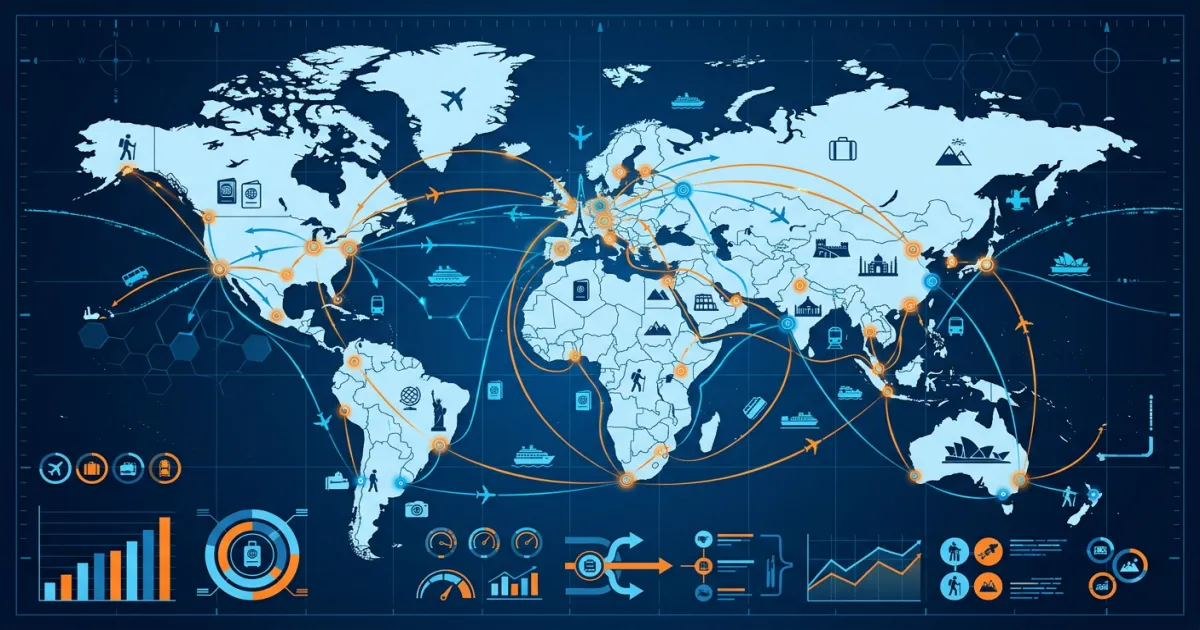
Whether you are a travel blogger looking for data to cite, a journalist covering tourism trends, or a business professional analyzing the travel industry, this page compiles 75+ verified travel planning statistics for 2026 with original sources.
Bookmark this page. We update it regularly as new data is released throughout the year.
Table of Contents
- Travel Industry Overview
- Family Travel Statistics
- Road Trip Statistics
- Air Travel and Layover Statistics
- Travel Planning and Technology
- Travel Budget Statistics
- Solo and Group Travel
- Seasonal and Trending Destinations
- Travel Insurance Statistics
Travel Industry Overview
The global travel industry continues its strong post-pandemic recovery, with 2026 set to establish new records across multiple metrics.
The global tourism industry is estimated at $11.11 trillion in 2026. (Source: Research Nester, 2026)
International tourism is projected to reach 1.58 billion arrivals in 2026, a new all-time record. (Source: UN Tourism World Tourism Barometer, 2026)
International tourism is expected to grow 3% to 4% in 2026 compared to 2025. (Source: UN Tourism, 2026)
The global tourism sector is estimated to reach approximately $1.07 trillion in revenue in 2026, growing at around 6.8% annually. (Source: Statista Market Insights, 2026)
91% of Americans plan to travel in 2026. (Source: IPX1031 Travel Industry Report, 2026)
The FIFA World Cup 2026 (hosted across the U.S., Canada, and Mexico) and the Milano Cortina Winter Olympics will be major tourism drivers in 2026. (Source: UN Tourism, 2026)
61% of Americans plan to travel in 2026, with 76% building trips around milestone moments such as birthdays, reunions, and anniversaries. (Source: Hilton 2026 Trends Report)
U.S. leisure travel spending is projected to reach a record $5,704 per household in 2026. (Source: Hotel News Resource / Longwoods International, 2026)
Americans plan an average of 3.87 vacations per household in 2026. (Source: Longwoods International, 2026)
Family Travel Statistics
Families remain a dominant force in the travel industry, with spending levels and trip frequency both climbing in 2026. If you are planning a family trip, these numbers show you are not alone.
81% of families plan to maintain or increase their travel spending in 2026. (Source: Hotel Agio / Family Travel Survey, 2026)
The average family vacation costs between $2,000 and $5,000 total, or approximately $1,145 per person ($4,580 for a family of four). (Source: Colormelon / U.S. Vacation Cost Analysis, 2026)
47% of families choose multigenerational travel in 2026, up 17% from the previous year. (Source: Hilton 2026 Trends Report)
89% of Millennial and Gen Z families say spending quality time together is their primary travel motivation. (Source: DuckAbroad Family Travel Trends, 2026)
75% of families favor road trips over air travel. (Source: Hotel Agio Family Travel Statistics, 2026)
Nearly half of Americans (45%) plan to take a vacation in summer 2026 that requires a flight and/or paid lodging. (Source: NerdWallet 2026 Summer Travel Report)
Americans expect to spend $3,940 on average for summer travel costs in 2026. (Source: NerdWallet 2026 Summer Travel Report)
Planning family travel can be complex, especially with multiple generations involved. An AI travel planner can help coordinate everyone’s preferences into a single itinerary.
Road Trip Statistics
Road trips are experiencing a major resurgence in 2026, fueled by the lead-up to America’s 250th anniversary celebrations in July.
71% of Americans are planning to drive on their next vacation in 2026. (Source: Hilton 2026 Trends Report)
Road trips rank as the single most popular trip type Americans are planning in 2026, ahead of beach vacations and major metro trips. (Source: Hilton 2026 Trends Report)
76% of global car travelers favor road trips over flying because it allows for more spontaneity. (Source: PJX Media / 2026 Travel Trends)
61% of travelers say they will not drive more than five hours without stopping for a hotel stay. (Source: Hilton 2026 Trends Report)
83% of road trippers report that a free morning meal at their hotel is essential to get back on the road without delay. (Source: Hilton 2026 Trends Report)
63% of road trippers say a hotel pool is essential, giving families a way to burn off energy and break the driving rhythm. (Source: Hilton 2026 Trends Report)
America’s 250th anniversary in July 2026 is a major driver of domestic road trip interest. (Source: PJX Media / Travel Tourism Trends, 2026)
Whether you are doing a weekend trip or a cross-country adventure, having a solid plan makes all the difference. Browse our trip planning templates to organize your next road trip.
Air Travel and Layover Statistics
Connecting flights and layovers remain a reality for millions of travelers. Understanding what to do during a layover can transform dead time into a mini adventure.
Roughly 20% of domestic flights in the U.S. involve at least one connection. (Source: Bureau of Transportation Statistics)
The FAA handles approximately 45,000 flights per day across U.S. airspace. (Source: FAA Air Traffic By The Numbers, 2026)
Hartsfield-Jackson Atlanta (ATL) leads globally with 350+ routes, making it the world’s most connected airport. (Source: SkySonar 2026 Route Analysis)
Dubai International (DXB) tops international connectivity with 280+ routes to 90+ countries. (Source: SkySonar 2026 Route Analysis)
For domestic connections, 1 to 2 hours is the recommended minimum layover time. For international connections, 2 to 3 hours is recommended. (Source: AAA Club Alliance, 2026)
Connecting flights amplify traveler stress exponentially, with each additional connection increasing exposure to delays and disruptions. (Source: MIT News, 2026)
Singapore Changi Airport (SIN) leads for international connectivity and passenger experience, with investments in indoor gardens, cinemas, and spas. (Source: Aviation A2Z, 2026)
If you find yourself with a few hours between flights, check out our layover guides to make the most of your time in any major hub airport.
Travel Planning and Technology
Technology is reshaping how travelers research, plan, and book trips. AI-powered tools are moving from novelty to necessity.
90% of travelers are aware that AI can help plan or book travel, yet only 38% have actively used AI for trip planning so far. (Source: CNBC / Travel AI Report, 2026)
Over 40% of travelers globally are already using AI-based tools for planning trips, with over 60% expressing openness to trying them. (Source: TakeUp AI Research, 2026)
Among AI travel planning users, the top uses are: discovering activities and restaurants (65%), finding destinations (56%), and building itineraries (55%). (Source: TakeUp AI Research, 2026)
78% of AI users have booked travel based primarily on AI recommendations. (Source: Travala Travel AI Insights, 2026)
84% of travelers say a trusted AI recommendation would make them more likely to book a specific property. (Source: Travala Travel AI Insights, 2026)
51% of AI travel users use AI to compare flight prices, and 48% use it to compare hotel prices. (Source: TakeUp AI Research, 2026)
48% of AI travel users rely on AI for budgeting or estimating trip costs. (Source: TakeUp AI Research, 2026)
Google Maps has over 2 billion monthly active users as of 2026. (Source: Loopex Digital / Google Maps Statistics, 2026)
Google Maps’ multi-stop trip planner feature is used in 41% of long-distance route queries. (Source: Loopex Digital, 2026)
Google Maps offline maps were downloaded 450 million times in the past 12 months, driven by international travel and data-saving needs. (Source: Loopex Digital, 2026)
The average time between booking a trip and departing is 73 days. (Source: APH Travel Booking Statistics, 2026)
On average, it takes a traveler 71 days from initially considering a trip to booking it, with 33 days spent on inspiration and 38 days on research and planning. (Source: APH Travel Booking Statistics, 2026)
Yopki’s AI travel planner helps you build personalized itineraries in minutes instead of days, covering destinations, activities, and budgets in one place.
Travel Budget Statistics
Travel spending is hitting record levels in 2026, though cost remains the top concern for most travelers.
Americans expect to spend an average of $6,354 on travel in 2026, $667 more than in 2025. (Source: Beach.com 2026 Travel Trends Report)
68% of Americans say their travel budget for 2026 is greater than 2025, with Millennials and Baby Boomers expecting the sharpest increases. (Source: Beach.com 2026 Travel Trends Report)
The average domestic vacation costs $2,400 per person for a 7-day trip in 2026. (Source: Colormelon U.S. Vacation Cost Analysis, 2026)
International vacations average $4,500 per person, including flights, accommodation, and activities. (Source: SpendMeNot Vacation Cost Breakdown, 2026)
The average daily cost of a vacation in the United States is $325 per day for mid-range, $121 per day for budget, and $925 per day for luxury. (Source: Colormelon, 2026)
72% of Americans list cost as their number one travel concern for the second year running. (Source: NerdWallet 2026 Summer Travel Report)
35% of travelers book between one and three months before departure, making it the most common booking window. (Source: APH Travel Booking Statistics, 2026)
Among those booking 4 to 6 months ahead, 30% do so because they prefer planning ahead, and 16% cite concerns about price increases. (Source: APH Travel Booking Statistics, 2026)
For the FIFA World Cup 2026, event-adjacent regions require 8 to 12 months advance booking, with prices up 40-60% in affected areas. (Source: The Points Guy, 2026)
Use our trip planning guide to build a realistic budget and avoid overspending on your next vacation.
Solo and Group Travel
Solo travel continues its explosive growth, while group travel evolves toward more personalized experiences.
Solo Travel
The global solo travel market was estimated at $482.34 billion in 2024 and is projected to reach $1.07 trillion by 2030, growing at 14.3% annually. (Source: Grand View Research, 2025)
Women make up approximately 84% of solo travelers globally. (Source: PhotoAid Solo Travel Statistics, 2026)
Solo travelers aged 25 to 40 account for 44.2% of the solo travel market, driven by Millennials and Gen Z seeking freedom and self-discovery. (Source: Grand View Research, 2025)
76% of Gen Z and Millennial travelers plan to embark on solo travel experiences in 2026. (Source: Gitnux Solo Travel Statistics, 2026)
Domestic solo travelers account for 64.7% of solo travel revenue. (Source: Grand View Research, 2025)
The solo travel industry in Asia Pacific is expected to grow at 16.3% annually from 2026 to 2033. (Source: Custom Market Insights, 2026)
Group Travel
The group travel market was valued at $369.8 billion in 2024 and is projected to reach $689.85 billion by 2035. (Source: Market Research Future, 2025)
The average organized group tour has about 30 passengers. (Source: The Group Travel Leader Survey)
The average student travel group size is 65 to 70 students per trip. (Source: Rustic Pathways Student Travel Statistics, 2026)
Group travelers are increasingly choosing coordinated, shared, and pre-booked transportation instead of individual ride options. (Source: Chino Limo Group Transportation Study, 2026)
Whether you are traveling solo or coordinating with a group, having a shared itinerary helps everyone stay on the same page. Try our AI trip planner to create shareable plans.
Seasonal and Trending Destinations
Search data and booking trends reveal where travelers are heading in 2026. If you are looking for inspiration, check our destination explorer for ideas.
Madeira (Portugal) is the world’s top trending destination for 2026 according to Tripadvisor. (Source: Tripadvisor / TimeOut, 2026)
Kyoto remains one of the most searched travel destinations in 2026, as Japan promotes travel beyond Tokyo and Osaka. (Source: DXB News Network, 2026)
Vietnam is a highly searched destination for 2026 due to outstanding value, rich culture, and diverse landscapes. (Source: DXB News Network, 2026)
Argentina is trending for its mix of urban energy in Buenos Aires and natural wonder in Patagonia. (Source: American Express Travel 2026 Trending Destinations)
Searches for stays “near a national park” are up 35% in the U.S. in 2026. (Source: Airbnb 2026 Travel Predictions)
The Great Smoky Mountains is one of the top trending destinations globally in 2026. (Source: Airbnb 2026 Travel Predictions)
Kanazawa is one of the fastest-growing cities in Japan for international visitors. (Source: Explore Worldwide 2026 Travel Trends)
2026 travel trends show a blend of natural wonders, historic cities, wellness spots, and lesser-known gems gaining significant search traffic. (Source: Lonely Planet Best in Travel, 2026)
Travel Insurance Statistics
The global travel insurance market was valued at $35.82 billion in 2026. (Source: The Business Research Company, 2026)
The U.S. travel insurance market has grown to $7.71 billion with a 40% traveler penetration rate, nearly double the global average. (Source: HelloSafe 2026 Travel Insurance Barometer)
U.S. travel insurance penetration rose from about 28% pre-pandemic to 40% in 2025. (Source: HelloSafe, 2026)
Projections indicate U.S. travel insurance penetration could reach 50% by 2030, driven by embedded insurance and insurtech innovation. (Source: HelloSafe, 2026)
Gen Z and Millennials make up 60% and 54% respectively of U.S. travel insurance buyers. (Source: Emergency Assistance Plus / IMG Survey, 2026)
In Canada, over 65% of international trips are insured, reflecting growing concerns around health and trip disruptions. (Source: HelloSafe, 2026)
95% of IMG survey respondents purchased travel insurance coverage for at least one international trip. (Source: Emergency Assistance Plus / IMG Survey, 2026)
How to Cite These Statistics
You are welcome to cite any statistic on this page. We ask that you link back to this page as your source. Example citation:
According to Yopki’s Travel Planning Statistics for 2026, 91% of Americans plan to travel in 2026.
About This Page
This statistics page is maintained by the research team at Yopki, a travel planning platform that helps travelers build personalized itineraries with AI. We compile data from government agencies, industry associations, market research firms, and major travel companies.
Last updated: April 2026. Have a travel statistic you think we should include? Contact us and we will review it for inclusion.