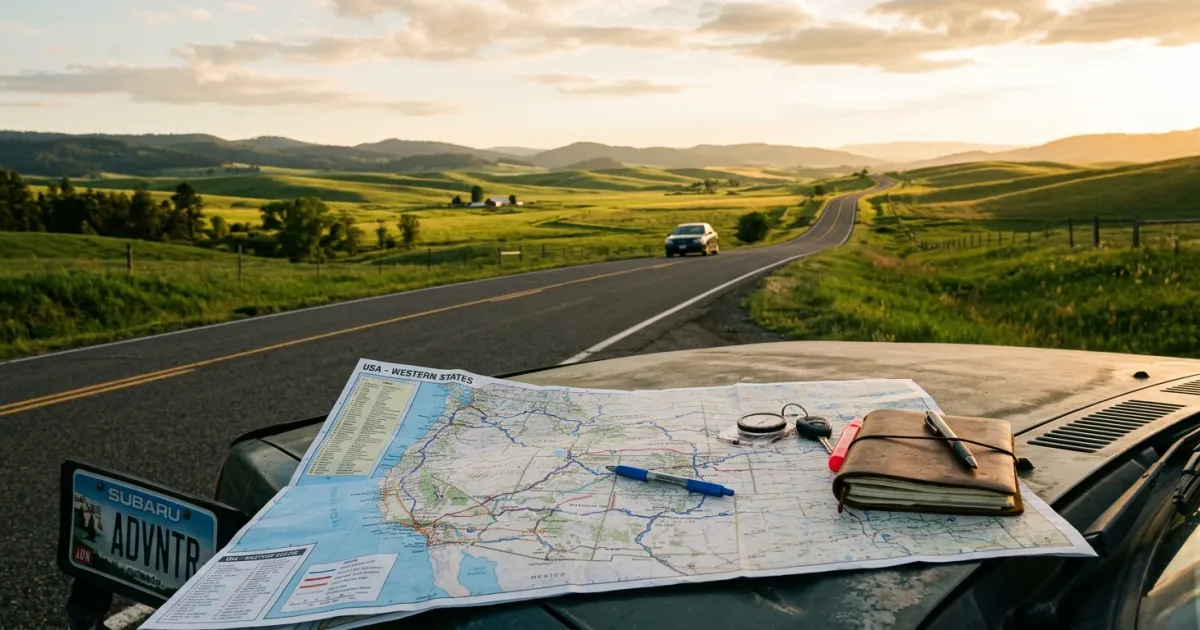
A road trip has more moving parts than a fly-in vacation. You’re not just planning what to do at a destination — you’re planning the entire route, every overnight stop, fuel logistics, and what happens when someone needs a bathroom in the middle of nowhere. An AI trip planner can help generate your route and stops automatically. See our road trip route planner.
This guide covers road trip planning from the first route sketch to the moment you pull out of the driveway. Whether it’s a three-day weekend escape or a month-long cross-country drive, the process is the same — just scaled up or down.
Step 1: Choose Your Route Type
There are three basic road trip structures. A point-to-point trip drives from A to B (like San Francisco to Portland). A loop starts and ends at home, making a circuit through multiple destinations. A hub-and-spoke drives to one base location and takes day trips from there. Most road trips are loops or point-to-point. Decide your structure first — it determines everything else.

Step 2: Plot Your Must-Visit Stops
Pin your non-negotiable destinations on Google Maps: the national parks, the cities, the friend’s house, the restaurant you’ve been wanting to try. These are your anchor points. Don’t worry about the route between them yet — just get the big stops on the map. Three to five anchor points is plenty for a week-long trip. More than that and you’ll be driving more than exploring.
Step 3: Connect the Dots With a Route
Now connect your anchor points into a logical route. Use Google Maps or Roadtrippers to test different paths. The fastest route isn’t always the best route — a scenic byway that adds 90 minutes might be the highlight of the trip. Compare total drive time, road conditions, and scenery for each option.
For multi-stop routes, check that you’re not zigzagging. A common mistake is plotting stops in the order you thought of them rather than the order that makes geographic sense. Rearranging three stops can save hours of driving.
Step 4: Break the Route Into Driving Legs
No driving leg should exceed 4-5 hours without a meaningful stop. Longer legs cause driver fatigue and turn the trip into a chore. Break your total route into segments of 2-4 hours each, with planned stops between them. Each leg needs a departure point, an arrival point, estimated drive time, and at least one interesting stop along the way.
Use our Road Trip Itinerary Template to organize each driving leg with distance, drive time, planned stops, and overnight accommodations in one structured document.
Step 5: Find Stops Between the Anchor Points
The best road trip memories often come from the in-between stops — the roadside diner, the unexpected waterfall, the small town with the world’s largest ball of twine. Search for must-see attractions along the way, scenic overlooks, state parks, and highly-rated restaurants along each driving leg. Roadtrippers, Atlas Obscura, and Yelp are good resources for this.
Sports fans can plan a baseball stadium road trip hitting multiple cities along the route. Don’t over-plan the stops. Mark 3-4 options per driving leg and decide in the moment which ones you actually want to visit. Some you’ll skip. Some you’ll spend longer at than expected. That flexibility is what makes road trips different from scheduled vacations.
Step 6: Book Accommodation
Book your first night and last night in advance — you want certainty at the start and end. For nights in between, it depends on the season and location. Near national parks in summer? Book months ahead. On a random Tuesday in Nebraska? You can probably wing it. Not sure when to go? Check the best time to travel in the US by region.
Mix your accommodation types: hotels near highways for late-night arrivals, Airbnbs in towns where you’re spending a full day, campgrounds for scenic areas. Variety keeps the trip interesting and saves money.
Plan Your Trip Today!
Get a complete, personalized trip template in seconds.
Take full control to customize every detail.
Step 7: Budget for the Road
Road trip costs are dominated by fuel, accommodation, and food — in that order. Estimate fuel cost by dividing total miles by your car’s MPG, then multiplying by average gas price along your route. GasBuddy shows current prices by state. For electric vehicle owners, see our EV road trip planner. Planning an RV adventure? Check our RV road trip planner.
A rough daily budget for two people on a mid-range road trip: $40-80 fuel, $80-150 accommodation, $50-80 food, $20-50 activities. For more budget tips for travelers, see our detailed savings guide. Multiply by trip days for your total. Use our Travel Budget Template to track it all.
Step 8: Prep the Vehicle
Before any road trip over 500 miles: check tire pressure and tread depth, check oil level, top off coolant and wiper fluid, confirm your spare tire and jack are in the trunk, and verify your roadside assistance membership is active. Pack jumper cables, a first-aid kit, a flashlight, a phone charger, and paper maps of your route as backup for dead zones.
Step 9: Download Offline Maps and Pack
Download Google Maps offline regions for every area along your route. Cell service disappears on many scenic highways, and “no signal” at a fork in the road is stressful. Pack a cooler with snacks and drinks — highway food options are expensive and unhealthy. Bring entertainment for passengers: podcasts, audiobooks, and road trip playlists.
Organize all your planning documents — itinerary, hotel confirmations, campground reservations — using the Yopki Travel Document Organizer so everything is accessible offline in one place.
Planning Tips by Road Trip Type
Cross-country road trip: Budget 5-7 driving days minimum for coast-to-coast. Don’t try to see everything — pick a theme (national parks, coastal highways, music cities) and let it guide your route. Build in rest days where you stay two nights in one place. For the ultimate adventure, try a cross country road trip. Drive the iconic Route 66 or plan a national park road trip.
Road trip with kids: Cut your expected daily driving distance by 30%. Plan stops every 1.5-2 hours. Pack a “boredom bag” per kid with activities, snacks, and headphones. See our Family Vacation Itinerary for kid-specific planning structure.
Weekend road trip: Keep total driving under 4 hours each way. Focus on one destination with one or two stops en route. Use our Weekend Itinerary for a compact plan.
Free Download: Road Trip Planner Spreadsheet
An Excel spreadsheet to plan your road trip route, track daily driving distances, gas costs, lodging, and stops along the way.
More free templates at yopki.com/templates
FAQ
How many miles per day is reasonable on a road trip?
250-350 miles per day (4-5 hours of driving) is comfortable and leaves time for stops, meals, and exploring. You can push to 500 miles on a transit day where you’re just trying to cover distance, but more than two transit days in a row and the trip stops being fun.
How do I plan a road trip with multiple stops?
Plot all your stops on a map first, then arrange them in geographic order to minimize backtracking. Use Google Maps to add each stop as a waypoint and check total drive time. Break the route into daily driving legs of 3-5 hours each with overnight stops between them. Our Road Trip Itinerary Template is built specifically for multi-stop driving trips. Pair it with a road trip itinerary template checklist to stay organized.
How much does a road trip cost?
A rough estimate for two people: $100-250 per day covering fuel, accommodation, food, and activities. A 7-day road trip typically costs $700-1,750 total. The biggest variables are accommodation (camping vs. hotels) and fuel costs (which depend on vehicle efficiency and gas prices along your route).
Should I book hotels in advance or wing it?
Book the first night, last night, and any nights near popular destinations (national parks, beach towns in summer). For other nights, flexibility is fine — especially in rural areas and off-season. Having a backup plan (knowing there’s a motel in the next town) removes the stress of not having a reservation.